
England · Still standing
Tonbridge Castle
Tonbridge Castle is a 13th-century stone castle in Tonbridge, Kent, centred on a large twin-towered gatehouse completed around 1260. The gatehouse and stretches of curtain wall survive; the site later gained a mansion and today the grounds form a public park.
Its prime
1260
Today
Still standing
As it stood in 1260
What Tonbridge Castle looked like in its prime.
A dominant twin-towered gatehouse: two massive cylindrical stone drums flank a high central entrance with a tall pointed-arch gateway. The fabric is warm honey-brown sandstone laid in coursed masonry, pierced by narrow vertical slit windows and paired pointed-arch openings in the upper face. A crenellated curtain wall runs off to one side with a visible wall-walk; the gate passage penetrates the thickness of the gatehouse and the whole presents a fortress silhouette against the town and open parade ground before it.
Its story
The story of Tonbridge Castle.
Richard Fitz Gilbert and the Medway Crossing
Following the Norman Conquest, Richard Fitz Gilbert was granted land in Kent to guard the crossing of the River Medway. He raised a simple motte-and-bailey castle on the site; digging the moat and piling up the motte shifted some 50,000 tonnes of earth.
From the Rebellion of 1088 to the Town Wall of 1295
In 1088 the de Clares, Fitz Gilbert's descendants, rebelled against King William II, and the king's army besieged the castle. It held for two days before it fell, and as punishment William had both castle and town burnt to the ground. Before 1100 the de Clares replaced the timber castle with a stone shell keep; that work was reinforced during the thirteenth century, and in 1295 a stone wall was built around the town.
The Twin-Towered Gatehouse of 1260 and Edward I's Great Seal
The twin-towered gatehouse was built by Richard de Clare, third Earl of Hertford, or by his son Gilbert. Construction took thirty years and was completed in 1260. It shares many similarities with the gatehouses at Caerphilly Castle, which Gilbert built in 1268–1271. During one of Edward I's visits to France the great seal of England was kept at Tonbridge for a time.
Empty Rooms, the Mansion of 1793 and the Council's Park
The castle was not lived in between 1521 and the late eighteenth century, apart from a short period during the civil war, and a mansion was added to the site in 1793. The local council bought the property in 1900 and made the grounds a public park; the mansion serves as council offices. The site has been a scheduled monument since 1915, and both castle and mansion are Grade I listed, the castle's designation dating from 1950. From the castle the Tudor Trail, a six-mile cycle ride, runs to Penshurst Place.
Step inside
6 places to explore in 1260.
The record describes 6 distinct spots at Tonbridge Castle, including 1 interior: gate passage through the gatehouse. Create your own photoreal reconstruction and explore every one, more scenes means more rooms, more angles, and more of the place to stand in.
Build Your Own Castle
Recreate Tonbridge Castle with AI to explore it.
The artist rebuilds it as it stood in 1260, a photoreal reconstruction that belongs to you alone. Pay with coins, no subscription needed.
Recreate this castle →Defend this castle →Whose castle
Clans who held Tonbridge Castle.
The families that held Tonbridge Castle for a decade or more across its history, follow a name to its clan.
de Clare
Held by the de Clares, descendants of Richard Fitz Gilbert's Conquest-era grant; the 13th-century gatehouse was built by Richard de Clare, Earl of Hertford, or his son Gilbert.
From the archive
Tonbridge Castle on paper: the measured plan and period views.
The survey plan and photographs below are the ground truth this page's reconstructions are checked against, drawn and photographed while the castle was still a working garrison. Every image is public-domain or openly licensed, with its source named.
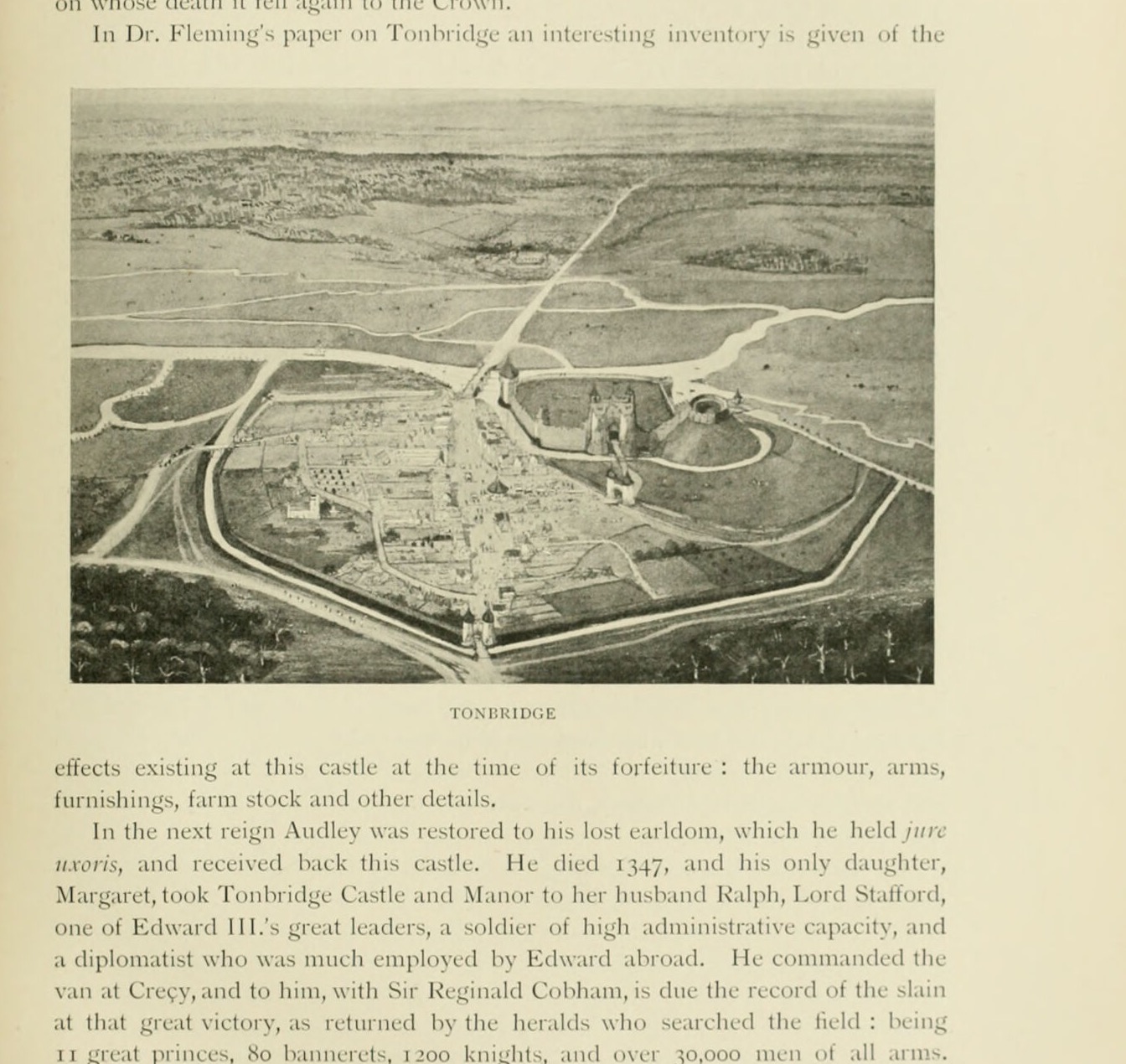
TONBRIDGE
1897 · J. D. Mackenzie, The Castles of England, vol. 1 (1897)
Public domain
Nearby


