
England · Still standing
Totnes Castle
Totnes Castle is a Norman motte-and-bailey castle in Totnes, Devon, occupying a commanding hilltop above the town and the River Dart. Its surviving stone shell keep and curtain wall date from rebuilding in the early 14th century and the site served as the caput of the feudal barony of Totnes. The site is a scheduled monument and is managed by English Heritage.
Its prime
1326
Today
Still standing
As it stood in 1326
What Totnes Castle looked like in its prime.
A rounded stone shell keep and encircling curtain wall sit atop a large earthen motte, forming the skyline above Totnes and the River Dart. The 14th-century work is built of pale Devonian limestone with bands and dressings of red sandstone. Below the motte the outer bailey contains domestic ranges and a separate stone stable block. From the summit the castle looks down into three converging valleys and over the town roofs toward the river.
Its story
The story of Totnes Castle.
Juhel of Totnes and the Barony, 1068-1088
The feudal barony of Totnes was granted in 1068 to Juhel of Totnes, also known as Judhael, a Breton who was one of William the Conqueror's lieutenants. To cement his control of the area he raised a fortification on the hill above the town and founded Totnes Priory within the town. The first castle probably amounted to a wooden palisade and tower, set in a commanding position above Totnes and guarding the approach to three valleys, and it served as the caput of the barony. On the death of William I, Juhel lost his lands, possibly for having supported the Rebellion of 1088.
The Nonants and the First Stone Keep, to 1205
The barony passed to Roger de Nonant, whose descendants appear to have held it for the next three generations. It then came to William de Braose, 3rd Lord of Bramber, who is probably responsible for the first stone shell keep and walls on the site. In 1205 William de Braose, 4th Lord of Bramber and a descendant of Juhel, reclaimed the castle, although he is unlikely to have lived in it; his son Reginald de Braose is credited instead with erecting the first stone castle here.
Ruin, a Royal Repair Order and the de la Zouch Rebuilding, 1326-1485
By 1326 the castle had fallen into ruin and was under the control of the de la Zouch family, who took ownership that year and rebuilt it extensively. A royal order for the repair of the fortifications was made during this period, and as a result the castle was re-fortified with a new shell keep of Devonian limestone and red sandstone, a stable was built and a constable appointed. The surviving stone keep and curtain wall date from around the 14th century. After the Wars of the Roses the castle fell into disrepair once more, and in 1485 Sir Richard Edgecomb became its owner.
The Civil War, the Seymours and English Heritage
The castle was occupied for a period during the Civil War but saw no notable action. In 1764 Edward Seymour, 9th Duke of Somerset, and his family took up residence, and during their tenure added leisure facilities including a tennis court and a tea room. The castle was listed Grade I in 1969 and is also protected as a scheduled monument; since 1984 it has been under the stewardship of English Heritage. It is one of the best preserved examples of a Norman motte and bailey castle in England.
Step inside
8 places to explore in 1326.
The record describes 8 distinct spots at Totnes Castle, including 3 interiors: shell keep courtyard on the motte, stable block in the bailey, inner bailey courtyard and domestic ranges. Create your own photoreal reconstruction and explore every one, more scenes means more rooms, more angles, and more of the place to stand in.
Build Your Own Castle
Recreate Totnes Castle with AI to explore it.
The artist rebuilds it as it stood in 1326, a photoreal reconstruction that belongs to you alone. Pay with coins, no subscription needed.
Recreate this castle →Defend this castle →Whose castle
Clans who held Totnes Castle.
The families that held Totnes Castle for a decade or more across its history, follow a name to its clan.
de Nonant
The feudal barony of Totnes was granted to Roger de Nonant, whose descendants held it for three generations.
de Braose
Held by the de Braose Lords of Bramber, who probably built the first stone shell keep; reclaimed by the 4th Lord in 1205.
de la Zouch
The de la Zouch family assumed ownership by 1326 and extensively rebuilt the castle in stone.
Seymour
Edward Seymour, 9th Duke of Somerset, and his family took up residence in 1764.
From the archive
Totnes Castle on paper: the measured plan and period views.
The survey plan and photographs below are the ground truth this page's reconstructions are checked against, drawn and photographed while the castle was still a working garrison. Every image is public-domain or openly licensed, with its source named.
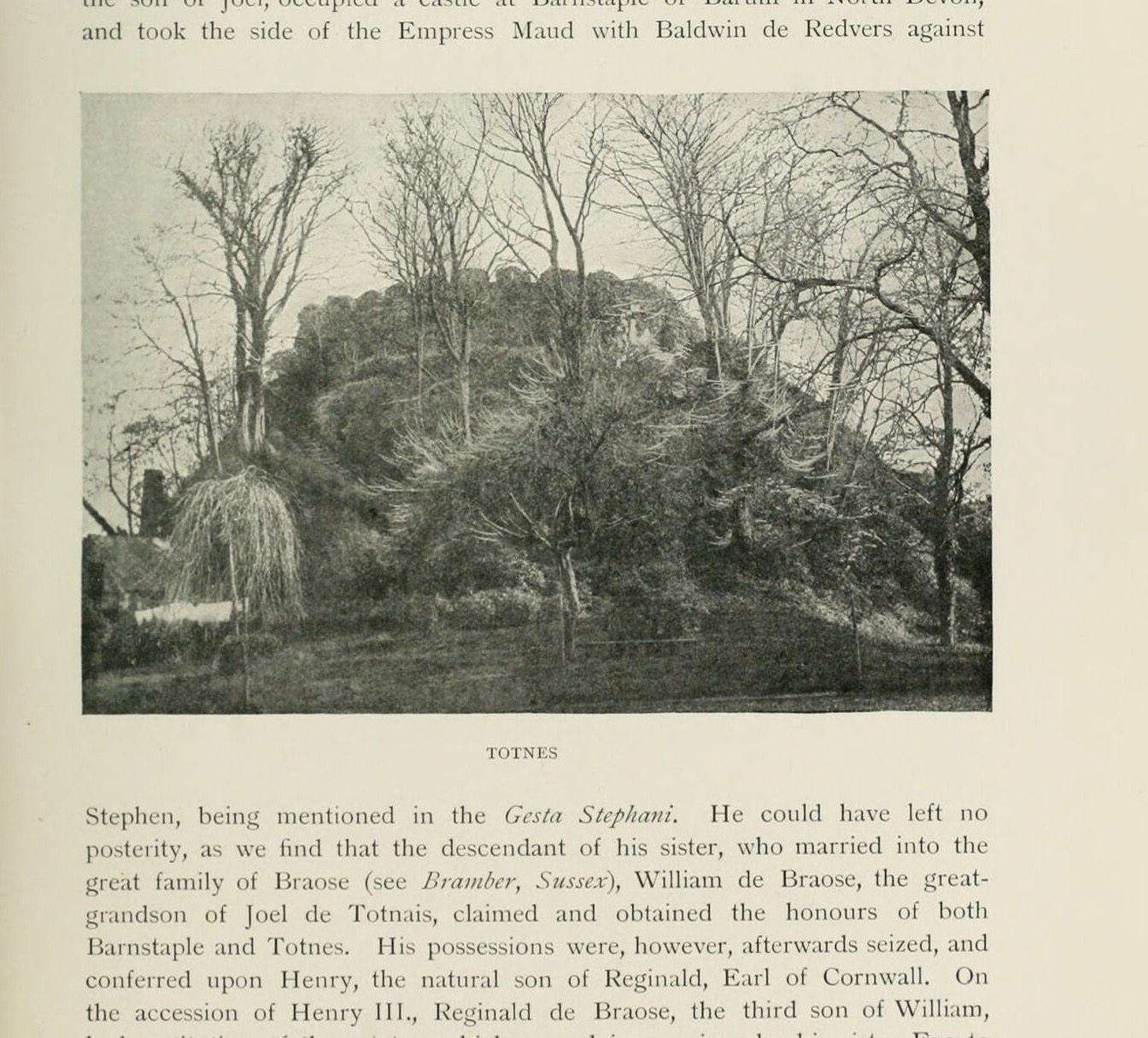
TOTNES
1897 · J. D. Mackenzie, The Castles of England, vol. 2 (1897)
Public domain
Nearby


