England · Partial ruin
Tutbury Castle
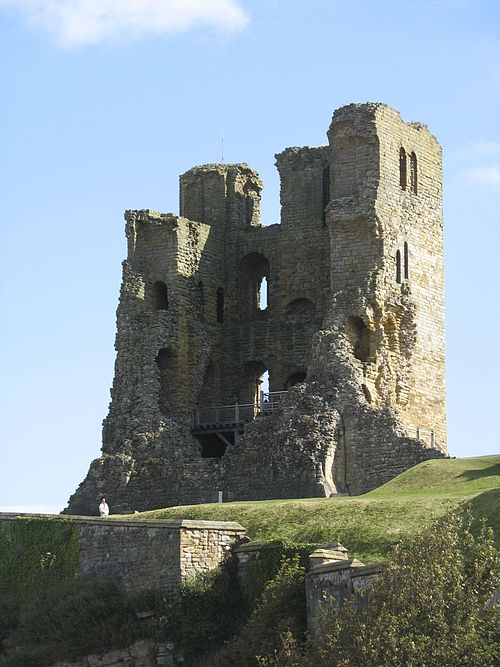
Tutbury Castle is a medieval motte-and-bailey castle in Tutbury, Staffordshire, now largely ruined and owned by the Duchy of Lancaster. It was a major Lancastrian residence in the later Middle Ages and later served as a prison for Mary, Queen of Scots. The site is a scheduled monument and a Grade I listed building.
Its prime
1380
Today
Partial ruin
As it stood in 1380
What Tutbury Castle looked like in its prime.
Perched on a prominent grassy motte, the castle at its prime presented a continuous stone shell keep and curtain encircling the summit, with pierced openings and a crenellated parapet. A multi-storey domestic lodging was built against the inner curtain, its upper timber chamber set immediately beneath the roof and small windows looking into the court; rectangular windows and chimney stacks punctuated the service ranges in the inner bailey. The castle dominated surrounding farmland and a riverside landscape.
Its story
The story of Tutbury Castle.
The Ferrers Earls and Two Ruinous Rebellions
Tutbury Castle became the headquarters of Henry de Ferrers and the centre of the wapentake of Appletree, which took in Duffield Frith. With his wife Bertha he endowed Tutbury Priory with two manors in about 1080, when Tutbury seems to have been a dependency of the Norman abbey of Saint-Pierre-sur-Dives.
His descendants twice gambled the castle on rebellion and twice lost. William de Ferrers, 3rd Earl of Derby, joined the rising against Henry II in 1173–74, and Tutbury was among at least twenty rebel castles slighted in the aftermath. It was "nearly destroyed" a second time by Prince Edward in 1264, after Robert de Ferrers, 6th Earl, rebelled in his turn; a further rebellion in 1269 cost the family the lands altogether. They were given to Edmund Crouchback, and have remained part of the Duchy of Lancaster ever since, which is why the ruin belongs today to King Charles III.
Thomas of Lancaster's "More Than Princely" Household
By the 1300s the castle had been largely repaired, though as a residence rather than a military strongpoint. Thomas, 2nd Earl of Lancaster, not only made good the damage of the Ferrers years but, in the words of an 1836 account, gave the castle "a grandeur and magnificence which it had not previously possessed". He made it his principal residence and lived in more than princely style, his housekeeping in the single year 1313 reckoned at £22,000 of that account's own day, at a time when provisions were remarkably cheap.
Some time before 1370 John of Gaunt rebuilt the castle even more substantially. From 1372 until her death in 1394 it was the permanent residence of his wife Constance, whose court lavishly patronised music and the arts and was said to be "somewhat similar to a modern Windsor" in its ambition.
The "Pauvre Prisonnière": Mary, Queen of Scots, 1569–1570
After Mary, Queen of Scots fled her defeat at Langside in 1568, the English Privy Council resolved to lodge her at Nottingham, Fotheringhay or Tutbury, anywhere further from the Scottish border. Tapestries, furniture and bedding were sent from the Royal Wardrobe at the Tower of London, and when bad weather delayed them Bess of Hardwick sent her own things from Sheffield. Mary arrived on 4 February 1569 and was unimpressed: the castle struck her as a hunting lodge, its enclosure on a slight hill reminiscent of the Bois de Vincennes, and she complained of the damp, the wet plaster and the draughty, ill-fitting old carpentry.
Her keeper, George Talbot, 6th Earl of Shrewsbury, held detailed instructions for her custody. In March he described Mary sitting at embroidery in the countess's chamber with Bess, Lady Livingston and Mary Seton. She was moved to Wingfield Manor in April, returned in September under increased guard with a reduced household, and after the Rising of the North in November 1569 was rushed south to Coventry. She was back (the "pauvre prisonnière", as she described herself) on 2 January 1570, and was sent on to Chatsworth that May.
Mary's Return: Billiards, Hawks and Amyas Paulet, 1585
Mary came back to Tutbury in January 1585 via Wingfield Manor. Her bedchamber sat at the top of a timber lodging built against the castle wall, its two windows facing only the castle court; for warmth she improvised a tent of tapestry over her bed. She kept a billiard table, and her keeper Ralph Sadler sometimes took her hawking on the River Dove under a mounted guard of forty or fifty, until Queen Elizabeth, disapproving of the freedom, forbade it. The outdoor enclosure of wooden palings, Mary wrote, was more like a pig run than anything that might be called a garden.
On 19 April 1585 she passed into the care of Sir Amyas Paulet, who took down her cloth of estate, barred her servants from the wall walk near the gate, curtailed her charity in the town and disarmed her Scottish servants, many of whom carried pistols. On Christmas Eve 1585 she was finally moved to Chartley Castle.
Decay, Royalist Garrison and Demolition
The fabric had begun to decay by the late sixteenth century, though James I stayed a number of times between 1619 and 1624, knighting Sir Henry Rainsford and Sir Edward Vernon there in August 1624. In the Civil War the castle was re-fortified for the Crown; Parliamentary forces failed to dislodge the garrison in 1643, and it held out until April 1646, when it surrendered after a three-week siege on terms drawn up by its governor, Sir Andrew Kniveton, and signed on 20 April. In July 1647 the battered castle was judged untenable, and Parliament ordered its destruction; demolition ran through 1647–48. A folly was added to the motte in 1780, and the ruins are now a scheduled monument and a Grade I listed building.
Step inside
7 places to explore in 1380.
The record describes 7 distinct spots at Tutbury Castle, including 2 interiors: top chamber of the lodging (queen's bedchamber), countess' chamber (residential chamber). Create your own photoreal reconstruction and explore every one, more scenes means more rooms, more angles, and more of the place to stand in.
Build Your Own Castle
Recreate Tutbury Castle with AI to explore it.
The artist rebuilds it as it stood in 1380, a photoreal reconstruction that belongs to you alone. Pay with coins, no subscription needed.
Recreate this castle →Defend this castle →Whose castle
Clans who held Tutbury Castle.
The families that held Tutbury Castle for a decade or more across its history, follow a name to its clan.
Ferrers
Stronghold of the Ferrers Earls of Derby in the 12th–13th centuries; slighted in 1173–74 and ruined again after the 6th Earl's rebellion of 1264.
Lancaster
Principal residence of Thomas, 2nd Earl of Lancaster; rebuilt by John of Gaunt before 1370, and still owned by the Duchy of Lancaster.
From the archive
Tutbury Castle on paper: the measured plan and period views.
The survey plan and photographs below are the ground truth this page's reconstructions are checked against, drawn and photographed while the castle was still a working garrison. Every image is public-domain or openly licensed, with its source named.
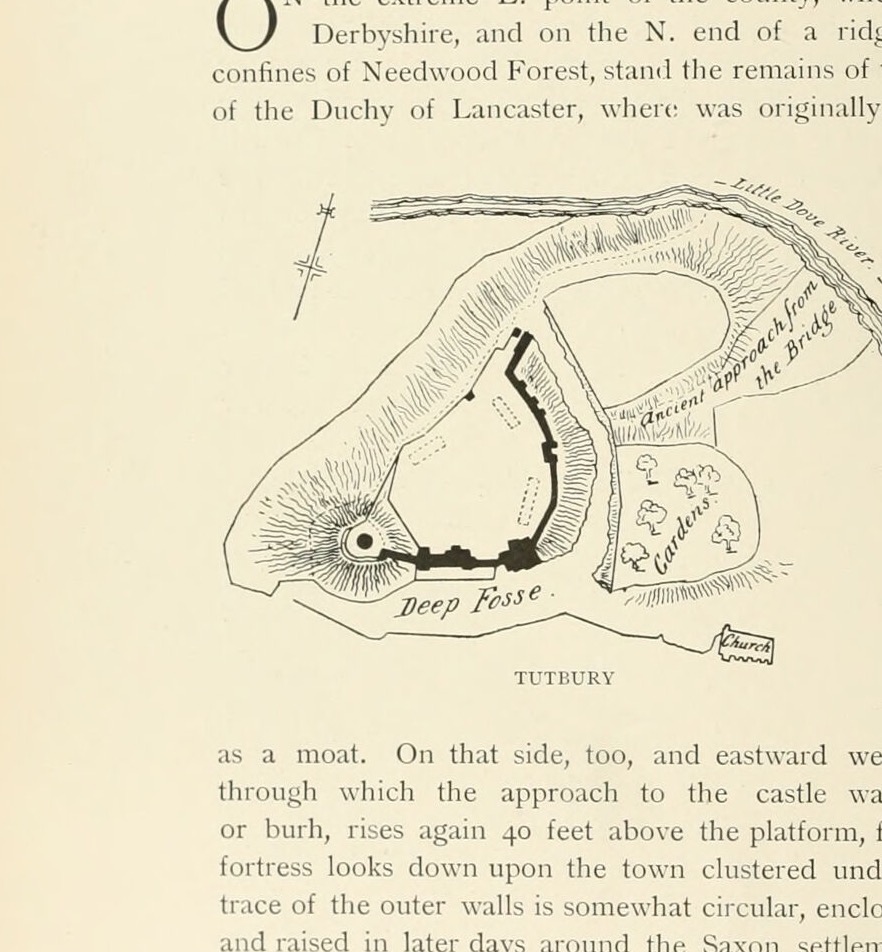
TUTBURY
1897 · J. D. Mackenzie, The Castles of England, vol. 1 (1897)
Public domain
Nearby