England · Ruin
Wark on Tweed Castle
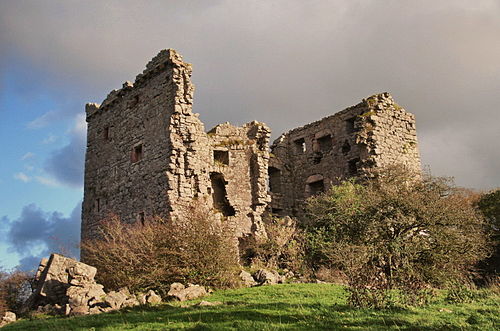
Wark on Tweed Castle is a ruined motte-and-bailey castle at the west end of Wark on Tweed in Northumberland. Built in the 12th century and extensively refortified through the medieval and early Tudor periods, it once had an octagonal donjon, multiple wards and a gatehouse; only earthworks and fragmentary stonework remain today as a scheduled/listed ruin.
Its prime
1518
Today
Ruin
As it stood in 1518
What Wark on Tweed Castle looked like in its prime.
A large, grass-covered motte rises from pasture with the lower face of its stone keep exposed in a broken sweep; the surviving masonry is pale, weathered rubble set into the earthen slope. The summit would have supported an octagonal donjon with a roughly vertical stone profile and battlements, surrounded by terraced earthworks and the footprints of multiple wards and curtain lines extending out into low baileys.
Its story
The story of Wark on Tweed Castle.
Walter Espec, the Siege of 1138 and the Octagonal Keep
Walter Espec built the castle, sometimes called Carham Castle, in 1136 at the west end of Wark on Tweed in Northumberland. The Scots besieged and destroyed it in 1138, and it was rebuilt between 1157 and 1161. In the early thirteenth century an octagonal keep was raised on the motte, at roughly the same time that the towers and the gatehouse were added.
The Garter at Wark, 1349
It was at Wark in 1349 that Edward III bent down and helped the "Countess of Salisbury" with her garter, either Joan of Kent, his future daughter-in-law, or her former mother-in-law Catherine Montagu, Countess of Salisbury. In honour of that moment he afterwards founded the Order of the Garter.
Dacre's Donjon and Albany's Assault, 1518-1533
Thomas Dacre described the newly refurbished castle in June 1518, after work directed by the Master Mason of Berwick. The donjon was finished and fit to mount great cannon on each vaulted floor, with an internal well up which the guns could be hoisted; the watchman on top could see Norham and the outskirts of Berwick. Three wards or courtyards were almost complete.
A Scottish army commanded by Regent Albany besieged Wark in November 1522. The Prioress of Coldstream and the Prioress of Eccles had sent advance warning of Albany's invasion plan to the English commanders. The weather was poor and it was thought that Scottish artillery could not be brought to the border, but the Scottish guns were set up to batter Wark. After two days Albany's force of 2,000 men, mostly French, crossed the Tweed in boats and penetrated the inner court, where Sir William Lisle's garrison repulsed them. The Earl of Surrey wrote that newly built bulwarks of earth had made the castle better able to withstand a siege; he found it hard to maintain a garrison, and wished the castle was in the sea so there could be no deserters.
In September 1523 Surrey viewed the defences at Wark and Norham with William Frankelyn, Chancellor of Durham, and Sir William Bulmer, Sheriff of Durham. He gave orders for new bulwarks and earthwork defences, judged that the inner ward could withstand a ten-day siege while the outer ward could be held only two days, and thought the keep as strong as any he had seen, stronger than the keep at Guînes. Cardinal Wolsey ordered repairs to the donjon walls in June 1524, with lead for the roof to be brought from Dunstanburgh Castle. George Lawson reported to Thomas Cromwell in March 1533 that the walls by the waterside had fallen.
John Carr, Haddon Rig and Arcano's Survey, 1542-1545
John Carr, Captain of Wark, was captured at the battle of Haddon Rig in August 1542, and a number of men of the garrison, commanded by John Tempest, were lost or injured. During repairs that September, carts carrying stone from Carham church to the castle were attacked by Scottish raiders. Over 1,800 pounds was spent on the castle in 1543, and an Italian military engineer commented that Wark was still a "marvellous great ruin".
In 1544, during the war of the Rough Wooing, Carr complained that a length of curtain wall near the river had fallen. An Italian military engineer, Archangelo Arcano, was sent in February 1545 to advise on repairs; he sent a plan to the Earl of Shrewsbury, noting particularly that the roofs were leaking, and lead could be brought from Kelso Abbey, which Arcano was also fortifying. The names of the garrison and the numbers of cannon were listed in March 1545. On top of the donjon stood a saker and a broken falcon. Ralph Sadler, reporting on the border garrisons, wrote that Carr was "surely a good borderer" and "esper in these frontier wars".
The Crown Garrison and the Removal of the Guns
Scotland was at war with England in 1557, and Sir Ralph Grey passed control of the castle to the crown; it was held and defended by Sir John Slingsby, a brother-in-law of the Earl of Northumberland. After peace was concluded in 1559, Northumberland asked the Privy Council of England for advice on the future of the castle, suggesting the site be surveyed by John Brende or Richard Lee.
During the Marian Civil War, Rowland Foster, captain of Wark, came into Scotland in May 1570 and raided Blyth in Lauderdale, a property of William Maitland of Lethington. James VI of Scotland passed by on the other side of the Tweed on 26 April 1588, was saluted by the castle cannon, and sent a reward of 20 crowns; the same guns saluted the Scottish rebel Earl of Bothwell twice in 1594, which angered James VI. In December 1604 the inhabitants of Berwick requested the use of smaller cannon removed from Wark to defend their town and harbour.
The motte-and-bailey ruins are a scheduled monument, listed Grade II* on 21 September 1951.
Step inside
7 places to explore in 1518.
The record describes 7 distinct spots at Wark on Tweed Castle, including 1 interior: donjon interior with vaulted floors and central well. Create your own photoreal reconstruction and explore every one, more scenes means more rooms, more angles, and more of the place to stand in.
Build Your Own Castle
Recreate Wark on Tweed Castle with AI to explore it.
The artist rebuilds it as it stood in 1518, a photoreal reconstruction that belongs to you alone. Pay with coins, no subscription needed.
Recreate this castle →Defend this castle →Whose castle
Clans who held Wark on Tweed Castle.
The families that held Wark on Tweed Castle for a decade or more across its history, follow a name to its clan.
Held by Sir Ralph Grey, who passed control to the crown on the outbreak of war in 1557.