England · Ruin
Whorlton Castle
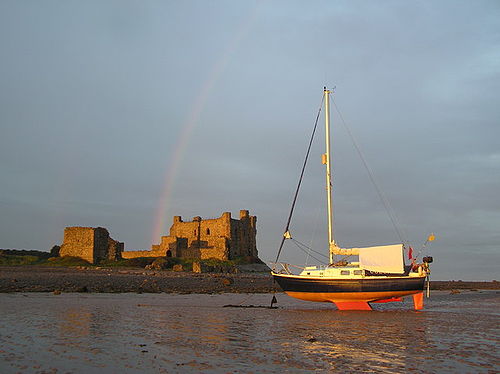
Whorlton Castle is a medieval motte-and-bailey site in North Yorkshire whose main surviving fabric is the roofless, three-storey 14th‑century gatehouse. The rest of the former bailey and the Norman cellars survive as earthworks and buried remains; the site is privately owned but visitable. The gatehouse is a Grade I listed ruin and was substantially rebuilt in the mid‑14th century by the Darcy family.
Its prime
1350
Today
Ruin
As it stood in 1350
What Whorlton Castle looked like in its prime.
A mid-14th-century rectangular, three-storey gatehouse built of sandstone ashlar (about 17.7 by 10 m) with walls up to c.8.5 m high; each long face pierced by a large segmental-arched entrance flanked by narrow cross-windows and portcullis grooves. Above the eastern arch is a row of three carved shields and a single impaled shield. The gatehouse originally had floors and a roof with a vaulted central passage, mural chambers, and a projecting spiral stair tower to the northwest, standing at the edge of a broad dry ditch and bailey.
Its story
The story of Whorlton Castle.
Domesday to the de Meynells' Motte, 1086–1343
Whorlton was recorded in the Domesday Book of 1086 as belonging to Robert, Count of Mortain, half-brother of William the Conqueror, and later passed to the de Meynell family, who founded the castle in the early 12th century. In its first phase it was a wooden fortress on a roughly square motte some 60 by 50 metres, ringed by a dry ditch up to 20 metres wide and 5 metres deep behind an outer bank up to 2.5 metres high (most of the ditch survives, though its south-east quadrant has been destroyed by a modern road), and it adjoined a fortified enclosure taking in the village and church. In the 13th century it was known variously as Hwernelton or Potto Castle. The castle fell into disrepair or was dismantled during the first part of the 14th century; an account of 1343 describes it as a ruin.
The Darcy Gatehouse, mid-14th century–1541
In the mid-14th century Whorlton passed by marriage to John Darcy, Lord Darcy of Knayth, a figure with close ties to the royal court. Darcy levelled the motte and raised a new keep with a fortified gatehouse a short distance to the east; no evidence of a curtain wall survives, though centuries of stone-robbing may account for its absence. Above the gatehouse's main entrance are three carved shields (Darcy at the centre, flanked by Meynell and Gray) the Gray shield commemorating the marriage of Philip Darcy, 6th Baron, to Elizabeth Gray late in the century; a further shield above shows the arms of Darcy and Meynell impaled, marking the earlier match that had brought the castle to the family. The Darcys held Whorlton until 1418, when Philip Darcy's death passed it to his daughter Elizabeth and her husband Sir James Strangeways; the Strangeways family kept it until a dispute between heirs in 1541 made it a Crown possession.
The Lennox Match and the Bruce Earls, 1540s–1664
Henry VIII granted the castle and estate to Matthew Stewart, 4th Earl of Lennox, whose eldest son Henry Stuart, Lord Darnley, would marry Mary, Queen of Scots. Margaret Douglas, Countess of Lennox, wrote to Mary in the autumn of 1561, possibly from Whorlton, to propose the match. Local tradition holds that the marriage contract was signed at Whorlton in 1565, but this is mistaken; it was actually signed at Stirling Castle in Scotland. In the late 16th or early 17th century the Lennox family built a house adjoining the gatehouse's north-west end, sketched in 1725 by Samuel Buck as a large two-storey building with gabled dormer windows; nothing of its structure survives beyond a roofline still visible on the gatehouse wall. The castle reverted to the Crown but fell into disrepair, and by 1600 was described as "old and ruinous". In 1603 the castle and manor were given to Edward Bruce, 1st Lord Kinloss; his second son, Thomas Bruce, 1st Earl of Elgin, was given the title Lord Bruce of Whorlton in 1641, and Thomas's son Robert became first Earl of Ailesbury in 1664.
Sale, Stone-Robbing and Listing, 1800s–1960s
By the early 19th century the keep's ruins had largely disappeared, as a lithograph of the period shows. The Bruce family retained the castle and manor until the late 19th century, when they were sold to James Emerson of Easby Hall, and in 1875 a large quantity of the castle's stonework was taken to build Swainby's village church. The castle is now privately owned, bought in the mid-20th century by Osbert Peake, 1st Viscount Ingleby, as part of a shooting estate; the site was scheduled as an ancient monument in 1928 and later listed Grade I, and the gatehouse received structural repairs from the Ministry of Works in the 1960s but has otherwise been left open to the elements.
Heritage at Risk and the 2005 Conservation Plan
The gatehouse, in poor condition and repeatedly vandalised, is on English Heritage's Heritage at Risk Register. It stands within the North York Moors National Park, and the Park Authority, English Heritage and the owner have worked on a conservation plan; a 2005 report recommended converting the gatehouse into a liveable property over the alternatives of retaining it as a managed ruin or handing it to a community group. English Heritage part-funded a feasibility study for that conversion, but the plan fell through when the Vivat Trust, which had proposed it, collapsed into administration. The castle is a Grade I listed building and a scheduled monument, privately owned but open to public visits.
Step inside
10 places to explore in 1350.
The record describes 10 distinct spots at Whorlton Castle, including 5 interiors: central vaulted passage through the gatehouse, ground-floor guardrooms and mural chambers, top‑floor great hall and more. Create your own photoreal reconstruction and explore every one, more scenes means more rooms, more angles, and more of the place to stand in.
Build Your Own Castle
Recreate Whorlton Castle with AI to explore it.
The artist rebuilds it as it stood in 1350, a photoreal reconstruction that belongs to you alone. Pay with coins, no subscription needed.
Recreate this castle →Defend this castle →Whose castle
Clans who held Whorlton Castle.
The families that held Whorlton Castle for a decade or more across its history, follow a name to its clan.
Meynell
The de Meynells founded the castle in the early 12th century and held it until it passed by marriage to the Darcys.
Darcy
Held by the Darcys from the mid-14th century until the death of Philip Darcy, 6th Baron Darcy de Knayth, in 1418.
Strangeways
Came by Elizabeth Darcy's marriage to Sir James Strangeways in 1418; held until a dispute between heirs in 1541.
Granted by Henry VIII to Matthew Stewart, 4th Earl of Lennox; the Lennox family built a house adjoining the gatehouse.
Given to Edward Bruce, 1st Lord Kinloss, in 1603; his line took the titles Lord Bruce of Whorlton (1641) and Earl of Ailesbury (1664).
Nearby