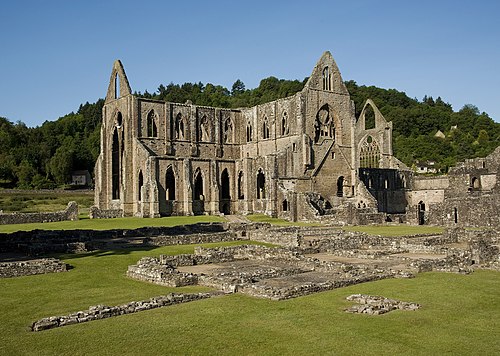
England · Partial ruin
Wilton Castle
Wilton Castle is a 12th-century Norman stone castle in south‑eastern Herefordshire, England, sited beside the River Wye adjacent to Ross‑on‑Wye. It was the seat of the Longchamp, de Cantilupe and de Grey families and saw military action over several centuries before suffering destruction in the English Civil War.
First raised
1200
Its prime
1308
Today
Partial ruin
As it stood in 1308
What Wilton Castle looked like in its prime.
In its prime (c.1308) Wilton Castle presented as a complete Norman stone fortress set immediately beside the River Wye next to Ross‑on‑Wye. Continuous crenellated curtain walls rose to full height around a compact inner ward, with defended parapets and roofed domestic ranges visible behind the battlements; the silhouette was a low, solid medieval masonry stronghold hugging the riverbank rather than a timber settlement.
Its story
The story of Wilton Castle.
The Longchamps of Wilton on the Wye
Wilton is a 12th-century Norman castle in south-eastern Herefordshire, standing on the River Wye beside the town of Ross-on-Wye and named after the manor associated with it. It still stands mostly to battlement height, a monument to its former lords, and is today both a Grade I listed building and a scheduled monument in the parish of Bridstow.
The Longchamps of Wilton in their time provided Bailiffs of Normandy, Chancellors of England, sheriffs of Hereford and the Welsh Marches, and enemies of King John.
Cantilupes, Greys and Matilda's Claim Before Edward I, 1292–1557
The Longchamps were succeeded by the families of De Cantilupe and De Grey, who between them built up a powerbase in Wales and the Marches. In 1292 Matilda de Grey, née de Cantilupe, declared untruthfully in court before Edward I that the castle had been built by her Longchamp ancestors in the days of Edward the Confessor (1042–66). It could not in fact have been built before 1154, and the 'barony' certainly never held the Marcher Lord rights she claimed for it.
The castle was chiefly associated with a branch of the Norman-descended family of Grey, the Barons Grey of Wilton, a prominent dynasty of Marcher Lords, who held it from 1308 or before. It passed out of the family when William Grey was captured by the French at the end of the defence of Guînes in 1557 and was forced to sell it to raise funds for his ransom.
Destroyed by Barnabas Scudamore's Royalists in the Civil War
Wilton was finally destroyed in the English Civil War by troops led by the local Royalist Barnabas Scudamore. It was a period that saw skirmishes and sieges locally at Goodrich Castle, Ruardyn Castle and Raglan Castle.
Step inside
4 places to explore in 1308.
The record describes 4 distinct spots at Wilton Castle, including 1 interior: inner ward (courtyard). Create your own photoreal reconstruction and explore every one, more scenes means more rooms, more angles, and more of the place to stand in.
Build Your Own Castle
Recreate Wilton Castle with AI to explore it.
The artist rebuilds it as it stood in 1308, a photoreal reconstruction that belongs to you alone. Pay with coins, no subscription needed.
Recreate this castle →Defend this castle →Whose castle
Clans who held Wilton Castle.
The families that held Wilton Castle for a decade or more across its history, follow a name to its clan.
Longchamp
Held by the Longchamps of Wilton, who supplied Bailiffs of Normandy, Chancellors of England and sheriffs of Hereford.
Cantilupe
The de Cantilupe family succeeded the Longchamps, building a powerbase in Wales and the Marches.
Held by the Barons Grey of Wilton from 1308 or before until 1557, when William Grey sold it to pay his French ransom.
Nearby