England · Partial ruin
Wressle Castle
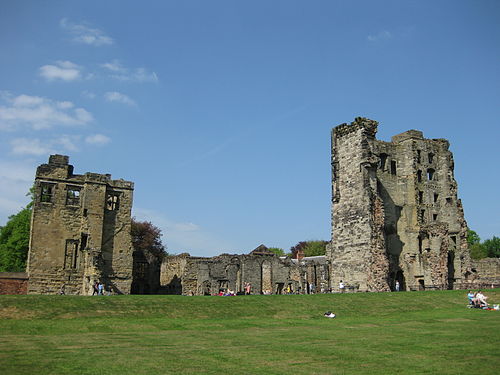
Wressle Castle is a late 14th‑century quadrangular palace‑fortress in the East Riding of Yorkshire, built for Thomas Percy and later belonging to the Percy family. Much of the castle was demolished in the mid-17th century and a fire in 1796 gutted the remaining wing; the surviving south range stands as a ruined remnant in its original landscape.
First raised
1390
Its prime
1527
Today
Partial ruin
As it stood in 1527
What Wressle Castle looked like in its prime.
A long southern range of pale squared ashlar, two large multi-storey rectangular corner towers anchoring each end, and a lower linking wall with repeated tall paired arched windows and narrow slit openings; stonework shows coursed blocks with a continuous plinth and a simple moulded cornice at parapet level. Many window openings are empty, upper wall-tops are flat rather than crenellated, and the building sits directly onto a grassy forecourt with trees visible to one side.
Its story
The story of Wressle Castle.
Thomas Percy's Quadrangular Palace, 1364-1403
The Percys held the manor of Wressle from the early 14th century, and in 1364 it was granted to Thomas Percy. By 1390 he had spent nearly ten years abroad as a soldier or on diplomatic errands, and thereafter moved in the royal sphere, a friend of both Richard II and Henry IV. The castle is first documented in 1402 but was probably built in the 1390s, raised, in the archaeologist Anthony Emery's phrase, “as a residence reflecting [the Earl's] pedigree and distinguished state service”.
It was a quadrangular castle: four ranges around a courtyard, a tower at each corner, a five-storey gatehouse in the middle of the east side facing the village, and the great hall opposite it in the west range. The historian John Goodall judged the outside “austerely detailed to give an outward impression of strength”, a treatment that set off the opulence of the interiors. Malcolm Hislop has suggested that John Lewyn, designer of the great tower at Warkworth, designed Wressle too.
Henry IV gave Thomas Percy influence in south Wales, but relations between them deteriorated, partly over delays in payment. When his nephew Henry Percy rose in armed rebellion in July 1403 Thomas joined him; he was captured at the battle of Shrewsbury and beheaded two days later, on 23 July. His property, Wressle among it, was confiscated by the crown.
Crown Custody and the Percy Restoration, 1403-1527
Between 1403 and 1471 the castle passed back and forth between the crown and whoever the reigning monarch chose to grant it to, and never for long. In 1471 it was given to Henry Percy, 4th Earl of Northumberland, returning it to the family. His son Henry Algernon Percy, 5th Earl, at the time one of the richest men in England, refurbished the interior and updated the gardens; in the walled Old Garden south of the moat stood a two-storey ‘School House’ where he would read. The Northumberland Household Book, compiled around this period, records the daily domestic running of Wressle and Leconfield and is used by historians of the late medieval household. He died at Wressle in 1527.
Robert Aske Comes to Wressle, 1536-1545
The Pilgrimage of Grace, the popular revolt against Henry VIII in 1536, brought its Yorkshire leader Robert Aske to Wressle that October. He pressed Henry Percy, 6th Earl of Northumberland, then suffering from illness, to join the rising; the earl was at first opposed but eventually gave Aske control of the castle. When he died in 1537 his one surviving brother did not inherit, being imprisoned for his part in the revolt. The crown resumed control the same year, and Henry VIII stayed three nights in 1541.
The antiquary John Leland saw Wressle in about 1540 and called it “one of the most proper beyond the Trent, and seemeth as newly made”, all “of very fair and great squared stone”; the gardens he thought “exceedingly fair”, with orchards beyond the moat. Matthew Stewart, 4th Earl of Lennox, was lodged there in January 1545.
Parliament's Garrison and the Slighting, 1646-1650
Wressle was intended as a high-status residence rather than a fortress and was never besieged, but parliamentarians garrisoned it during the Civil War and it was badly damaged; repairs to the castle and the ground around it were reckoned at the time to need £1,000. It was slighted on several occasions between 1646 and 1650. The 1648 work concentrated on the battlements, a contemporary letter complaining that Parliament's “agents would show no care in preserving any of the materials, but pitched of[f] the stones from the battlements to the ground”. Two years later Algernon Percy, 10th Earl of Northumberland, was ordered to demolish everything except the south range, which he was allowed to keep as a manor house.
The Tenant's Fire and the Long Rescue
The castle stayed with the Percys until the mid-18th century, when it passed to the earls of Egremont and then by inheritance to Elizabeth Seymour, who took the Percy name and was later Duchess of Northumberland. On 19 February 1796 a tenant farmer trying to clear a chimney caused a fire that gutted the remaining wing; three months on, The Gentleman's Magazine called the loss “of truly national significance”. The farm continued to be leased, and by 1880 the ruin was partly under ivy. In 1957 castle and farm were sold to the Falkingham family, who own the site today.
Wressle is a Grade I listed building and a scheduled monument. Put on the Heritage at Risk Register in 1999, it was repaired with £500,000 from Historic England, Natural England and the Country Houses Foundation and came off the register in 2015. It is privately owned and usually open to the public for a few days each year.
Step inside
11 places to explore in 1527.
The record describes 11 distinct spots at Wressle Castle, including 5 interiors: chapel tower and two‑storey chapel interior, lady's chamber and library (above chapel), great hall in the west range and more. Create your own photoreal reconstruction and explore every one, more scenes means more rooms, more angles, and more of the place to stand in.
Build Your Own Castle
Recreate Wressle Castle with AI to explore it.
The artist rebuilds it as it stood in 1527, a photoreal reconstruction that belongs to you alone. Pay with coins, no subscription needed.
Recreate this castle →Defend this castle →Whose castle
Clans who held Wressle Castle.
The families that held Wressle Castle for a decade or more across its history, follow a name to its clan.
Held the manor of Wressle from the early 14th century; the castle was built for Thomas Percy in the 1390s and returned to the family in 1471.
Nearby