England · Restored
Yarmouth Castle
Yarmouth Castle is a mid-16th-century square artillery fort on the west side of Yarmouth Harbour, Isle of Wight, built under Henry VIII and altered in subsequent centuries. The fort has an Italianate arrow‑head bastion on its landward side, a seaward gun platform and formerly worked with an adjacent quay battery; it is now managed by English Heritage as a visitor attraction.
First raised
1547
Its prime
1670
Today
Restored
As it stood in 1670
What Yarmouth Castle looked like in its prime.
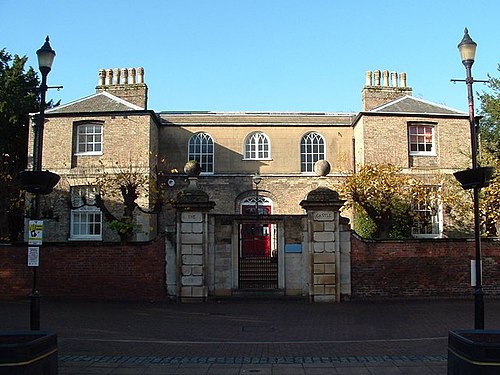
A compact, square stone fort about 30 m across with a low, flat roofline forming a continuous gun platform to seaward and an angular arrow‑head bastion projecting on the landward side. Walls are ashlar with some red brick on the south face, pierced by a few gunloops; the north and west faces are reinforced by angular buttresses and face the harbour. The southern interior was raised into a solid artillery platform while the northern side retains ranges of service buildings around a courtyard.
Its story
The story of Yarmouth Castle.
Henry VIII's Second Device, 1544-1547
Yarmouth Castle came out of Henry VIII's break with Rome. With France and the Empire allied against him from 1538, the King ordered coastal fortifications by an instruction called a "device" in 1539, and a second device in 1544 when France threatened invasion across the Channel. The French may have raided Yarmouth in 1543; if so, that raid probably encouraged the castle built there in the second wave of Device Forts.
George Mills built it under Richard Worsley, Captain of the Island, on Crown land, and stone from the dissolved Quarr Abbey was probably reused in the walls. Mills was paid £1,000 in 1547, when the work was finished. The square fort, just under 100 feet across, carried three cannons and culverins and twelve smaller guns, with a master gunner, a porter and seventeen soldiers under Richard Udall, its first captain. Its angular "arrow-head" bastion on the landward side broke with the semi-circular bastions of earlier Device Forts, and was the first of its kind in England.
Richard Worsley's Gun Platform, 1553-1599
Worsley was dismissed in 1553 under Mary I in favour of a Roman Catholic appointee, and Udall was executed in 1555 for his part in the Dudley conspiracy against the Queen. Under Elizabeth I, with attention turning from France to Spain, the reappointed Worsley filled in half the courtyard to make a solid artillery platform for eight heavy guns with an uninterrupted field of fire over the sea, and probably built the Master Gunner's House. An inspection in 1586 found the fort in poor condition; £50 was spent in 1587 on repairs and an earth bulwark alongside the castle for extra guns, with more work after the attempted Spanish invasion of 1588. By 1599 the Crown was informed that the castle needed expensive repairs.
A Ruinous Garrison and the Civil War, 1609-1655
In 1609 £300 went on Yarmouth and nearby Sandown, adding two angular buttresses to the sea-facing walls. A survey in 1623 by the captain, John Burley, reported a garrison of four gunners and himself, buildings in a "ruinous" state and defences needing repair. In 1632 the parapets were raised and further lodgings and a long store room built inside.
When war broke out in 1642, Captain Barnaby Burley, a relative of John and an ardent Royalist, held the castle for Charles I with a tiny garrison. He negotiated surrender terms that let him stay on inside at first under armed protection, and Parliament held the castle for the rest of the war. Early in the Interregnum the garrison rose from 30 to 70 soldiers over fears of a Royalist attack from Jersey, at around £78 a year; it was cut back in 1655 to save money.
Robert Holmes and the Revolution of 1688
Charles II demobilised most of the army on his return in 1660, and in 1661 the garrison was given four days' notice to leave. The artillery, the King announced, would go to Cowes unless the town paid to run the site; Yarmouth declined, and when the offer came again in 1666 it appointed four soldiers but no officer. The Crown took the castle back in 1670, and Robert Holmes, the new Captain of the Isle of Wight, had guns brought back from Cowes. The site was refortified and a new battery placed on the quay, while the older earthworks were demolished and the moat filled in. Holmes built a mansion for himself alongside the castle. In 1688, with James II facing widespread revolt and a potential invasion by William of Orange, Holmes intended to hold Yarmouth for the King, but the townspeople and the garrison sided with William.
Silted Harbour to English Heritage, 1718-2010
Records of 1718 and 1760 list eight 6-pounders on the castle and five 9-pounders on the quay, probably manned by a captain and six gunners with the local militia in support. By then Yarmouth Harbour had silted up and been destroyed by industrial developments, and the castle's design was outdated. The parapet was altered in 1813 during the Napoleonic Wars, and the Crimean War invasion scare brought considerable repairs in 1855, when four naval guns and traversing rails were installed on the platform and a regular county unit garrisoned it. A modernisation scheme was rejected in 1881, and in 1885 the guns and the garrison were withdrawn.
The coastguard took the castle as a signalling station in 1898. In 1912 parts were leased to the Pier Hotel, which incorporated Holmes's former mansion; as the George Hotel it still occupies part of the old castle moat. The Office of Works took control in 1913, and the castle served the military in both World Wars before being retired in the 1950s. It is a scheduled monument and a Grade I listed building, and English Heritage runs it as a tourist attraction; it drew 9,007 visitors in 2010.
Step inside
9 places to explore in 1670.
The record describes 9 distinct spots at Yarmouth Castle, including 3 interiors: seaward gun platform (southern interior), master gunner's house (interior front), courtyard and long room for stores. Create your own photoreal reconstruction and explore every one, more scenes means more rooms, more angles, and more of the place to stand in.
Build Your Own Castle
Recreate Yarmouth Castle with AI to explore it.
The artist rebuilds it as it stood in 1670, a photoreal reconstruction that belongs to you alone. Pay with coins, no subscription needed.
Recreate this castle →Defend this castle →Nearby