France · Restored
Castle of Brézé
Château de Brézé
Château de Brézé is a compact fortified residence near Saumur in the Loire Valley, combining Renaissance façades with surviving medieval features. It sits within a dry moat and incorporates an extensive troglodytic basement of rock-cut galleries. The château remains a private residence and produces wine from surrounding vineyards.
Its prime
1600
Today
Restored
As it stood in 1600
What Castle of Brézé looked like in its prime.
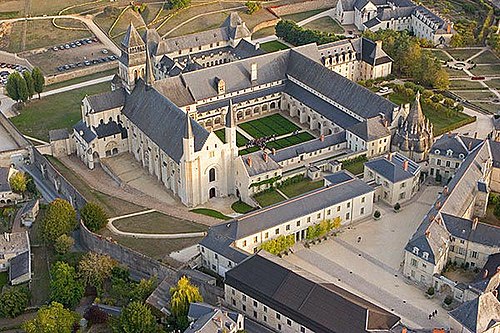
A compact stone château set inside a broad dry moat and approached by a historic drawbridge; the exterior shows Renaissance-style façades juxtaposed with older medieval masonry and defensive features. The main corps de logis faces a small forecourt, while the estate is set within vineyards of the Loire Valley. At the château's base are entrances to an extensive 12th-century troglodytic basement of rock-cut galleries that include cellar openings and external stair access.
Its story
The story of Castle of Brézé.
The Roche de Brézé: a Refuge Cut Below the Courtyard
The oldest part of the network cut beneath Brézé is the roche de Brézé, nine metres below the courtyard. It is older than 1063, and was probably first cut as a refuge and shelter from Viking raids. It was laid out on a clover plan around a central light shaft and equipped to hold out through a long siege: silos stored food, the entrance could be blocked without difficulty, and the narrow, sharply angled passages let defenders ambush anyone who came down them.
Kilometres of galleries run beneath the château and around its ditches, holding living quarters, a bakery, an icehouse and a silkworm house, with further stretches given over to keeping wine. An underground wall-walk rings the ditches, one of its main features a watch-turret. About a kilometre of the network is open to visitors.
King René's Licence of 1448 and the Maillé Renaissance
The lands were held by the lords of Brézé from the eleventh century, and the first of them made numerous donations to the nearby abbey of Fontevraud. From the early fourteenth century the lordship passed through the female line to other branches, among them the Maillé. Among the family's members was the Grand Seneschal Louis de Brézé, husband of Diane de Saint-Vallier (Diane de Poitiers), though he never held the lordship of Brézé itself.
In 1448 Gilles de Maillé-Brézé obtained King René's authorisation to fortify the castle, and had the ditches dug. They were deepened in stages: around 1450 they reached ten to twelve metres, and by the sixteenth century eighteen. The stone quarried out of them was used to build the château. The Renaissance house in the Italian manner, and its outbuildings, were rebuilt at the start of the sixteenth century by Arthur de Maillé; the cylindrical dovecote of the same date has 3,700 nesting holes.
Richelieu's Kin, the Grand Condé and the Fronde, 1615–1685
Louis XIII raised the domain to a marquisate in 1615, and Urbain de Maillé-Brézé became its first marquis. He married Nicole du Plessis, sister of Richelieu. Their son Armand, Grand Admiral of France, died in Tuscany at the age of 27 without issue; their daughter Claire-Clémence married Louis II de Bourbon-Condé, the Grand Condé, and carried the inheritance to him in 1650.
Condé led the Fronde and set himself against the regency during the minority of Louis XIV; in 1653 royal troops occupied the castle. In 1682 he exchanged Brézé for the castellany of La Galissonnière at Béré, in Châteaubriant, which belonged to Thomas de Dreux. Three years later, in 1685, Louis XIV confirmed Thomas de Dreux, a counsellor in the Parlement of Paris, in the title of marquis de Brézé.
Dreux-Brézé and the Neo-Gothic Rebuilding by René Hodé
Henri-Évrard de Dreux-Brézé, Grand Master of Ceremonies to Louis XVI, extended the Renaissance range of the château in the nineteenth century. His son Pierre, bishop of Moulins, and his grandson Henri-Simon de Dreux-Brézé then had the house recast in neo-Gothic by the Angevin architect René Hodé, who remade two of the three wings, pierced the ground floor of the central range as a seven-arched gallery and added a square tower with battlements, false machicolations and gargoyles.
The corner tower holds the chamber called Richelieu's, the only room in the château to keep its original sixteenth-century fittings, including a monumental chimneypiece inlaid with polychrome marbles. The nineteenth-century decoration of the Grande Galerie was left unfinished and was completed in 2006.
Colbert Custody, the 1979 Classification and Proust's "Brézé, c'est royal"
The marriage of Charlotte de Dreux-Brézé to the comte Bernard de Colbert in 1959 carried the property to the Colbert du Cannet family, who live there still. The château was classified as a historical monument on 6 March 1979. Thirty hectares of vineyards surround it and a range of wines is made there. The château lies ten kilometres south of Saumur, in the commune of Brézé until the end of 2018 and in Bellevigne-les-Châteaux since 2019.
Proust put the place into the second part of Du Côté de Guermantes, where the baron de Charlus declares "Brézé, c'est royal !": a fiction, though Brézé did for a time belong to the Bourbon-Condé, princes of the blood and cousins of Louis XIV.
Step inside
8 places to explore in 1600.
The record describes 8 distinct spots at Castle of Brézé, including 3 interiors: troglodytic main gallery (living spaces), underground bakery, subterranean livestock and storage areas. Create your own photoreal reconstruction and explore every one, more scenes means more rooms, more angles, and more of the place to stand in.
Build Your Own Castle
Recreate Castle of Brézé with AI to explore it.
The artist rebuilds it as it stood in 1600, a photoreal reconstruction that belongs to you alone. Pay with coins, no subscription needed.
Recreate this castle →Defend this castle →