
France · Restored
Château de Brissac
The Château de Brissac is a large Loire Valley château in Brissac-Quincé, owned by the noble Cossé (Duke of Brissac) family and listed as a monument historique. Built originally in the Middle Ages and rebuilt into its present form in the early 17th century, it is noted for its exceptional height and Baroque-influenced façade. The château remains in family ownership and is open to the public for tours and overnight stays.
Its prime
1620
Today
Restored
As it stood in 1620
What Château de Brissac looked like in its prime.
A very tall seventeenth-century French château of seven stories set on a raised stone terrace, dominated by a large cylindrical round keep with a corbelled stone gallery and a steep conical slate roof; the main block shows pale limestone ashlar façades with regularly spaced tall windows, pilastered bays and steep mansard and hipped slate roofs pierced by numerous tall brick chimneys; grounds of trimmed lawn and mature trees surround the base and retaining wall.
Its story
The story of Château de Brissac.
Foulques Nerra's Castle and the Brézé Sword, 1477
The castle at Brissac was raised in the 11th century by Foulques Nerra, Count of Anjou. After Philip Augustus defeated the English, the king handed the place to his seneschal Guillaume des Roches. It was bought in 1435 and rebuilt from 1455 by Pierre de Brézé, chief minister to Charles VII, who died at the Battle of Montlhéry saving the king's life.
Brissac passed to his son Jacques de Brézé, who lived there with his wife Charlotte de Valois, daughter of Charles VII and Agnès Sorel. On 1 June 1477, having discovered her affair with his friend Pierre de Lavergne, Jacques ran the pair through with his sword; a legend has grown since that Charlotte walks the château as a white lady on stormy nights.
The League, the Siege and the Dukedom of 1611
The property came to René de Cossé during the reign of Francis I, who made him governor of Anjou and Maine; the family took the name Brissac with it. In the Wars of Religion, René's grandson Charles de Cossé held for the Catholic League, and the château was besieged by Henri IV. Charles came over to the king in 1594, and when he saw the place again in 1606 he found it gravely damaged, so badly that the fortress was close to being pulled down.
Instead the king made him a marshal of France and, in 1611, Duke of Brissac, with the money to rebuild. The work was directed by the architect Jacques Corbineau and produced the tallest château in France: seven levels and some 204 rooms behind a façade carrying the Baroque influences of the 17th century. Two towers on the eastern face survive from the 15th-century castle.
Louis XIII Meets His Mother, August 1620
On 13 August 1620 Brissac was chosen as neutral ground for the first meeting between Louis XIII and his mother, Marie de Médicis, who were then at odds. Three days of festivities and several private conversations produced a solemn reconciliation; the truce did not hold long, and the queen mother was in the end banished.
Quarters for the Bleus, 1792
The Cossé-Brissac held the château until 1792. In the Revolution it was requisitioned as billets for the ‘Bleus’ campaigning in the Vendée and then sacked, and it stayed in that state until a restoration programme began in 1844, carried on by the Cossé-Brissac, to whom the château had been returned after the Revolution, and by their successors.
A theatre on two levels was inaugurated in 1890 by the owner Jeanne-Marie Say (1848–1916), granddaughter of the sugar refiner Louis Say and widow of Roland de Cossé, marquis de Brissac; it was restored around 1983. In 1950 Jean Morin, prefect of Maine-et-Loire, proposed a theatrical performance at the château, and the production staged by René Rabault became the first of what grew into the Festival d'Anjou. The house is run now by Charles-André de Cossé, 14th Duke of Brissac, born in 1962, elder son of the 13th Duke, who died in 2021.
The Versailles Furniture, 1939–1946
The Duke of Brissac offered the château as a refuge for works of art, and in 1939–40 it took in the furniture of Versailles, kept there until 1946 by the wife of Gaston Brière, the palace's former curator. With it came holdings from the Gustave Moreau, Nissim de Camondo and Arts Décoratifs museums, from the Élysée and the Senate, the Comédie-Française, the Swiss legation and the Argentine and British embassies, the treasure of Angers cathedral, and 65 private collections, among them those of André Lhote, Maurice Denis and Paul Valéry.
Brière's report records that five German soldiers burst into the château in August 1944 and killed the caretaker, J.-B. Faucher.
Step inside
7 places to explore in 1620.
The record describes 7 distinct spots at Château de Brissac, including 2 interiors: the château's gilded theatre, ducal guest chamber (principal guest rooms). Create your own photoreal reconstruction and explore every one, more scenes means more rooms, more angles, and more of the place to stand in.
Build Your Own Castle
Recreate Château de Brissac with AI to explore it.
The artist rebuilds it as it stood in 1620, a photoreal reconstruction that belongs to you alone. Pay with coins, no subscription needed.
Recreate this castle →Defend this castle →Whose castle
Clans who held Château de Brissac.
The families that held Château de Brissac for a decade or more across its history, follow a name to its clan.
Cossé
Held by the Cossé family, Dukes of Brissac from 1611, since René de Cossé acquired the estate under Francis I, still theirs today.
From the archive
Château de Brissac on paper: the measured plan and period views.
The survey plan and photographs below are the ground truth this page's reconstructions are checked against, drawn and photographed while the castle was still a working garrison. Every image is public-domain or openly licensed, with its source named.
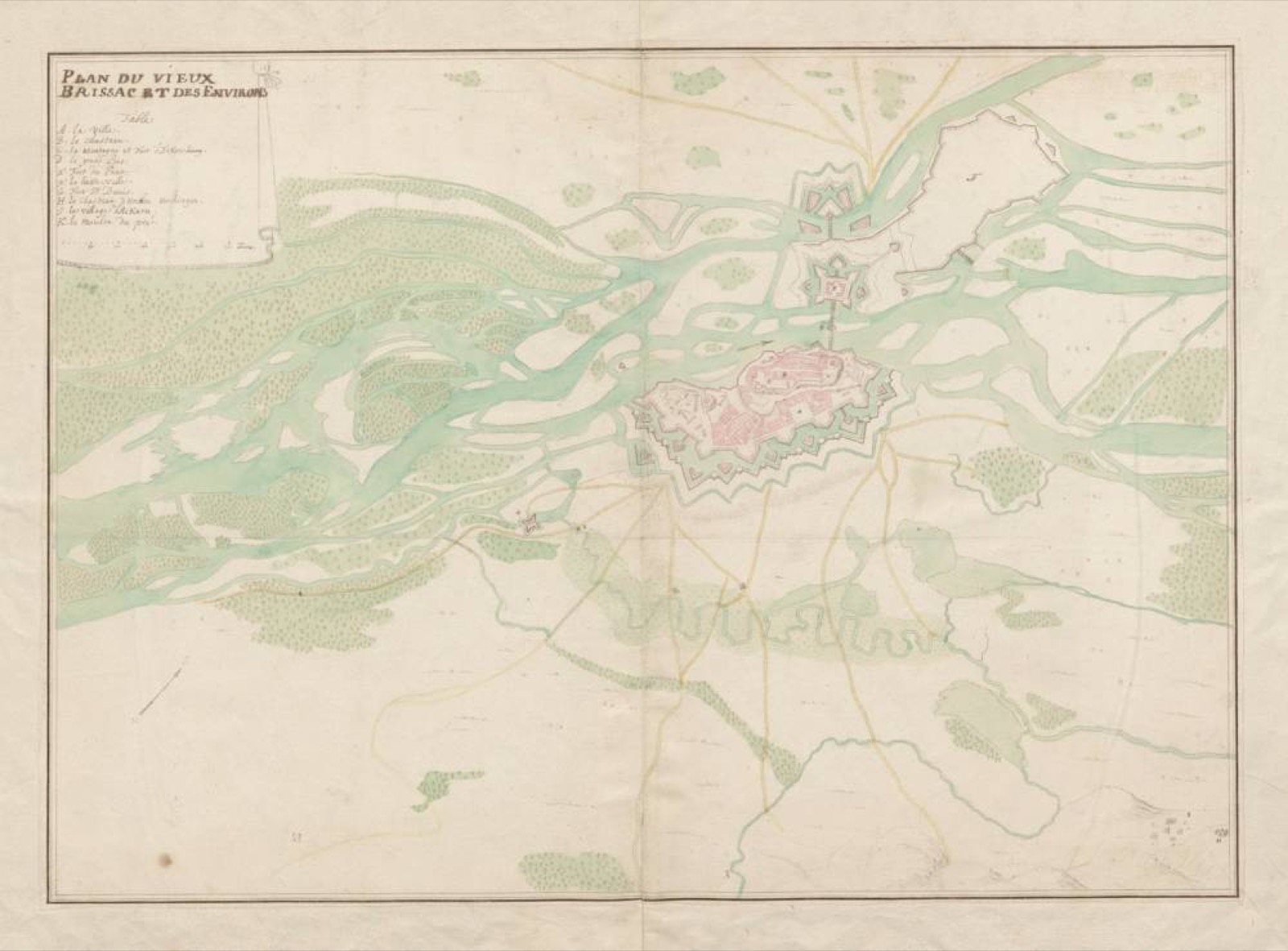
Plan du vieux Brissac et des environs
· State Archives of Baden-Württemberg (via Europeana)
CC BY


