Clan Rising
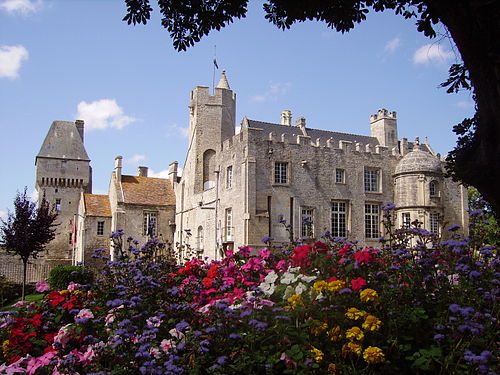
Château de la Madeleine today

France · Restored

Château de la Madeleine

Château de la Madeleine is a medieval hilltop castle in Chevreuse, Yvelines, Île-de-France. Built from the 11th century and altered through the 15th century, it preserves a stone keep, curtain walls with towers, machicolations and a gatehouse. The site is open to the public and is protected as a monument historique.

Photograph via Wikimedia Commons

Its prime

1483

Today

Restored

As it stood in 1483

What Château de la Madeleine looked like in its prime.

Perched on a wooded hill above the valley, the castle presents a long stone curtain wall interrupted by a sequence of tall blind arcades and crenellations. Two square towers anchor the eastern face toward the village; round towers (one semicircular, one with a small lookout turret) punctuate the ramparts. A high, steep red-tiled gabled roof covers the principal hall behind the curtain. The compact rectangular keep shows small 11th‑century openings on one side and larger 15th‑century windows on the other; machicolations run along the ramparts.

Its story

The story of Château de la Madeleine.

Construction of the Château de la Madeleine began between 1020 and 1090 under Guy I, lord of Chevreuse, on the hilltop that dominates the town; the name comes from the castle chapel, dedicated to Sainte Marie-Madeleine. Altered through the 15th century, it preserves its stone keep, curtain walls with towers, machicolations and gatehouse in a good state of preservation.

The castle changed hands in 1356: Ingerger le Grand, lord of Chevreuse and Amboise, taken prisoner by the English during the Hundred Years' War, was constrained to sell his domain to pay his ransom, and the buyer was the future Pierre de Chevreuse. Protected as a monument historique, the château is open to the public and now houses the offices of the Haute Vallée de Chevreuse regional natural park.

Step inside

11 places to explore in 1483.

The record describes 11 distinct spots at Château de la Madeleine, including 3 interiors: inner courtyard with 15th-century well (interior), chapel of sainte marie-madeleine (interior), rooms inside the keep (interior). Create your own photoreal reconstruction and explore every one, more scenes means more rooms, more angles, and more of the place to stand in.

Approach from the valley (exterior)East curtain and square towers (exterior)Gatehouse over the defended ditch and dam (exterior)Arcaded curtain wall (exterior close-up)Semicircular round tower and watch turret (exterior)Keep exterior showing early and later openings (exterior)Rampart walk and machicolations (exterior)Inner courtyard with 15th-century well (interior)Chapel of Sainte Marie-Madeleine (interior)Rooms inside the keep (interior)View from tower top over the valley (exterior)

Build Your Own Castle

Recreate Château de la Madeleine with AI to explore it.

The artist rebuilds it as it stood in 1483, a photoreal reconstruction that belongs to you alone. Pay with coins, no subscription needed.

Recreate this castle →Defend this castle →

Whose castle

Clans who held Château de la Madeleine.

The families that held Château de la Madeleine for a decade or more across its history, follow a name to its clan.

  • Chevreuse

    Held by the lords of Chevreuse from Guy I, who began the castle between 1020 and 1090; bought in 1356 by the future Pierre de Chevreuse.

Questions about Château de la Madeleine

What is the history of Château de la Madeleine?

Château de la Madeleine began as an 11th-century fortress built to protect Chevreuse from pillage. Construction began between 1020 and 1090 under Guy I, lord of Chevreuse, and the wooden palisade was replaced by stone curtain walls during the 12th century. The fortifications were improved under Charles V and Charles VI and completed under Louis XI; Jean Racine supervised alterations to the keep around 1661.

What is inside Château de la Madeleine?

Inside Château de la Madeleine are an inner courtyard with a 15th-century well, the Chapel of Sainte Marie-Madeleine and rooms in the keep. The castle’s modern park headquarters uses old rooms within the interior. The high court is open to visitors, while the lower court is divided into private plots.

Why was Château de la Madeleine built, and what is it used for?

Château de la Madeleine was built to defend Chevreuse against pillage. Its defensive role included a wooden palisade, later stone curtain walls, a moat and a dam that retained water for domestic use. The castle now houses the offices of the Haute Vallée de Chevreuse regional natural park.

Where is Château de la Madeleine?

Château de la Madeleine is in Chevreuse, in the Yvelines département of Île-de-France. It stands on a wooded hill above the Chevreuse valley and dominates the town. The castle is associated with the valley through which the Yvette flows.

When was Château de la Madeleine built?

Château de la Madeleine was built in phases from the 11th century through the 15th century. Construction began between 1020 and 1090, while the stone curtain walls replaced a wooden palisade during the 12th century. Later fortification work was completed under Louis XI, with the site's prime year given as 1483.

Which family or clan held Château de la Madeleine?

Château de la Madeleine was held by the lords of Chevreuse, beginning with Guy I, who started the castle between 1020 and 1090. In 1356, Ingerger le Grand sold his domain while imprisoned by the English during the Hundred Years’ War, and the future Pierre de Chevreuse bought it to pay the ransom.

What did Château de la Madeleine look like in its prime?

Château de la Madeleine has a long stone curtain wall with blind arcades and crenellations, anchored by two square towers facing the village. Round towers punctuate the ramparts, including a semicircular tower and one with a lookout turret. A compact rectangular keep has small 11th-century openings, larger 15th-century windows and surrounding machicolations.

Is Château de la Madeleine still standing or is it a ruin?

Château de la Madeleine is still standing and restored, rather than a ruin. Its stone keep, curtain walls, towers, machicolations and gatehouse survive in a good state of preservation. The keep was partially restored during the 19th century, and the last modifications were made in the 20th century.

Can you visit Château de la Madeleine?

Château de la Madeleine is open to the public. Visitors can access the high court, while the lower court is divided into private plots that are not open to the public. The castle also houses the offices of the Haute Vallée de Chevreuse regional natural park and is protected as a monument historique.
All castles of France · Castles of Europe · the best castles in Europe · explore the finished reconstructions.