Palace · France · Restored
Palace of Versailles
Château de Versailles
The Palace of Versailles is a grand royal château and complex in Versailles, France, that served as the principal residence and seat of government for the French kings from the late 17th century until 1789. The estate comprises the main palace building with many state apartments and ceremonial interiors, extensive formal gardens, the Grand and Petit Trianon, the Orangerie, canals and parterres.
First raised
1661
Its prime
1682
Today
Restored
As it stood in 1682
What Palace of Versailles looked like in its prime.
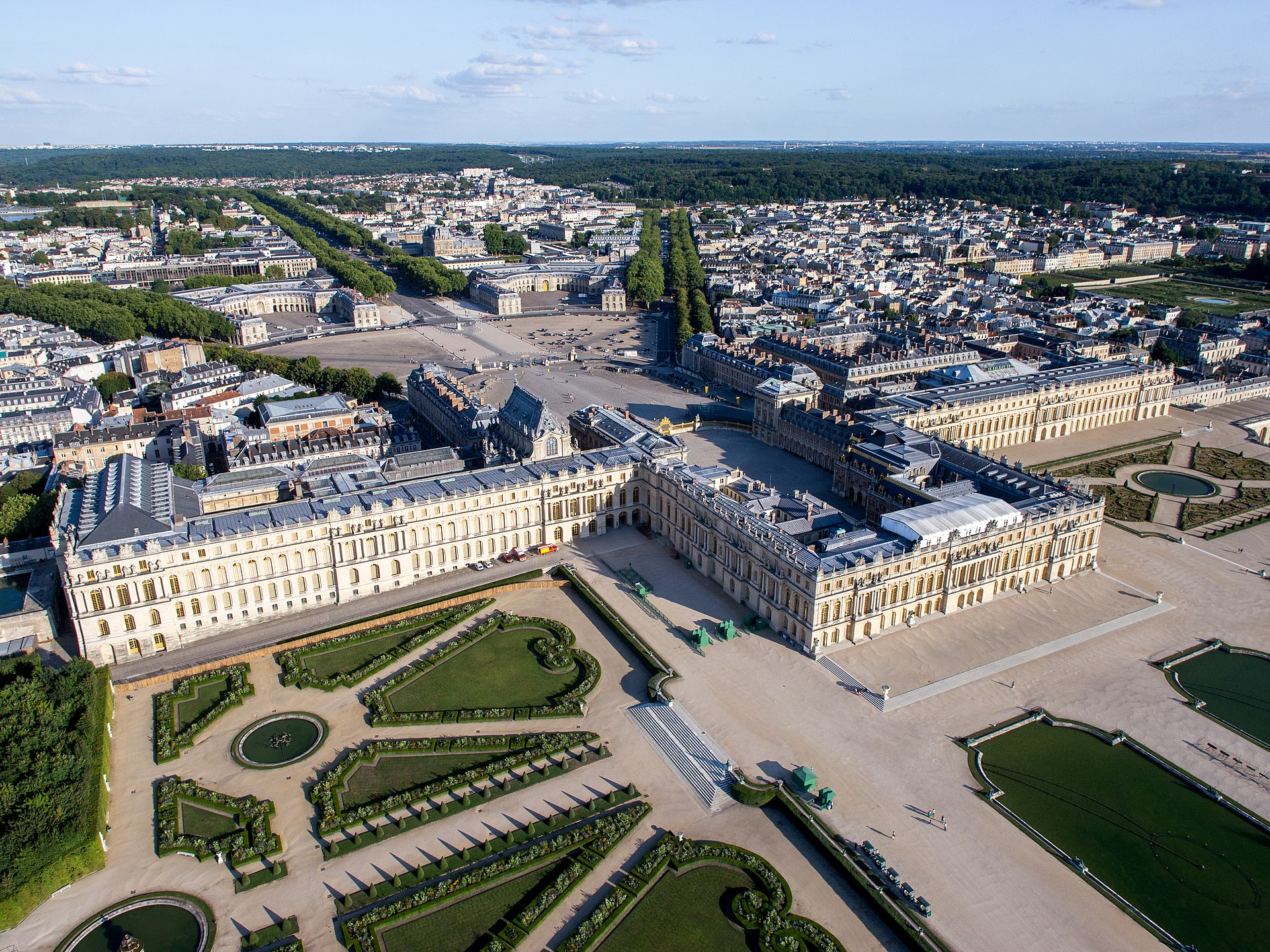
A vast, symmetrical classical stone palace with long, low façades punctuated by rows of tall, closely spaced windows and mansard roofs; central pavilions rise above the cornice and a long, central axis extends into the formal gardens. In front lies a broad gravel forecourt and geometric parterres with rectangular pools and clipped hedges; the complex of wings encloses courtyards and links to outlying pavilions, stables and avenues stretching toward a distant canal.
Its story
The story of Palace of Versailles.
Louis XIII's Hunting Lodge and the Day of the Dupes, 1623–1643
Louis XIII acquired part of the Gondi family's estate at Versailles in 1623 and bought the remainder in 1632. In 1623 he built a brick-and-stone hunting lodge about 35 metres long on the marshy site, sometimes mocked by contemporaries as the "chétif château", the puny château. On 11 November 1630 it was the setting of the Day of the Dupes, when Cardinal Richelieu regained the king's favour. Philibert Le Roy replaced the lodge with a château between 1631 and 1634, and after Louis XIII died in 1643 the estate was left to neglect.
Vaux-le-Vicomte, the Enveloppe and the Hall of Mirrors, 1661–1710
After Mazarin's death in 1661 Louis XIV ordered his father's château expanded into a palace. That August he attended a festival given by his Superintendent of Finances, Nicolas Fouquet, at Vaux-le-Vicomte; its scale and opulence led the king to imprison Fouquet in September and to recruit its makers, the architect Louis Le Vau, the gardener André Le Nôtre and the painter Charles Le Brun. In 1668–69 he decided to make Versailles a full royal residence, and from 1668 to 1671 his father's château was encased on three sides in the enveloppe, a mixture of styles Colbert called a "patchwork". Le Vau died in 1670 and his assistant François d'Orbay took over.
Jules Hardouin-Mansart was appointed First Architect in 1678. He added the Hall of Mirrors from 1678 to 1681 and raised two new wings for the court, at the south end from 1679 to 1681 and the north from 1685 to 1689. The Nine Years' War stopped work altogether from 1688 to 1698, and the palace chapel was built between 1699 and 1710.
The Court at Versailles, 1682–1789
The king, the court and the royal government lived at Versailles permanently from 6 May 1682 until 6 October 1789, apart from the Regency years of 1715 to 1723. By 1687 it was the de facto capital of France, and Louis XIV drew the nobility there to pursue prestige and royal patronage under a strict court etiquette, eroding their traditional provincial power bases. He received an embassy from the Ayutthaya Kingdom in 1686, and died at the palace on 1 September 1715. Louis XV and Louis XVI largely left the building as they inherited it; the Royal Opera, begun in 1748, was delayed by war until 1770. On 4 September 1783 Spain and France signed treaties with Britain here that formally ended the American Revolutionary War.
The Women's March and the Auction of the Contents, 1789–1794
The king and queen were at Versailles when they learned of the storming of the Bastille on 14 July 1789, and stayed isolated there as the Revolution spread. On 5 October several thousand men and women, protesting the price and scarcity of bread, marched from the markets of Paris, took weapons from the city armoury, besieged the palace and compelled the king, the royal family and the members of the National Constituent Assembly to return to Paris with them the next day.
The palace was closed as soon as the royal family left. In 1792 the National Convention ordered its paintings and sculptures moved to the Louvre; in 1793 it declared the monarchy abolished and sent the royal property to auction, and between 25 August 1793 and 11 August 1794 the contents went in seventeen thousand lots. Royal emblems were chiselled off the buildings, and the grand apartments were opened to visitors from 1793.
Museum, German Occupation and Public Establishment, 1833–2024
Louis Philippe I began the Museum of the History of France, dedicated to "all the glories of France", in 1833 and inaugurated it on 30 June 1837; the project largely halted when he was overthrown in 1848. During the Franco-Prussian War the palace was occupied by the general staff of the German Army, and parts of it, including the Hall of Mirrors, were turned into a military hospital; the German Empire was proclaimed in that hall on 18 January 1871. The Germans remained until the armistice that March, when the new Third Republic's government moved in and the National Assembly met in the Opera House. The Treaty of Versailles was signed in the Hall of Mirrors in June 1919.
Restoration began under Pierre de Nolhac, the first conservator, in 1892; John D. Rockefeller Jr gave $2,166,000 between 1925 and 1928, and from the 1950s the director Gérald van der Kemp set out to return the palace as nearly as possible to its state in 1789, buying back its original furnishings. Classified a historical monument in 1906 and inscribed as a World Heritage Site, it is owned by the French state and run since 1995 as a public establishment under the Ministry of Culture. The Senate and National Assembly still meet in joint session here to amend the constitution, as they did in March 2024.
Step inside
12 places to explore in 1682.
The record describes 12 distinct spots at Palace of Versailles, including 6 interiors: hall of mirrors (galerie des glaces), royal chapel, ambassadors' staircase (ceremonial stair) and more. Create your own photoreal reconstruction and explore every one, more scenes means more photos, more angles and more of the immersive experience.
Build Your Own Castle
Recreate Palace of Versailles with AI to explore it.
The artist rebuilds it as it stood in 1682, a photoreal reconstruction that belongs to you alone. Pay with coins, no subscription needed.
Recreate Palace to Explore →Whose seat
Families who held Palace of Versailles.
The families tied to Palace of Versailles across its history, follow a name to its page.
Bourbon
Principal residence of the Bourbon kings Louis XIV, Louis XV and Louis XVI from 1682 until 1789.
Nearby


