France · Ruin
Château des Baux
The Château des Baux is a ruined fortified castle perched on a limestone plateau above the village of Les Baux-de-Provence in southern France. Built from the 10th century, it was a major stronghold in the medieval period and today survives as extensive ruined walls, terraces and rock-hewn chambers open to visitors.
Its prime
1450
Today
Ruin
As it stood in 1450
What Château des Baux looked like in its prime.
Perched on a pale limestone rocky outcrop, the fortress is dominated by a large rectangular keep set near the highest point and a shorter cylindrical tower to one side; broad curtain walls run along the cliff edges, enclosing terraced paved courtyards and stepped platforms. Many chambers and openings are cut directly into the rock face; rooflines would have been mostly flat or low-pitched stone, with continuous walks along the ramparts.
Its story
The story of Château des Baux.
Origins Above Les Baux, from the Late 10th Century
The rock above Les Baux had already served as a refuge in the Neolithic period, and a castrum called Balcium is recorded there by 975; the fortress that grew from it probably dates to the 10th to 12th centuries, with a rectangular keep added in the 13th. From it the lords of Baux ruled the fortress and the small town it protected for five hundred years, through the ceaseless conflicts that ravaged Provence, and the most celebrated troubadours of the age sang songs of courtly love there to the maidens of the house.
The Baussenque Wars, 1142–1162
Through the 12th and 13th centuries the power of the ruling family made Baux a place of weight in both the culture and the politics of medieval Provence, though local wars struck it repeatedly, notably the Baussenque Wars, fought between 1142 and 1162 over the succession to Provence.
Raymond de Turenne's Siege, 1393
From 1372 to 1399 the effective lord of Baux was Raymond de Turenne, uncle of Alix des Baux, whose private war against the county of Provence and the Avignon papacy provoked Marie de Blois, regent of Naples, to send the admiral Jean de Vienne against the castle. On 7 June 1393 Jean de Vienne arrived beneath its walls with 6,000 men; Arles sent twenty-five lances and twenty-five crossbowmen, paying for them with a loan of 250 gold florins from the city's Jewish community, and the Estates of Provence, meeting at Aix on 1 August 1393, put a price of 10,000 gold florins on Turenne's head, dead or alive.
In mid-September three timber towers roughly fifty metres high, built at Tarascon and armoured with ox-hide like battering rams, were set up at three points around the rock, to shield the besieging troops and to cut off men and supplies to Les Baux; by early October the siege had settled into a blockade. Francesco di Marco Datini's correspondent in Avignon complained that the pope's men-at-arms "are still around Les Baux, doing nothing." The siege was lifted before winter. On 13 December 1393 Pope Clement VII, from Avignon, excommunicated Turenne as an "ungrateful son spitting in the face of the Church" and denounced him and his men as thieves and public plunderers, but the French crown protected him: the royal council married his daughter Antoinette to Marshal Boucicaut in the castle's own chapel on 23 December 1393.
Absorption into France and the Fortress's End, 1426–1632
Baux passed to the county of Provence in 1426, and Provence itself was permanently united to the kingdom of France in 1486; by 1528 the château was administered by the Constable of Montmorency. The wars of religion struck the town again between 1562 and 1598, and in 1632 the fortress was pulled down on the orders of Louis XIII.
Listed Ruins Since 1875
The enclosure walls and towers (the Sarrazine, Paravelle and Bannes towers) the keep, its outbuildings and the former chapel of Sainte-Catherine were listed as monuments historiques in 1875 and confirmed by decree on 9 June 1904. Full-scale replicas of medieval siege engines (a couillard, a bricole, a ballista and the largest trebuchet in Europe) stand on the ruined plateau; the trebuchet is fired in demonstrations several times daily between April and September.
Step inside
7 places to explore in 1450.
The record describes 7 distinct spots at Château des Baux, including 1 interior: rock-cut chambers and façades. Create your own photoreal reconstruction and explore every one, more scenes means more rooms, more angles, and more of the place to stand in.
Build Your Own Castle
Recreate Château des Baux with AI to explore it.
The artist rebuilds it as it stood in 1450, a photoreal reconstruction that belongs to you alone. Pay with coins, no subscription needed.
Recreate this castle →Defend this castle →Whose castle
Clans who held Château des Baux.
The families that held Château des Baux for a decade or more across its history, follow a name to its clan.
Baux
The lords of Baux ruled the fortress and town for five hundred years from the 10th century.
From the archive
Château des Baux on paper: the measured plan and period views.
The survey plan and photographs below are the ground truth this page's reconstructions are checked against, drawn and photographed while the castle was still a working garrison. Every image is public-domain or openly licensed, with its source named.
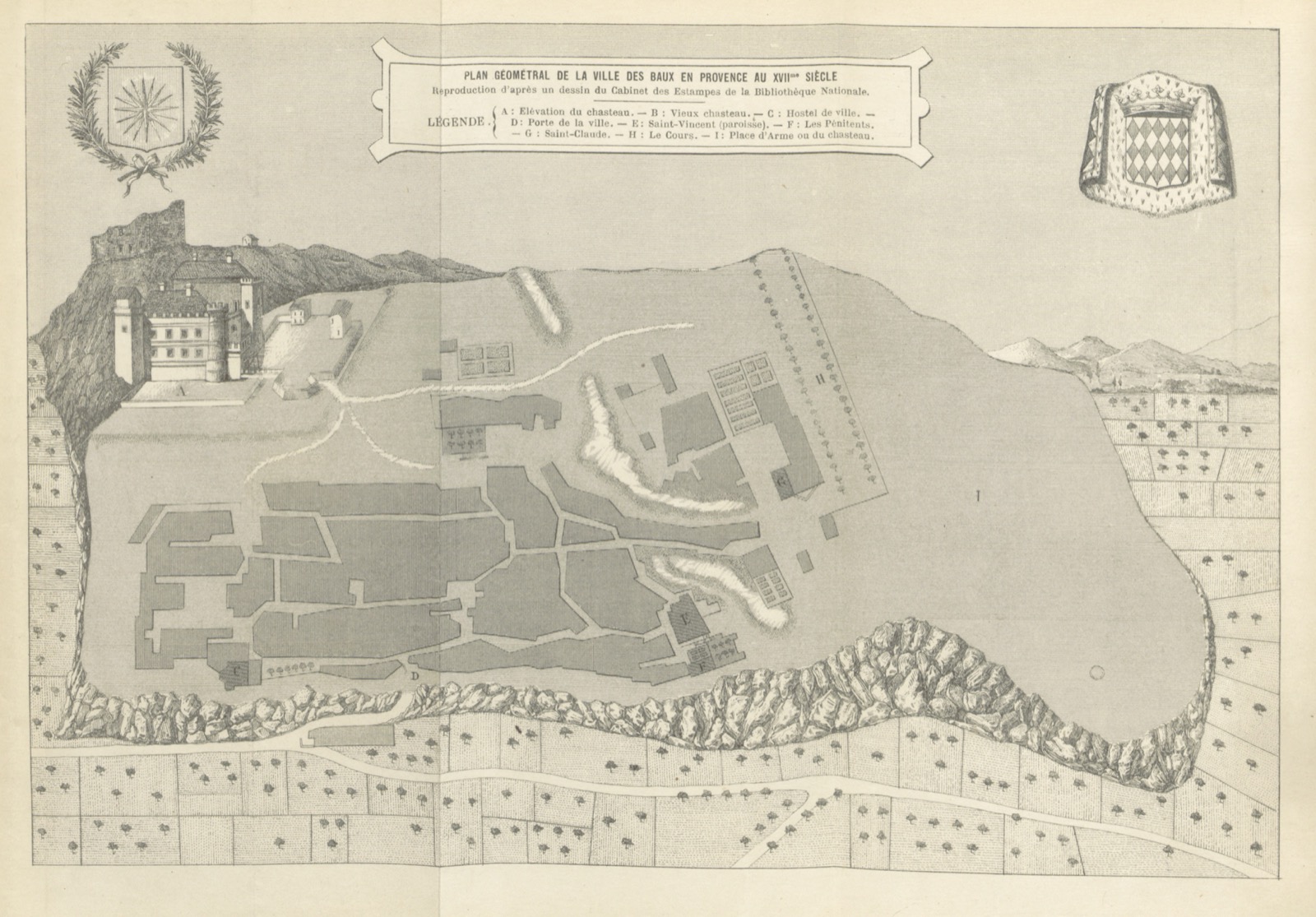
map from "La Ville des Baux et ses seigneurs".
1882 · The British Library (via Europeana)
Public domain
Nearby