Germany · Restored
Altena Castle
Burg Altena
Altena Castle is a medieval hill castle built on a rocky spur above the Lenne in Altena, North Rhine-Westphalia, established in the early 12th century by the Counts of Berg. It later served administrative and military roles, was reconstructed in the early 20th century, and today functions as a restored historic site with a museum and a youth hostel.
First raised
1100
Its prime
1108
Today
Restored
As it stood in 1108
What Altena Castle looked like in its prime.
Perched on a wooded spur above the Lenne, the castle is a long stone complex of grey masonry with a continuous curtain wall and outer bailey descending the ridge. Two prominent cylindrical towers rise above the inner ward: a taller central keep and a slightly lower round tower, joined by ranges of steep slate roofs and dormered residential blocks. The inner courtyard is broad and paved, with low gatehouses and connecting stone walks hugging the hillside, all built of local grey stone.
Its story
The story of Altena Castle.
Wulfeshagen on the Klusenberg, about 1108–1161
Tradition holds that around 1108 the brothers Adolf and Everhard von Berg were given a stretch of land in the Märkisch Sauerland by Emperor Henry V for loyal service, and raised a castle on the Wulfseck which they first called Wulfeshagen and later Altena. It is one of at least three legends of the county's founding. The castle stands on a spur of the Klusenberg above the Lenne, and it has been supposed that it was put there to guard and exploit the region's important iron trade.
The first Count of Altena traceable in a charter is Eberhard I of Berg-Altena, a son of Adolf II of Berg, recorded in 1161; the castle was the seat of his county.
From Seat of the County to the Bailiff's House, 1170–1455
Eberhard's son Friedrich von Berg-Altena acquired the lordship of Mark near Hamm at some point between 1170 and 1198, and Friedrich's son Adolf I moved his permanent residence to Burg Mark there around 1202. The county styled itself Altena-Mark, then simply the County of Mark. The ancestral castle was afterwards held mostly by drosts, administrators and at times by junior comital lines, and from 1392 served only as the bailiff's seat.
On 20 December 1367 Count Engelbert III of the Mark granted the small settlement at the foot of the hill its liberties, among them self-government and freedom from tolls. In 1455 the castle burned down, and was only partly rebuilt.
Garrison, Criminal Court and Almshouse, 1609–1906
The Jülich-Cleves succession dispute brought a Brandenburg garrison into the castle in 1609. An invalids' house followed in 1670, and from 1766 to 1811 the criminal court and prison of the County of Mark occupied part of the buildings. In 1771 the castle was demilitarised for good and the garrison dissolved; the town of Altena bought the empty portions and ran a poorhouse and orphanage there until 1840.
In 1797 Johann Caspar Rumpe, an Altena needle manufacturer and mayor, was given leave to take stone from the castle for his own house. A romantic neo-Gothic rebuilding drawn up in 1835 by the building inspector Friedrich August Ritter, for the Prussian Oberpräsident Ludwig Freiherr von Vincke, was not carried out for want of money. In 1842 the town gave its shares in the castle to King Frederick William IV, who wanted it kept as a historical monument and decided the following year that its surroundings should become a public park; the garden architect Maximilian Friedrich Weyhe began the work and his son Joseph Clemens finished it in 1852. The Order of St John then opened a hospital in the buildings in 1856 under Arnold Ludwig von Holtzbrinck, which ran until 1906.
Thomée's Reconstruction and the First Youth Hostel, 1907–1934
With the 300th anniversary of the County of Mark's attachment to Brandenburg-Prussia approaching, Fritz Thomée, Landrat of the Kreis Altena, pressed to have the castle rebuilt as a gathering point for the people of the Mark. The architecture professor Georg Frenzen was handed the planning, and the Märkischer Burgverein founded to raise funds. Work began in 1907 and a public quarrel broke out over it: the art patron Karl Ernst Osthaus and the historian Hermann Ehrenberg held that Frenzen's designs, which overlaid the medieval and early modern fabric, put the castle's authenticity at risk, and argued for conserving the ruin. On 29 August 1907 the plans were laid before Kaiser Wilhelm II at an audience in Münster; he called the scheme an artistically patriotic deed, and the argument was settled in Thomée's favour. The rebuilding was largely done by 1914, apart from the outer bailey and lower gatehouse, and the last works were completed in 1918.
Also in 1914 the schoolteacher Richard Schirrmann founded in the castle the world's first permanent youth hostel, and with it the German Youth Hostel Association. The castle opened in 1915 with the Museum of the County of Mark, which Thomée had devised; Schirrmann's original rooms are a museum in their own right today, the hostel having moved to the lower castle courtyard in 1934.
Kreis Ownership, National Monument Status and the Rock Lift, 1943–2019
The castle passed to the then Kreis Altena in 1943, and the permanent museum display still in place was conceived in 2000. In 2007 the Federal Government Commissioner for Culture and the Media classed the castle a monument of national importance.
A lift opened on 26 April 2014, rising 60 metres through the rock from the foot of the Klusenberg to the castle yard. The Märkischer Kreis, which owns the castle, restored its gates between 2016 and 2018; in December 2018 the LWL heritage service named them monument of the month for Westphalia-Lippe. Part of the castle is let as a restaurant; until 2019 a medieval festival was held in castle and town each August.
Step inside
10 places to explore in 1108.
The record describes 10 distinct spots at Altena Castle, including 3 interiors: residential range facing the courtyard, private chamber (original rooms), service range now used for dining (service wing). Create your own photoreal reconstruction and explore every one, more scenes means more rooms, more angles, and more of the place to stand in.
Build Your Own Castle
Recreate Altena Castle with AI to explore it.
The artist rebuilds it as it stood in 1108, a photoreal reconstruction that belongs to you alone. Pay with coins, no subscription needed.
Recreate this castle →Defend this castle →Whose castle
Clans who held Altena Castle.
The families that held Altena Castle for a decade or more across its history, follow a name to its clan.
The early Counts of Berg erected the castle around 1108, before the house moved its residence to Hamm.
von der Mark
Seat of the counts who from 1198 styled themselves Counts of the Mark; from 1392 Altena housed only their county bailiff.
From the archive
Altena Castle on paper: the measured plan and period views.
The survey plan and photographs below are the ground truth this page's reconstructions are checked against, drawn and photographed while the castle was still a working garrison. Every image is public-domain or openly licensed, with its source named.
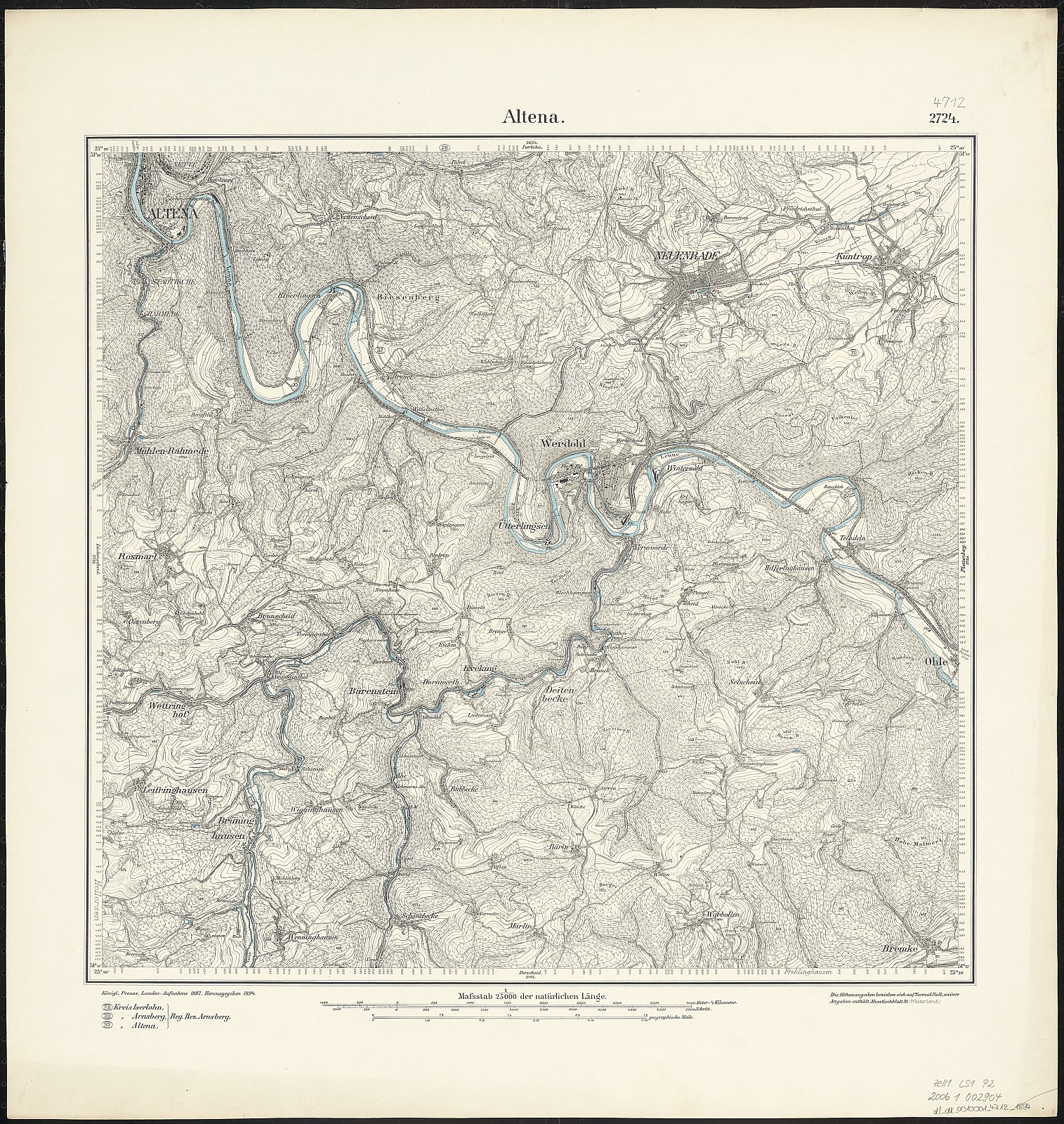
Measuring table sheet 2724: Altena, 1894
· Deutsche Fotothek (via Europeana)
CC BY-SA