
Germany · Restored
Berwartstein Castle
Burg Berwartstein
Berwartstein Castle is a medieval rock castle in the Wasgau (southern Palatinate Forest) of Rhineland-Palatinate, Germany. Much of its accommodation, stairways and passages are cut directly into a narrow sandstone cliff; the site includes a deep rock-cut well, a vaulted great hall and an outwork tower called Little France across the valley. The present visible fabric is a restoration of the original medieval stronghold.
First raised
1101
Its prime
1480
Today
Restored
As it stood in 1480
What Berwartstein Castle looked like in its prime.
A compact complex of rough grey-brown sandstone buildings and defensive walls built directly onto and into a narrow, almost vertical cliff about 45 metres high, with rock-hewn rooms, corridors and stairways visible where masonry meets raw bedrock. The castle reads as stacked stone chambers and short curtain walls tucked into the cliff face, dominated by a distinctive vertical entrance shaft on the southeast side and backed across the valley by a single stone observation tower (Little France). Interiors include a cross-vaulted great hall set into the rock.
Its story
The story of Berwartstein Castle.
Barbarossa's Grant and the Fall of the Berwartsteiner, 1152–1345
No record survives of who raised the Berwartstein or where its name came from. It enters the written record in 1152, in a document by which Emperor Frederick Barbarossa granted the castle to Bishop Günther of Speyer, and from that grant it is assumed to have begun as an imperial castle among the fortifications of the Salian and Hohenstaufen rulers, whose ancestral lands lay in south-western Germany. It belongs, with the Drachenfels and the Dahn group, to the three prime examples of the Wasgau rock castles, where the stairs, passages and chambers are cut out of the standing sandstone; at the Berwartstein those spaces run through the great rock of the upper castle as a cave system. In the castle's early years the only way in was the Aufstiegskamin, a natural chimney in the south-east face of the crag. A portable wooden stair or rope ladder was set into it and hauled up again when attack came, leaving the entrance to be held by a single man supplied with boiling sap, oil or liquid to pour on anyone climbing. A shaft two metres across was driven by hand vertically through the rock to the water-bearing layer of the valley floor, which guaranteed the water supply under siege.
In the 13th century a family named after the castle appears, holding it as ministerials of the bishops of Speyer. Robbery was laid to their charge, and the imperial cities of Strasbourg and Hagenau combined against them. After five weeks before the rock their troops took the Berwartstein and broke it, an assault that Bernhard Hertzog places in 1314 and that is said to have succeeded with a traitor's help. A large quantity of booty and about thirty prisoners were carried off to Strasbourg, and the knights of Berwartstein were permitted to buy their men back for a heavy ransom. The castle, or what was left of it, stayed in Berwartsteiner hands until the line died out in 1345.
Weissenburg Abbey and the Elector Palatine, 1347–1480
The castle passed to the related lords von Weingarten, the brothers Ort and Ulrich, who in 1347 sold it and its appurtenances to the abbey of Weissenburg for 800 gulden. Because the Berwartstein was an imperial fief the sale required confirmation from above, and Emperor Louis the Bavarian confirmed it in 1347, King Charles IV in 1348. The abbey placed the castle in stewardship under a feudal arrangement that allowed it to dismiss a vassal who grew too presumptuous.
In 1453 the monastery put itself under the protection of the Elector Palatine, a bargain that carried with it the Öffnungsrecht, the protector's right to use the abbey's castles free of charge in time of war. In 1472 the Eckbrechte von Dürkheim seized the Berwartstein in a feud, held themselves its owners by right of war and sold it at once to the Elector. The Elector's dynastic ambition ran to bringing the whole Weissenburg estate under his hand, and against the continuing protest of the monastery, which still counted itself the owner, Elector Philip the Upright in 1480 made the castle over in hereditary fief to his marshal Hans von Trotha, who appears in the records more often as Hans von Dratt.
Hans von Trotha and the Water Feud
Trotha was Marshal and Commander-in-Chief of the Palatinate forces, and he carried a grudge of his own against Weissenburg: years earlier Abbot Heinrich von Homburg had imposed a church fine on his brother, Bishop Thilo. The experienced warrior turned first to the castle, raising strong ramparts and bastions, and under his lordship the Berwartstein acquired its myth of impregnability. In 1484 he had an outwork built on a spur of the Nestelberg 370 metres away to the south, across the valley from the main castle, with a tower fourteen metres thick; it came to be known in local speech as Klein-Frankreich, Little France. The tower was an observation post and a fighting position that caught attackers in the valley in a crossfire between itself and the castle, and the open ground below still bears the name Leichenfeld, Corpse Field, for the fighting there.
The following year the Elector made over the castle's appurtenances as well. The abbey protested violently, and Trotha thereupon dammed the nearby Wieslauter, cutting off the water of Weissenburg eight kilometres downstream. After the expected complaints from Abbot Heinrich, who held office from 1475 to 1496, the knight had the dam torn out and sent a heavy flood down on the town. The monastery asked Pope Innocent VIII to place him under the ban of the Church, and Innocent's successor Alexander VI did so in 1499, fourteen years after the water feud. To avoid falling under the ban himself, Trotha's patron the Elector had to disavow his own man; already in 1496 Maximilian I, King of the Romans and later Emperor, had seen himself forced to declare the knight under the imperial ban. None of it troubled Trotha up to his death in 1503, and two years afterwards all the sanctions against him were lifted posthumously. Under the garbled popular form of his name, Hans Trapp, he passed into the legend of the region, and the events of the water feud are pictured in the castle's Rittersaal.
Lightning, Ruin and the Waldenburgs, 1545–1793
When Trotha's son Christoph died in 1545 without male heirs, the castle went to his son-in-law Friedrich, of the house of Fleckenstein, and remained in that family's hands for three generations. In 1590 it burned out after a lightning strike and was left a ruin; no attack is recorded against it. The main sections of the castle survived the fire, but it stood empty and unused for many years.
As a ruin it stayed with the Fleckenstein-Niederrödern line until that line died out in 1637, when the fief fell back to its lord. Baron Gerhard von Waldenburg, known as Schenkern, a favourite of Emperor Ferdinand III, was enfeoffed with the Berwartstein, Grafendahn and their appurtenances in 1641; the castle was named again in the Peace of Westphalia of 1648. Since he did not restore it, the ruin decayed further. The Waldenburgs held the lordship until 1793. Klein-Frankreich was heavily damaged in the course of the 17th century, either in the Thirty Years' War or in the War of the Palatine Succession.
Baginski's Rebuilding and Wadlé's Repairs, 1893–2005
The ruin changed owners repeatedly before it came in 1893 to Theodor von Baginski (1845–1929), a captain, who had the Berwartstein rebuilt and extended within two years (for the most part not faithfully to the original), and lived there from 1899. In 1922 it was sold to Aksel Faber of Copenhagen, passing into foreign ownership. Faber was seldom in Germany and asked Alfons Wadlé to act as his steward; Wadlé was later able to buy the castle himself.
Erlenbach, the village below the rock, was completely destroyed during the Second World War, and its inhabitants sought shelter in the castle. After the war the roof was gone, along with the woodwork of the windows, doors and staircases. No outside money came for the repairs, and Wadlé set about the renovation himself, at first doing only what was essential to protect the castle from the weather.
The partly restored Berwartstein is in private ownership and still serves as a dwelling, the only castle in the Wasgau that is still inhabited, and it is registered as a protected monument. It is also the only castle in the Palatinate that was rebuilt and re-inhabited after its destruction, though the buildings are in large part an addition of the 1890s restoration rather than the original rock castle. The site is now officially declared the Wohnplatz Berwartstein, castle and inn; the Rittersaal is used as a restaurant but is freely accessible. Work on restoring the remains of Klein-Frankreich began in 2005.
Step inside
8 places to explore in 1480.
The record describes 8 distinct spots at Berwartstein Castle, including 3 interiors: great hall (rittersaal) with cross-vaulting, hewn vertical lift shaft connecting kitchen and hall, rock-hewn corridors and underground passages. Create your own photoreal reconstruction and explore every one, more scenes means more rooms, more angles, and more of the place to stand in.
Build Your Own Castle
Recreate Berwartstein Castle with AI to explore it.
The artist rebuilds it as it stood in 1480, a photoreal reconstruction that belongs to you alone. Pay with coins, no subscription needed.
Recreate this castle →Defend this castle →Whose castle
Clans who held Berwartstein Castle.
The families that held Berwartstein Castle for a decade or more across its history, follow a name to its clan.
Berwartstein
Feudal tenants carrying the name von Berwartstein held the castle in the 13th century, using it as a robber-baron base.
Trotha
Held by the knight Hans von Trotha, castellan of the Berwartstein, and inherited by his son Christoph.
Fleckenstein
Passed to Christoph von Trotha's son-in-law Friedrich von Fleckenstein and remained in the family's hands for three generations.
Waldenburg
Granted to Baron Gerhard von Waldenburg, known as Schenkern, in the Peace of Westphalia, 1648.
From the archive
Berwartstein Castle on paper: the measured plan and period views.
The survey plan and photographs below are the ground truth this page's reconstructions are checked against, drawn and photographed while the castle was still a working garrison. Every image is public-domain or openly licensed, with its source named.
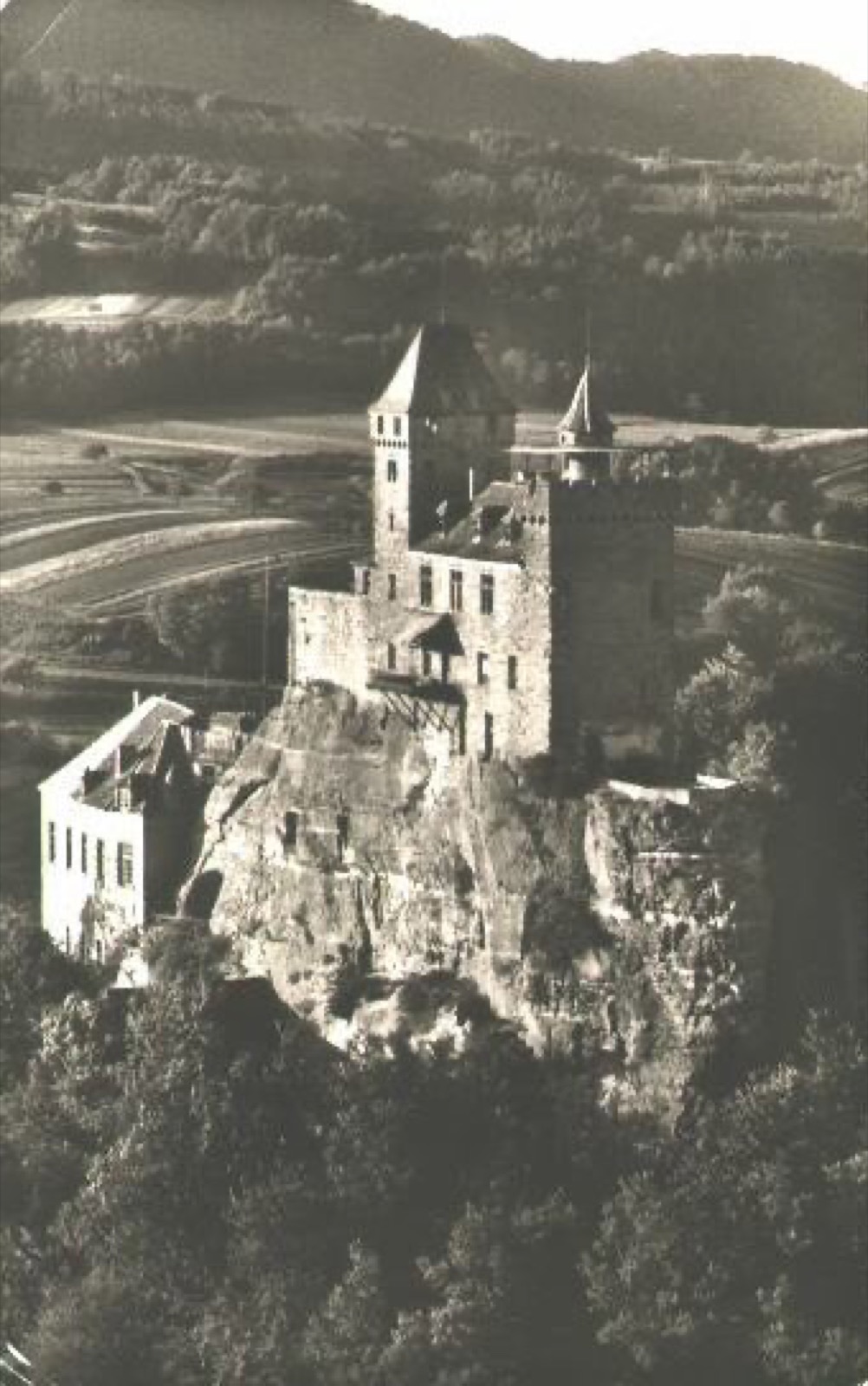
Berwartstein
· Badisches Landesmuseum Karlsruhe (via Europeana)
CC0 (no rights reserved)


