
Germany · Restored
Rochlitz Castle
Schloss Rochlitz
Rochlitz Castle (Schloss Rochlitz) is a historic hill-top palace in Rochlitz, Saxony, built on a medieval imperial site and remodelled into a margravial schloss from the 14th century onward. The complex includes a main palace on a rocky spur, two prominent towers, and lower baileys including the Vorburg with St. Peter's Church; today the castle houses a museum.
First raised
1095
Its prime
1500
Today
Restored
As it stood in 1500
What Rochlitz Castle looked like in its prime.
Perched on a rocky spur above the Zwickau Mulde, the palace presents a long rectangular main block of pale ashlar and rubble with several Romanesque wings and a steep pitched roofline. Two prominent, square tower-cores rise from the western end, each capped by steep, pointed slate roofs. Curtain walls descend the hill to flanking lower baileys; the eastern lower bailey holds St. Peter's Church. Materials read as light grey-brown masonry with slate roofing; overall the site is a continuous fortified-palatial silhouette.
Its story
The story of Rochlitz Castle.
The Burgward of Rochlitz, 981-1046
In the middle and late Slavic period the height above the Zwickau Mulde was the centre of the small Slavic district of Rochlitz. Archaeological finds suggest that a rampart fort of the 9th and 10th centuries stood on the Nosswitz castle hill immediately west of the present schloss, forerunner of the German castle and later reused as the western outer bailey. The land on the Mulde probably came under German rule under King Henry I, and in the second half of the 10th century a Burgward was established with the castle of Rochlitz at its centre. Before 981 the bishopric of Merseburg founded St Peter's church in the eastern suburbium as the mission and parish church for the whole Burgward. Rochlitz first appears in writing in 995, in a charter of Emperor Otto III which, after the dissolution of the see of Merseburg, fixed the Zwickau Mulde as the boundary between the dioceses of Naumburg and Meissen.
Around the year 1000 the castle and its surrounding country, certainly imperial property to begin with, passed as an allodial holding to Margrave Ekkehard of Meissen. When his sons Count Hermann (1009 to about 1031/32) and Ekkehard II quarrelled with their uncle Margrave Gunzelin over the inheritance, Gunzelin set fire to the urbs Rochelenzi in 1009; the entry recording that feud in the chronicle of Bishop Thietmar of Merseburg is also the first direct mention of the castle. In May 1018 Thietmar travelled in person into the south-eastern part of his diocese and took the property of the Merseburg church around Rochlitz back into his care, most probably performing confirmations in St Peter's. In 1046 the Ekkehardine holdings reverted to the empire and King Henry III grouped them with the rest of the imperial estate on the Mulde, which alongside Rochlitz took in the Burgwards of Colditz, Leisnig, Polkenberg and Döben. In the same year Henry granted his wife Agnes the possessions he had inherited from Margrave Ekkehard, among them property in burchwardo Rochidez.
Salian Reichsburg to the Siege of 1223
In the second half of the 11th century Rochlitz grew into a significant Salian imperial castle, and at least two stays by kings and emperors are documented there. Henry III issued charters at Rochlitz, and his son King Henry IV did so on 28 October 1068, actum Rochlezi. A donation charter of Henry IV dated 1074, by which he is said to have transferred the castellum Rochedez cum adiacente pago similiter nominato to the bishopric of Naumburg, is disputed: the diploma appears to have been redrawn in the second half of the 12th century and falsified in the process.
In 1143 Margrave Conrad I of Meissen received the castle and the land of Rochlitz, the provincia Rochelez, outright by gift of King Conrad III. With that the castle came to the House of Wettin, which held it until 1918. After Conrad abdicated in 1156 and withdrew to the Augustinian collegiate house on the Petersberg near Halle, the inheritance was divided among his five sons. The county of Rochlitz went, together with the county of Groitzsch that the Wettins had only partly secured in 1135, to Dedo V the Fat. He styled himself count of Groitzsch, comes de Groiz, but probably resided at Rochlitz rather than at the castle now called the Wiprechtsburg. Under his rule the Rochlitz country was opened up for settlement, and shortly after 1160 the monastery of Zschillen was founded in proprio suo videlicet pago Rochelez in ripa Milde fluminis. Below the castle Dedo, or one of his sons Dietrich and Conrad, founded the chartered town of Rochlitz with its town church of St Kunigunde.
The castle itself housed an evidently substantial court: a Henricus burggravius de Rochlitz and several castrenses de Rochlitz appear in 1208, and a Heinricus de Rocheliz is on record in 1198. Two residential towers and the palas of the south wing survive from those decades. When the Rochlitz line died out in the male line the county fell back in 1210 to the main Wettin line and was reincorporated into the March of Meissen by Margrave Dietrich of Meissen; Rochlitz remained an important fortified point within the Wettin lordship and the seat of the Rochlitz Amt, though its standing is thought to have slipped overall. In 1223 the Thuringian landgrave Louis IV took the castle, building a siege castle against it and bringing up a trebuchet.
Captive Landgraves and William the One-Eyed, 1286-1430
Between 1286 and 1291 the count palatine Frederick of Saxe-Lauchstädt kept his residence at Rochlitz, and in 1288 he held his own father, Landgrave Albert II the Degenerate, prisoner there. Between 1296 and 1298 the castle belonged briefly to the empire once more. In 1298 Frederick, count palatine and margrave, returned from his exile in Tyrol; Meissen troops took the castle and captured the king's governor for the March of Meissen, Henry of Hesse, a cousin of the king. Frederick the Serious held court at Rochlitz in 1325 and again in 1329.
Rochlitz flourished again under the brothers Frederick, Balthasar and William, who ruled jointly. In the last quarter of the 14th century Margrave William I the One-Eyed had an ambitious Gothic castle raised there, comparable with the Vorderschloss he built at Mildenstein, though he made little use of it himself: the Fürstenhaus went up between 1375 and 1380, the two towers known as the Jupen around 1390, and the transverse house with its chapel and the south wing were rebuilt. First called a sloss around 1370, the margravial seat served as one of the principal payment offices of the margraviate, as the financial archive of the Freiberg mining clerks, and from 1384 as the court venue of a Landfrieden. When Hussite raiders came in 1430 both town and castle had to be defended; the town fell, the castle was held.
Banished Princes, Dowager Duchesses and Grand Masters, 1436-1611
Duke Sigismund, deposed as bishop of Würzburg, had already spent a long stay at Rochlitz in 1436 before living out a banishment there in a style befitting his rank. The castle served for a time in 1457 as the schoolroom of the princes Ernst and Albert, and in 1477 of Frederick, later called the Wise, and John the Steadfast. Between 1477 and 1480 it was rebuilt again into a festes Schloss, and from 1481 to 1501 Duchess Amalia of Saxony, widow of Duke Louis the Rich of Bavaria-Landshut and sister of Ernst and Albert of Saxony, kept her residence there. The castle chapel was remodelled about 1480 and St Peter's rebuilt in 1470/99.
From 1507 to 1510 Rochlitz was the residence of Frederick of Saxony, Grand Master of the Teutonic Order. In 1511 Margrave Albert of Brandenburg-Ansbach, of the Franconian line of the Hohenzollern, was received into the Teutonic Order at Zschillen and elevated the next day at Rochlitz as Frederick's successor in the grand mastership. A cultural high point came between 1537 and 1547, when the dowager duchess Elisabeth of Hesse, a decisive patron of the Reformation in Saxony, took her seat in the castle. Elector Christian I followed from 1586 to 1591 and the dowager electress Sophie from 1591 to 1611; in all, members of the Saxon princely house made Rochlitz their residence eight times. In those years the complex was converted into a hunting lodge, the Fürstenhaus reworked in 1537/47 and again from 1586 and the Kleines Haus added in 1588, while on the castle hill in front a Renaissance pleasure garden with a banqueting house and vineyards had been laid out before 1548.
Swedish Guns, the Gaol and the Free State, 1645-2014
In the Thirty Years' War the castle was besieged and taken several times by Swedish troops, and cannonball strikes left on the tower called the Finstere Juppe record that bombardment; the Unterschloss below was destroyed by fire in 1645. In 1693 Emperor Leopold I, at the wish of Elector John George IV, raised the elector's mistress Magdalena Sibylla von Neitschütz to imperial countess of Rochlitz. During the Great Northern War in 1706/07 King Charles XII of Sweden twice chose Rochlitz as a place of residence and as a Swedish garrison headquarters, and three years later Queen Christiane Eberhardine of Poland, wife of Augustus the Strong, took her travelling quarters there. Apart from the building of the castle bridges in 1718, the 18th century brought a steep decline: the Unterschloss was finally pulled down in 1717, and in 1784 further parts of the castle followed, among them the upper storey of the palas, the well house and the granary.
In 1848 a guard detachment of 22 riflemen, later infantry, was stationed in the largely unused castle. From 1850 it also housed the Rochlitz district court, in which numerous prisoners taken after the revolution of 1848, the so-called Maigefangene, were held. In 1852 the Fürstenhaus and the transverse house were altered for the judiciary and the cell block of the remand prison was built, remaining in use until 1961. In 1893 the Rochlitz schoolmaster W. C. Pfau (1862-1946) installed a museum in the castle chapel, the fourth-oldest castle museum in Saxony. Between 1934 and 1936, under National Socialist rule, the Reich Labour Service carried out extensive repairs, at the end of which the Lichte Jupe was opened as a viewing tower; in 1944/45 the castle was used to store art and cultural property evacuated from the Dresden state archive, the Leipzig university library and the Museum der bildenden Künste in Leipzig, with numerous losses recorded after 1949.
After the capitulation the United States Army ran a collection camp at the castle from April to June 1945 for prisoners of war and NSDAP office-holders; when Soviet troops took over the area it was converted into an NKVD post and camp from July 1945 to May 1947. The museum was able to reopen in May 1948, with heavy losses recorded from looting and mishandling. In 1960 the castle passed from the GDR Ministry of Justice to the town administration and was put to varied use as housing, offices, town archive and museum, and from 1963/64 also as a school after-care centre; in 1960 building research and the expansion of the museum began under the museum's director Udo Baumbach and volunteer helpers. On 1 December 1983 the site was entered in the register of protected ground monuments as the burgstall of the predecessor castle, the finds made there before that date running from Slavic to medieval. The district court moved out in 1990 at reunification, the cell block was demolished and the northern wall-walk reconstructed, and when the State of Saxony and the state enterprise Staatliche Schlösser, Burgen und Gärten Sachsen took the castle over in 1994 extensive securing, repair and restoration began, on which the Free State had spent some 16 million euros by 2014. The schloss is protected as a heritage monument in Saxony, and the museum, expanded step by step, has grown towards occupying almost the whole complex.
Step inside
7 places to explore in 1500.
The record describes 7 distinct spots at Rochlitz Castle, including 1 interior: principal residential chamber (interior). Create your own photoreal reconstruction and explore every one, more scenes means more rooms, more angles, and more of the place to stand in.
Build Your Own Castle
Recreate Rochlitz Castle with AI to explore it.
The artist rebuilds it as it stood in 1500, a photoreal reconstruction that belongs to you alone. Pay with coins, no subscription needed.
Recreate this castle →Defend this castle →Whose castle
Clans who held Rochlitz Castle.
The families that held Rochlitz Castle for a decade or more across its history, follow a name to its clan.
Wettin
Held by the Wettin margraves from 1143; later a secondary residence, dower house and hunting lodge of the family.
From the archive
Rochlitz Castle on paper: the measured plan and period views.
The survey plan and photographs below are the ground truth this page's reconstructions are checked against, drawn and photographed while the castle was still a working garrison. Every image is public-domain or openly licensed, with its source named.
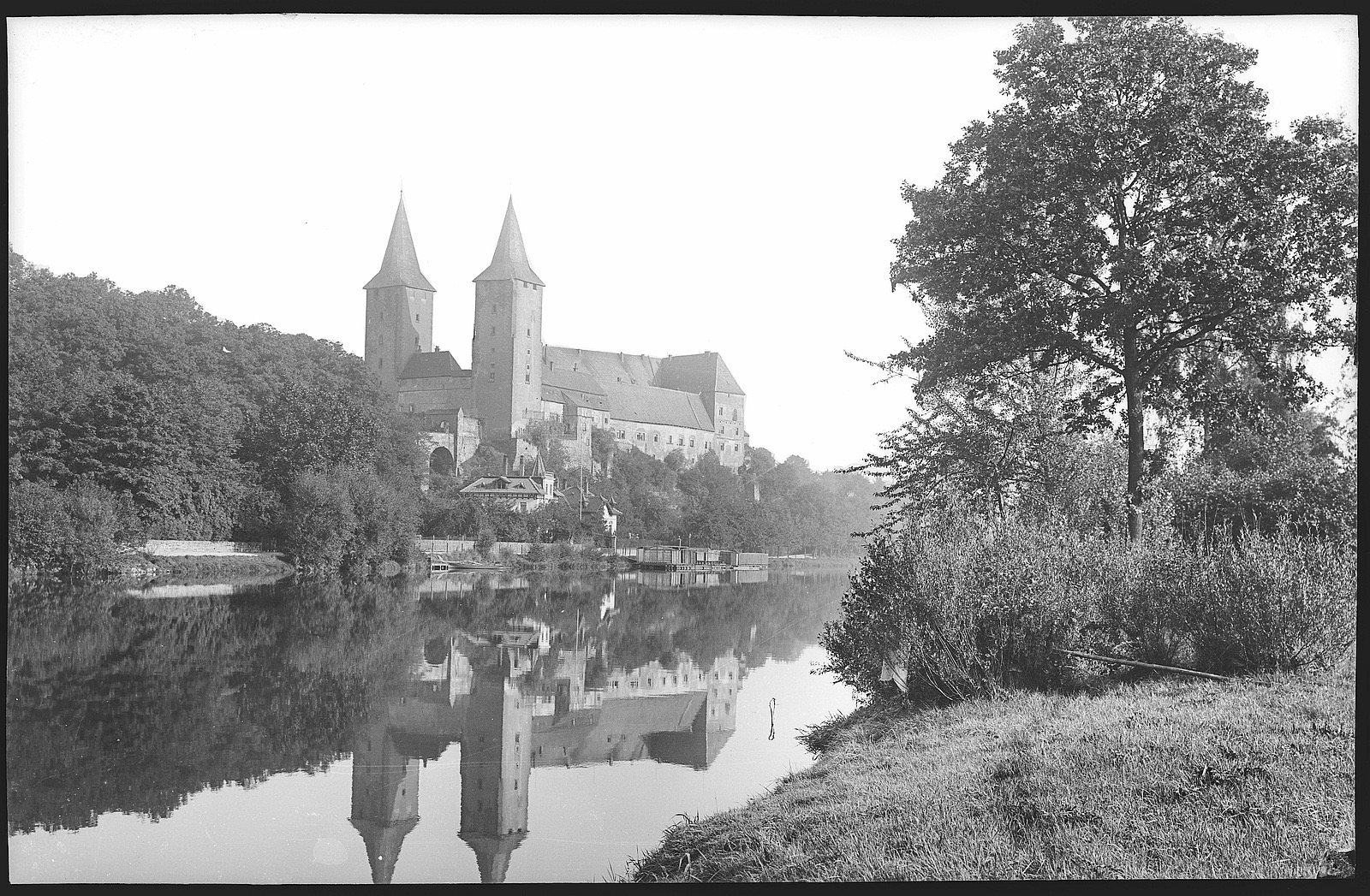
Rochlitz. Castle
· Deutsche Fotothek (via Europeana)
Public domain
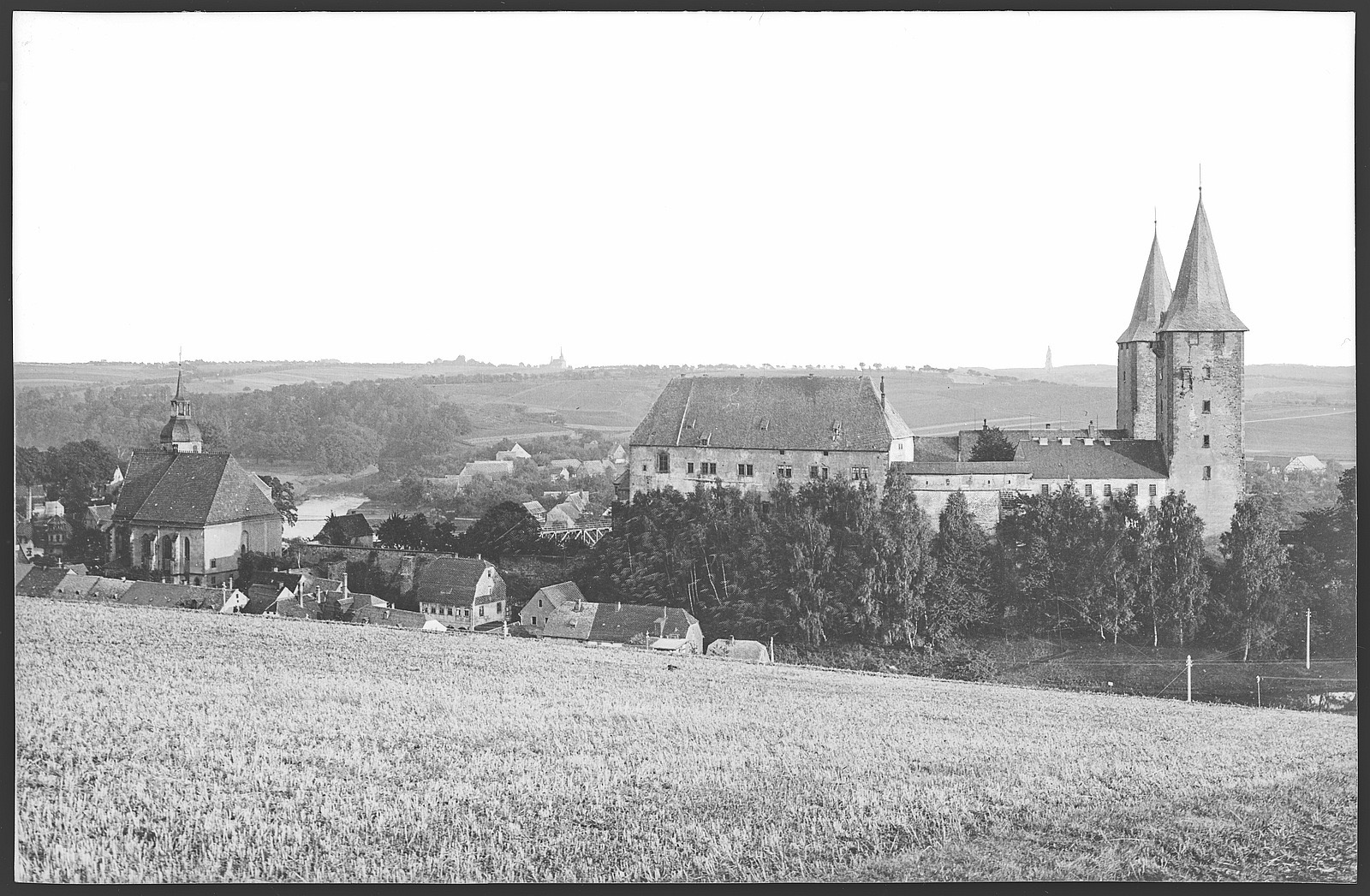
Rochlitz. Schloss
· Deutsche Fotothek (via Europeana)
Public domain
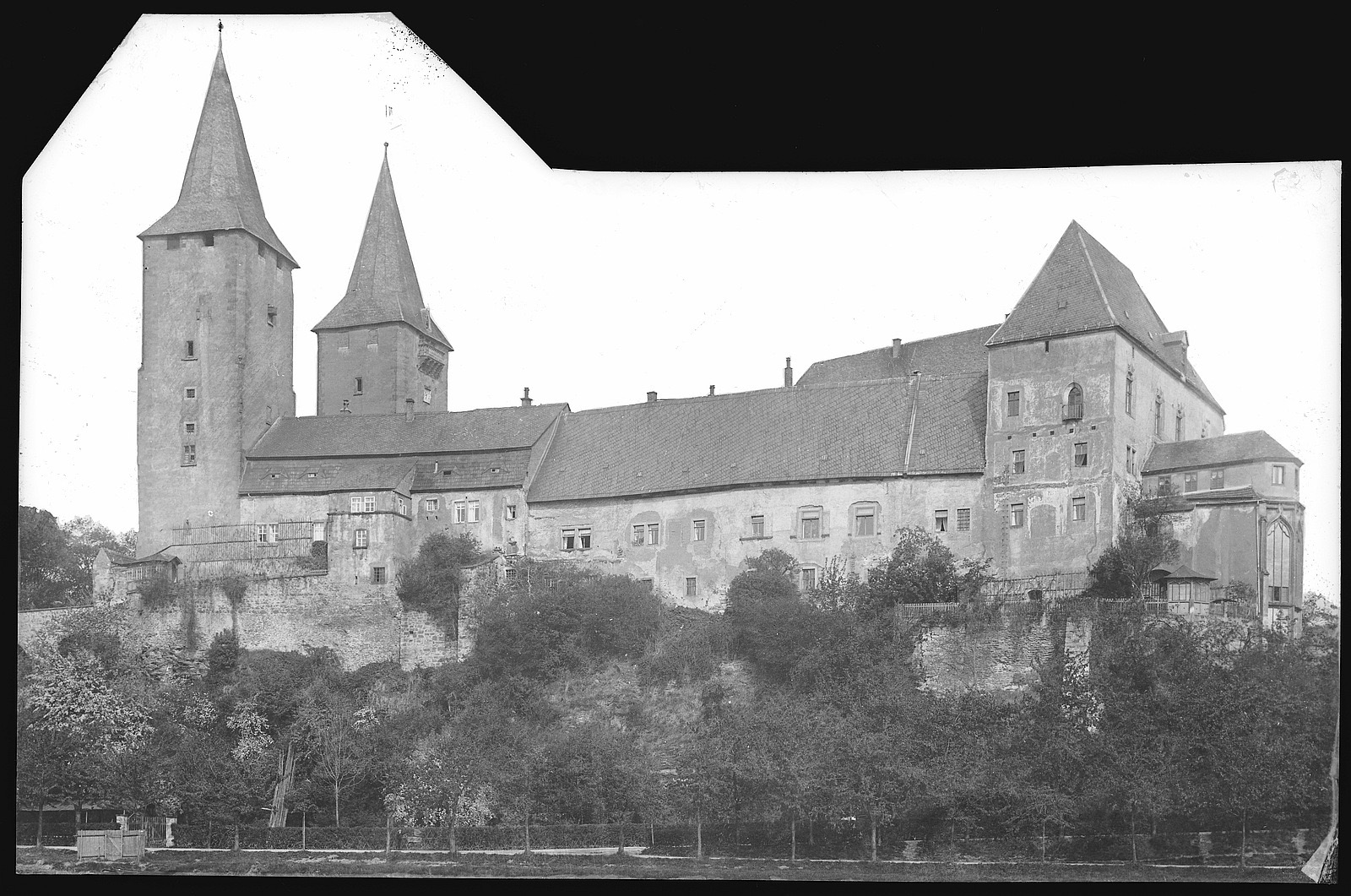
Rochlitz. Schloss
· Deutsche Fotothek (via Europeana)
Public domain


