
Germany · Restored
Brömserburg
The Brömserburg (Niederburg) is a medieval stone castle on the right bank of the Rhine at Rüdesheim am Rhein, notable as one of the earliest stone castles in the Rhine Gorge. Built in multiple phases ending in the late 12th century, it developed as a compact, quadrangular fortress with a massive central bergfried and thick curtain walls. It has undergone later damage and 19th–20th century reconstruction and today houses a (currently closed) wine museum.
First raised
1186
Its prime
1190
Today
Restored
As it stood in 1190
What Brömserburg looked like in its prime.
A compact quadrangular stone castle of coarse grey-brown rubble masonry with thick curtain walls and a dominant, massive central bergfried rising above adjoining ranges. The south front presents several large round-arched ground openings and narrow slit windows higher up; the outer wall was raised and partly brick-faced in the later phase. Rooflines are low where buildings abut the bergfried; the castle sits directly beside the Rhine with vineyards on the river terrace below, and a raised interior courtyard behind the curtain.
Its story
The story of Brömserburg.
The Brömserburg, also called the Niederburg, stands near the bank of the Rhine at Rüdesheim in Hesse, and was probably one of the first stone castles of the Rhine Gorge, now a UNESCO World Heritage Site. Built in phases ending in the late twelfth century, it took the form of a compact quadrangular fortress with a massive central bergfried and thick curtain walls.
From the thirteenth century the Brömser family of the Wisper valley are recorded as castellans, holding the castle within the territory of the archbishops of Mainz. The popular assertion that the Brömser von Rüdesheim lived here from 1548 until dying out in 1668 is wrong: after the main Rüdesheim line ended with the death of Melchior von Rüdesheim in 1538, the Brömsers gradually took over the Rüdesheim fief. When they too died out, the Archbishop of Mainz granted the fiefdom in 1678 to Emmerich of Metternich, an heir of the Brömser von Rüdesheim family.
In 1640, during the Thirty Years' War, French troops under Duke Henry II of Orleans blew up the south-eastern corner facing the Rhine, destroying the upper part of the bergfried and the donjon. After 1811 the counts of Ingelheim undertook a romanticised expansion of the castle into a country house, and in 1941 it was bought by the town of Rüdesheim; it later housed a wine museum, currently closed.
Step inside
8 places to explore in 1190.
The record describes 8 distinct spots at Brömserburg, including 2 interiors: raised inner courtyard, vaulted interior chambers and stacked storeys. Create your own photoreal reconstruction and explore every one, more scenes means more rooms, more angles, and more of the place to stand in.
Build Your Own Castle
Recreate Brömserburg with AI to explore it.
The artist rebuilds it as it stood in 1190, a photoreal reconstruction that belongs to you alone. Pay with coins, no subscription needed.
Recreate this castle →Defend this castle →Whose castle
Clans who held Brömserburg.
The families that held Brömserburg for a decade or more across its history, follow a name to its clan.
Brömser
Castellans of the castle from the 13th century; took over the Rüdesheim fief after 1538 and held it until the family died out.
Rüdesheim
The von Rüdesheim family held the fief until their main line ended with Melchior von Rüdesheim in 1538.
Metternich
The fiefdom was granted to Emmerich of Metternich, heir of the Brömser von Rüdesheim, in 1678.
Ingelheim
Held by the counts of Ingelheim from 1811 until the town of Rüdesheim bought the castle in 1941.
From the archive
Brömserburg on paper: the measured plan and period views.
The survey plan and photographs below are the ground truth this page's reconstructions are checked against, drawn and photographed while the castle was still a working garrison. Every image is public-domain or openly licensed, with its source named.
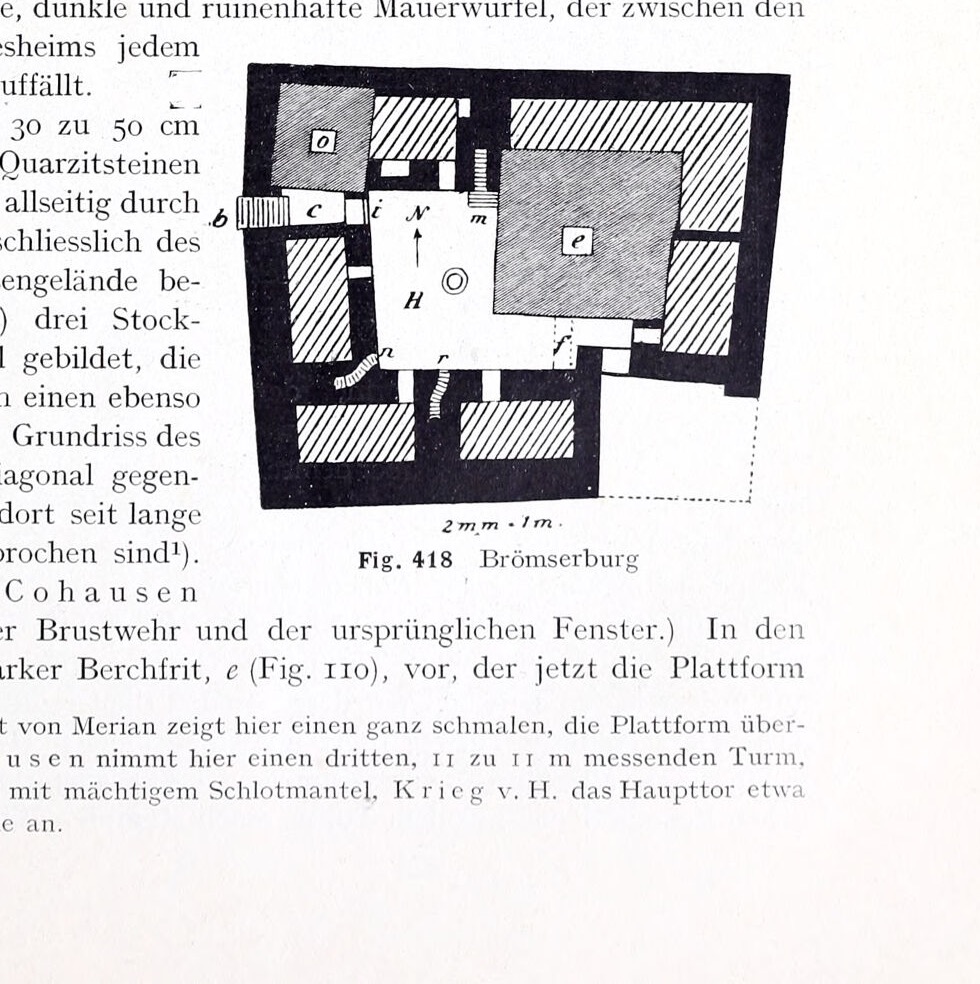
Fig. 418 Brömserburg
1912 · Otto Piper, Burgenkunde (1912)
Public domain


