
Germany · Restored
Burghausen Castle
Burg zu Burghausen
Burghausen Castle is a medieval castle complex in Burghausen, Upper Bavaria, noted for its exceptional length along a ridge. The surviving buildings form a sequence of a main castle (Hauptburg) with an inner courtyard and five successive outer courtyards, incorporating chapels, halls, towers and defensive works; today parts house a castle museum.
First raised
1051
Its prime
1503
Today
Restored
Ranked among Europe’s castles
As it stood in 1503
What Burghausen Castle looked like in its prime.
Long linear silhouette of stone curtain walls and stepped defensive terraces running along a narrow hill ridge, punctuated by a sequence of square and round towers and gatehouses; pale grey limestone or sandstone masonry with regular small window openings; continuous red clay-tiled gabled roofs over the main ranges and conical tiled roofs on some towers; a dominant palas at the highest point and lower outer baileys terraced down toward the town and the Wöhrsee lake; complete and occupied in its prime.
Its story
The story of Burghausen Castle.
Royal Estate on the Salzach: 1025 and the Counts of Burghausen
The ridge above the Salzach was occupied long before any castle stood on it. Excavations beneath the Dürnitz in 2002–04 produced pottery dated to the sixteenth century BC and the remains of a Bronze Age dry-stone wall, and digs on the hill have also turned up Celtic brooch fragments and Roman coins from Marcus Aurelius to Constantine; from the eighth to the tenth century a fortified court of the Agilolfing dukes probably watched the salt traffic on the river below.
The oldest surviving written record is from 1025, when Burghausen was named as a royal estate under Duke Henry V of Bavaria. Through the eleventh century the hill was the seat of the counts of Burghausen, a side line of the Sieghardinger, and a first major enlargement around 1090 left fragments still traceable in the Palas. When the last count, Gebhard II, died in 1168, the castle passed to the Wittelsbachs; raised to dukes of Bavaria in 1180, they extended it heavily under Duke Otto I, and the settlement below received its town charter in 1235.
Henry XIII's New Castle, 1255
The first partition of Bavaria in 1255 made Burghausen the second residence of the dukes of Lower Bavaria, after Trausnitz in Landshut. That year Duke Henry XIII, then only about twenty, began an entirely new complex, parts of which still stand within the main castle: the inner chapel of 1255, held to be the oldest early Gothic church in southern Bavaria, together with the mid-thirteenth-century Dürnitz and Kemenate. In 1331 castle and town passed to Otto IV, Duke of Lower Bavaria.
The Rich Dukes and the Kilometre of Walls, 1392–1503
After a fresh partition in 1392 Burghausen remained second residence of the new Bavaria-Landshut line, and under its three "rich" dukes, Henry XVI (1393–1450), Louis (1450–1479) and above all Georg (1479–1503), the castle took its present character. Beginning with Margarete of Austria, the deported wife of the despotic Henry XVI, it housed the dukes' consorts and widows and guarded the ducal treasures; in 1447 Louis VII, Duke of Bavaria, died here as Henry's prisoner.
From about 1490 fear of the advancing Turks drove a massive fortress build-out under the ducal master builder Ulrich Pesnitzer, its labour falling chiefly on the peasants of the surrounding countryside. The complex reached its present length of over a kilometre (1,051 metres, confirmed by Guinness World Records as the longest castle complex in the world) with gardens, workshops, several churches and stabling for several hundred horses spread across six courtyards. By Georg's time Burghausen was the strongest fortress of the region. The Landshut War of Succession of 1504–05 reunited Bavaria under Albrecht IV and ended Burghausen's days as a residence; it served thereafter as a dwelling for the duke's sons.
Horn in the Dungeon, Ney at the Walls
As a principal arsenal the castle kept its military weight into the modern era, and it was never taken by storm. During the Thirty Years War the defences were reinforced against the Swedes advancing in 1632, and the Swedish field marshal Gustav Horn sat imprisoned in the main castle's dungeon from 1634 to 1641. In the eighteenth century the outer works were extended on Vauban's system, Burghausen became a garrison town in 1763, and the Treaty of Teschen in 1779, ceding the Innviertel across the river to Austria, turned the fortress into a border post.
In 1800–01 French troops under Marshal Michel Ney demolished all the northern outer works, laying open the only level approach, and in 1809 Napoleon declared the fortress obsolete. The Bavarian garrison altered the buildings heavily, parts were sold off privately, and after the garrison was dissolved in 1893 the townspeople of Burghausen only narrowly prevented a planned demolition. Renovation of the main castle began in 1896 (the painter Maximilian Liebenwein occupied the tower now named for him from 1899 until his death, decorating its interior in Art Nouveau style), and restoration has continued since the 1960s. Most of the complex now belongs to the Free State of Bavaria, the Palas housing the Castle Museum and a branch gallery of the Bavarian State Picture Collections.
Step inside
12 places to explore in 1503.
The record describes 12 distinct spots at Burghausen Castle, including 5 interiors: hauptburg palas (ducal private rooms), chapel of st. elizabeth (1255), dürnitz (knights' hall) with its two vaulted halls and more. Create your own photoreal reconstruction and explore every one, more scenes means more rooms, more angles, and more of the place to stand in.
Build Your Own Castle
Recreate Burghausen Castle with AI to explore it.
The artist rebuilds it as it stood in 1503, a photoreal reconstruction that belongs to you alone. Pay with coins, no subscription needed.
Recreate this castle →Defend this castle →Whose castle
Clans who held Burghausen Castle.
The families that held Burghausen Castle for a decade or more across its history, follow a name to its clan.
Wittelsbach
Held by the House of Wittelsbach, dukes of Bavaria, from 1168; second residence of the dukes of Lower Bavaria from 1255.
From the archive
Burghausen Castle on paper: the measured plan and period views.
The survey plan and photographs below are the ground truth this page's reconstructions are checked against, drawn and photographed while the castle was still a working garrison. Every image is public-domain or openly licensed, with its source named.
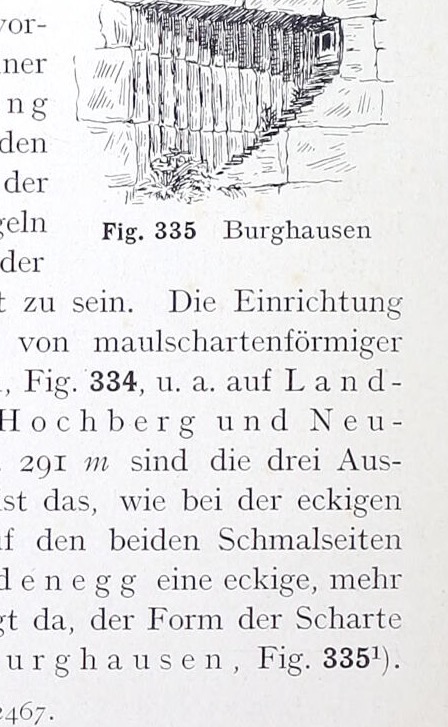
Fig. 335 Burghausen
1912 · Otto Piper, Burgenkunde (1912)
Public domain


