Germany · Ruin
Ehrenfels Castle
Burg Ehrenfels
Ehrenfels Castle is a ruined hillside castle above the Rhine Gorge near Rüdesheim am Rhein in Hesse, Germany. Built around 1212 for the Archbishop of Mainz to control Rhine shipping, it was heavily damaged in the Thirty Years' War and destroyed by French troops in 1689; the site today survives as a prominent ruin reached by a vineyard trail.
First raised
1212
Its prime
1212
Today
Ruin
As it stood in 1212
What Ehrenfels Castle looked like in its prime.
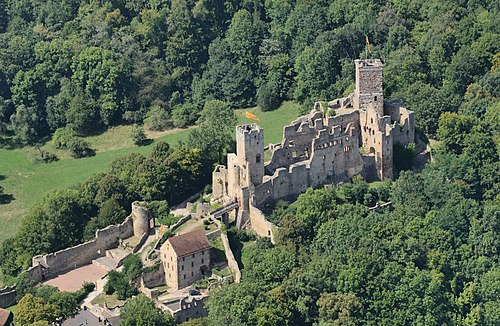
Ehrenfels perches on a rocky outcrop amid steep vineyards on the Rhine's eastern bank. Its profile combines a tall cylindrical bergfried with a corbelled upper stage, a shorter round tower, and a rectangular multi-storey palas with regular square window openings; continuous stone curtain walls terrace down the slope into polygonal retaining walls. Natural grey-brown sandstone masonry, pitched roofs on the living ranges in prime condition, and connecting wall-walks complete the silhouette of a fully roofed 13th-century hill castle.
Its story
The story of Ehrenfels Castle.
Philipp von Bolanden Builds for Mainz, 1211-1222
During the contested double election of Philip of Swabia and Otto of Brunswick, the archbishopric of Mainz was attacked by the Count Palatine of the Rhine, who as imperial vicar in Franconia was working to cut back the archbishop's reach. Ehrenfels was raised in answer, about 1211 or 1212, by Philipp von Bolanden acting on the orders of Archbishop Siegfried II of Eppstein, on the steep north-eastern bank above the Rhine Gorge, on the slope of the Rüdesheimer Berg.
Bolanden had paid for the building out of his own means. When his widow Beatrix married Dietrich von Heinsberg, Mainz laid claim to the castle regardless, and a royal judgment settled the matter in 1222 by awarding Ehrenfels to the archbishopric. Mainz then garrisoned it with its own Burgmannen.
The Rhine Toll and the Customs War, to 1306
By the middle of the thirteenth century Ehrenfels had become a customs station. The toll station proper lay down at the water, connected with the Binger Mäuseturm, rather than at the castle on the slope above.
In 1301, in the Rhenish customs war of the electors against King Albrecht, Ehrenfels served as the base of Archbishop Gerhard II of Eppstein. After Albrecht's victory the castle was handed over to Gottfried von Brauneck for five years.
Kuno von Falkenstein's Pledge and the Niederwald, 1353-1588
In 1353, during the second Mainz diocesan feud, the castle was pledged to the administrator of the see, Kuno II of Falkenstein, who enlarged the works. Archbishop Gerlach of Nassau wanted the pledge undone; he alleged that Kuno intended to have him murdered, and in 1356 he occupied the castle.
Forest reports of 1587 and 1588 record the Niederwald tied to the castle as its working woodland, together with a fief farm on the ground where the Niederwald hunting lodge was later built.
Sieges, Burning and the French Army, 1618-1705
Through the Thirty Years' War Ehrenfels was besieged more than once and occupied in turn by different warring parties. How the castle came to be gutted is told two ways. One account has Archbishop Anselm Casimir Wambolt von Umstadt ordering it burnt in 1636 to stop it being used as a hiding place. What is not disputed is 1689, when the army of the French marshal Nicolas Chalon du Blé, Marquis d'Huxelles, badly damaged it in the campaigning of the War of the Palatine Succession that also brought the siege of Mainz.
The outer works were cleared away as further vineyards were laid out over the ground. The cathedral chapter of Mainz gave up the ruin, which put the Niederwald up for sale: by 1693 the woodland belonged to the Counts of Stadion, and part of the property passed that same year, the remainder in 1705, to Johann Franz Sebastian von Ostein.
Prussia, Hesse and the World Heritage Valley, 1866 Onward
The castle fell to Prussia in 1866 and is today owned by the state of Hesse, which lists it as a cultural heritage monument; since 2002 it has stood inside the UNESCO World Heritage site of the Upper Middle Rhine Valley. Of the toll castle of barely 600 square metres there survive the shield wall, 4.6 metres thick and 20 metres high, closing the landward side with two round corner towers 33 metres tall, and remains of the palas and of a gatehouse.
A footpath climbs from Rüdesheim through the vineyards to the walls. The courtyard is locked behind grilles, and because peregrine falcons breed on the ruin it is viewed only from the outside. The grape variety Ehrenfelser is named after the castle.
Step inside
7 places to explore in 1212.
The record describes 7 distinct spots at Ehrenfels Castle, including 1 interior: inner courtyard. Create your own photoreal reconstruction and explore every one, more scenes means more rooms, more angles, and more of the place to stand in.
Build Your Own Castle
Recreate Ehrenfels Castle with AI to explore it.
The artist rebuilds it as it stood in 1212, a photoreal reconstruction that belongs to you alone. Pay with coins, no subscription needed.
Recreate this castle →Defend this castle →From the archive
Ehrenfels Castle on paper: the measured plan and period views.
The survey plan and photographs below are the ground truth this page's reconstructions are checked against, drawn and photographed while the castle was still a working garrison. Every image is public-domain or openly licensed, with its source named.
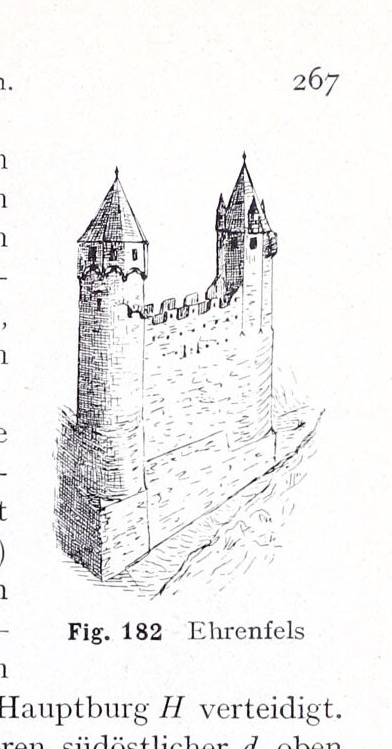
Fig. 182 Ehrenfels
1912 · Otto Piper, Burgenkunde (1912)
Public domain