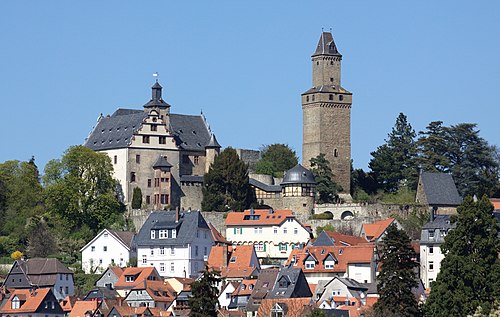
Germany · Partial ruin
Rötteln Castle
Burg Rötteln
Rötteln Castle is a large medieval hill castle above the Lörrach suburb of Haagen in Baden-Württemberg, Germany. Today it survives as an extensive ruin spread along a wooded spur; the site comprises a lower outer bailey of service buildings and an upper inner castle focused on a powerful keep and curtain walls.
First raised
1100
Its prime
1470
Today
Partial ruin
As it stood in 1470
What Rötteln Castle looked like in its prime.
Long, irregular castle laid out along a wooded limestone spur, running roughly northwest–southwest for about 300 metres. Dominant is a tall rectangular stone keep on the eastern spur and a second square gate tower rising from the curtain; curtain walls with crenellations and flanking round towers enclose an outer bailey of closely set service buildings with steep tile roofs. Masonry is pale grey-brown sandstone; at its prime the roofs were intact and battlements continuous along the wallwalks.
Its story
The story of Rötteln Castle.
The Free Lords of Rötteln, 1102–1316
The oldest surviving mention of the castle comes from 1259, when the counts Rudolf and Gottfried of Habsburg drew up a list of the fiefs they held from the prince-abbey of Murbach, the castrum de Rötelnhein among them; the Habsburgs had passed it on as a sub-fief to the lords of Rötteln. That free noble family is documented from 1102/03 and held property in the southern Breisgau, above all in the valleys of the Great and Little Wiese. Rötteln is also the name of a hamlet near the castle, recorded as raudinleim as early as 751, so the family name is no proof that a castle stood here in the early 12th century, and the building itself gives no clear answer either. The keep is dated between the middle of the 12th century and the beginning of the 13th, which points to an origin well before 1259, and parts of the hall range appear to have gone up around 1200; the oldest surface finds date from about 1100. The keep was raised on the highest plateau in the early 13th century, when the entrance to the castle was moved from the north-east round to the south; what stood on the keep's site before it has not been established.
The lords of Rötteln appear more often in the records in the early 13th century and climbed to high office. Walther von Rötteln became a canon in 1209, later cathedral provost at Konstanz, and in 1213 bishop of Basel; after his deposition in 1215 he returned to the Konstanz chapter. His brother Lüthold I also entered the church and was bishop of Basel from 1238 to 1248. Among the secular members a division of property seems to have been made in the first half of the 13th century between the brothers Konrad and Dietrich: Konrad continued to call himself after Rötteln, while Dietrich moved to Rotenberg castle near Wieslet and took his name from that. Konrad probably had a further castle built near Schopfheim in the middle Wiese valley and raised the place to a town, a step that mattered to the later shaping of the Markgräflerland. He married a daughter of Count Ulrich of Neuenburg and had three sons, of whom Lüthold II entered the Basel cathedral chapter while Otto and the early-dying Walter ran the lordship of Rötteln.
Several enlargements of the castle probably belong to these decades, when the family stood clearest in the charters and supplied two bishops of Basel: the hall range was enlarged by the early 14th century at the latest and the south tower raised at about the same time, and recent investigation has shown that at least parts of the ring wall around the lower castle date from the 13th century, possibly from the time of Lüthold I or Konrad. Early in the 14th century Lüthold II came close to the see of Basel himself. The chapter elected him twice and both times the pope chose another candidate, the second occasion setting off a dispute over the bishopric that ran for years and ended with Lüthold and his party defeated. While that quarrel was still running he had to settle the Rötteln succession: his brother Otto had probably died about 1305 and Otto's son Walter III shortly afterwards, in either 1310 or 1311. A daughter of Otto had married Margrave Rudolf of Hachberg-Sausenberg, who at first administered the Rötteln property jointly with Lüthold, but Rudolf died as early as 1313 and Lüthold had to carry the administration alone until December 1315, when he made over his entire holding to his great-nephew Heinrich von Hachberg-Sausenberg, Rudolf's son. Lüthold II died on 19 May 1316 and the male line of the lords of Rötteln died with him.
The Margraves of Hachberg-Sausenberg, 1316–1428
The margraves of Hachberg-Sausenberg were a branch of the margraves of Hachberg, split off by a partition between Heinrich III and Rudolf I at the end of the 13th century and named after the Sausenburg east of Sitzenkirch. The Rötteln inheritance brought them a marked increase in power, probably trebling the territory they ruled, and the castle became the centre of the enlarged lordship: the Sausenbergers moved to Rötteln, most likely before 1317, and the name of the inherited castle and lordship worked its way into the margraves' own style.
In the autumn of 1332, possibly out of disputes over the Rötteln inheritance, the castle was besieged. One of the margraves of Hachberg-Sausenberg had stabbed the mayor of Basel, probably Burkard Wernher von Ramstein, whereupon a Basel army marched on the castle, though it did not take the place; the quarrel was then settled through the mediation of the Basel country nobility. Arrowheads, crossbow bolts and other finds near the castle bear on that siege. Whether the Basel earthquake of 1356 damaged the castle is contested. Jürgen Krüger, arguing from the damage to Basel minster, assumes heavy destruction from which only the massively built keep may have been spared; Werner Meyer and Werner Wild point out that contemporary chroniclers never describe the castle as destroyed or damaged, and allow at most minor harm.
Under Margrave Rudolf III the parish church in the village of Rötteln was enlarged, and increased building at the castle is assumed, though its extent is not wholly clear. A summerhus lived in during the summer months, probably beside the hall range, and a gallery on the south tower appear in the charters of his day. It was long thought that the outer bailey was first built under the margraves of Hachberg-Sausenberg, but recent excavation suggests at least parts of it were raised while the lords of Rötteln still held the place. Rudolf enlarged his territory by buying the lordship of Neuenstein between the middle Wiese and the Wehra valley, and in 1403 King Ruprecht granted market rights to Lörrach, close by the castle, though without raising it to a town: Schopfheim remained the only town in Rudolf's margraviate and the castle its administrative centre. Probably between 1396 and 1428 various clerks at Rudolf's court wrote the Rötteler Chronik, the family chronicle of the margraves of Hachberg-Sausenberg-Rötteln.
Burgundy, the Rötteler Gemächte and the Passing to Baden, 1441–1595
Under Rudolf's son Margrave Wilhelm the family began to turn away from its home lands on the Upper Rhine. Wilhelm was often away on diplomatic missions and held offices such as governor at the Council of Basel and Austrian Landvogt in the Sundgau, Alsace, Breisgau and Black Forest, spending little time at Rötteln, where an administration headed by a Landvogt ran the margraviate. By the middle of the 15th century he was deep in debt, in which some costly feuds of his father Rudolf III may have played a part, and he handed the lordships of Rötteln and Sausenberg to his two sons Hugo and Rudolf IV. Under Rudolf IV the centre of the family's world shifted further from the Rhine. His guardian Johann von Freiburg gave him the lordship of Badenweiler in 1444, enlarging the Hachberg-Sausenberg holding in the Breisgau into the block still called the Markgräflerland, but Rudolf grew up with Johann at Neuchâtel and inherited that county in 1457, becoming a Burgundian vassal and, as Marquis de Rothelin, a frequent presence at the court of Duke Philip the Good. He owned a house at Dijon and had little interest in life at Rötteln, where he probably very seldom stayed.
On 9 July 1454 Duke Philip the Good visited Rudolf IV at the castle, which for a day saw the shine of court life; the ducal party was travelling with some 300 horses. The duke was on his way back from the Turkish diet at Regensburg, called by Emperor Frederick III and sitting from 23 April to 21 May 1454 to discuss plans for the recovery of Constantinople, and had come by way of Freiburg im Breisgau and Neuenburg am Rhein. The next day the party went on to Basel and from there to Neuchâtel, with the margrave riding in company. As the seat of the margravial administration the outer bailey was further built up and reached more or less its final shape around 1460; a tower added to the inner ring of the main castle can be dated by a plinth inscription to 1471, and the outer gate leading into the bailey carries the arms of Rudolf IV and the date 1468. The pilgrim Hans von Waltheim of Halle an der Saale, who saw the castle on 9 July 1474, marvelled at the tapestries in the cabinet and said they had the most beautiful workmanship of pictures, of countenance, of clothing, of animals and flowers and other work, as if they lived.
Rudolf's son Philipp also spent most of his childhood far from Rötteln and entered the court of Charles the Bold of Burgundy at sixteen. After Charles's death he took the French side, married Maria of Savoy, a niece of the French king, and at the French court became marshal of Burgundy and governor of Provence. In 1490 he made an inheritance treaty with his distant kinsman Margrave Christoph of Baden by which, should either die without heirs, the other would take the lordship; known as the Rötteler Gemächte, it was made known to the administrations of both margraviates. At Rötteln Philipp probably had the hall range modernised once more, or a new portal built there, which an inscription dates to 1494, yet he too was rarely at his castle. In the Swabian War of 1499 he fought on the side of the French king and the Swiss Confederates, and so against his own Landvogt at Rötteln, who stood in the Habsburg ranks. Philipp died in 1503 on one of his Burgundian estates and was buried at Neuchâtel; only his heart was laid, as he had directed, in the parish church of Rötteln. Two weeks after his death, on 24 September 1503, Christoph I of Baden took the homage of the Sausenberg estates and moved into the castle as its new lord, leaving Philipp's Burgundian heirs nothing but verbal and diplomatic protest. The margraves of Baden fortified the Kapf, the court and execution place in front of the outer bailey, as a bastion, but the castle never held the place it had under the Röttlers and Sausenbergers: it stayed out of date as a fortification despite the bastion and was never rebuilt as a residence, and only once more, from 1590 to 1595 under Margrave Georg Friedrich, was it the seat of a ruler.
The Peasants' War to Bernhard of Weimar, 1525–1654
In 1525 the castle held a margravial garrison under the Landvogt Konrad Dietrich von Bolsenheim, strengthened by nobles from the surrounding country. Margrave Ernst sought support from the city of Basel to protect the castle, and his Landvogt asked Basel outright for a garrison of 30 men with two councillors. The margrave himself was at Breisach am Rhein on 15 May, having left Freiburg im Breisgau in good time before a peasant army besieged it, and from Breisach he asked the Basel council for a personal meeting. The peasants intercepted the messengers and so learned of the Basel plan, upon which they came in haste before the castle and demanded entry; the Landvogt admitted 50 men against an assurance that the castle would not be damaged. The peasants took the guns and ammunition they found to the siege of Freiburg. When the Landvogt and the Landschreiber Balthasar Gut refused to join the rising they were held for a time, and released soon afterwards on Basel's intervention.
In a letter of complaint in July 1525 the margravial administration accused the peasants of breaking open the archive and destroying records and of plundering the stores. The peasants denied it, holding that the records had no longer been kept complete at Rötteln and that they themselves had suffered from the destruction of the country's contracts, and that the stores had gone only to feed the peasant garrison. The occupation of Rötteln and of the other margravial castles at Sausenburg and Badenweiler, they said, had been carried out to keep them from damage by other peasant bands, particularly the Black Forest band under Hans Müller; the peasantry treated these castles not merely as the margrave's strongholds but as fortresses of the country. After severe defeats of neighbouring bands the Markgräfler withdrew from the northern Breisgau and were back in their villages by 30 May, which is probably also when the occupation of the castles ended. Through the winter of 1525/26 and the spring of 1526 margravial horse patrols ranged out from Rötteln to pick up fugitive peasants and those returning from Switzerland who were accused of a part in the revolt, and in April 1526 fourteen death sentences were carried out on the castle's execution place at the Kapf. Whether the political leaders of the peasantry were being punished, or excesses committed during the rising, remains unresolved; the fate of most of the leaders known by name is unknown, and of two it is recorded that they escaped with their lives, though one of them forfeited all his margravial fiefs and with them his livelihood.
The castle was fought over from 1633. Badenweiler had been taken on 19 May 1633 by imperial troops out of the fortress of Breisach, and in the following days Rötteln too was taken by the imperial troops of Count Montecuccoli with the support of Margrave Hermann Fortunat of Baden-Rodemachern, two guns being lost in the action. On 3 July 1633 the imperial garrison of Rötteln capitulated to the Swedish troops of the Rhinegrave Otto Ludwig; the whole imperial garrison declared itself ready to enter Swedish service, and only part of it was accepted. After the heavy losses at Nördlingen in September 1634 the Swedes pulled their garrisons out of many fortified places, Otto Ludwig gathering the units at Strasbourg and the guns from the abandoned country being secured at the Hochburg and at Strasbourg; the vacated places, Rötteln among them, were given imperial garrisons by February 1635 at the latest. On the outside of the south wall of the Rötteln church hang the epitaphs of two officers of the imperial regiment Reinach who died natural deaths there during the occupation of 1635 to 1638. In 1638 Duke Bernhard of Saxe-Weimar beat the imperial troops at Rheinfelden, the imperial garrison gave up the town on 24 March, and the duke could turn the troops the siege had tied down against the Breisgau. The main force advanced to Lörrach on 26 March and the infantry regiments Kanoffski and Hattstein were sent against Rötteln; Colonel Kanoffski had already pushed musketeers forward and summoned the garrison to surrender, and when this was refused his troops began making gabions. After the duke arrived before the castle the summons was repeated, and when the castle commander, Captain Kemp, refused again, units of both regiments stormed the outer bailey early on 28 March. The garrison fell back into the upper castle and capitulated soon after, so that within an hour the whole castle was in the duke's hands; the cattle and stores were carried off to Neuenburg am Rhein. The damage done in the fighting was made good after the war under Margrave Friedrich VI, and the castle kept its role as the seat of the local administration. In 1654 the gate tower is mentioned as a prison.
Frézelière's Guns and the Long Afterlife, 1678–2026
In the Dutch War the Breisgau again became a theatre of fighting. After the loss of Freiburg to the French marshal François de Créquy in November 1677, French troops out of Hüningen, Breisach and Freiburg plundered the whole Breisgau in early 1678. On 28 January 1678 French troops appeared before Rötteln and attempted an assault with 400 men from the redoubt to the north, which was beaten off; on 29 January the French command burned Röttelnweiler and Rötteln Chilf. At the end of June 1678 Créquy's army was marching from its position at Freiburg towards Rheinfelden, which he meant to take, and on 28 June he sent the generals Louis-François de Boufflers and Claude de Choiseul-Francières ahead of the main army to occupy the right bank of the Rhine at Rheinfelden. By a contemporary German report a detachment under Boufflers summoned the garrison of Rötteln to surrender at four in the morning of 28 June as it passed. Créquy had entrusted the taking of Rötteln and of the Brombach castle to François Frézeau de La Frézelière, the lieutenant-général de l'artillerie who commanded the whole artillery of his army, and he reached the castle with seven squadrons of cavalry and three battalions of infantry, about 2,000 men, with guns, and closed it in. The castle was battered by two half-cartouns firing iron balls of some ten kilograms. The imperial garrison, about 150 men under Freiherr von Walther and mostly belonging to the Croatian infantry regiment of Colonel Count Adolf von Portia, capitulated 28 hours after the summons, at nine in the morning of 29 June. In circumstances never explained, but probably out of an intention to destroy it, the castle went up in flames in the following night of 29 to 30 June. On 2 July Frézelière's troops took the Brombach castle and burned it too, then moved before Rheinfelden and fought in the battle there on 6 July.
With the destruction the castle lost its part as the local seat of lordship; the administration moved to nearby Lörrach, which received town rights in 1682. In 1689, during the War of the Palatine Succession, French troops slighted the bastion at the Kapf as well, on the orders of Roger Brulart de Puysieux, governor of the fortress of Hüningen, and the stones built into it went afterwards into road building. The ruin's decay owed most to the private removal of building material in hard times, and the lands of the destroyed castle were merged with Röttelnweiler and Haagen. Contrary to the usual account the ruin was still inhabited in the 18th century and still used by the margravial administration: a cellar served among other things to store tithe wine, arable and vine cultivation went on around the castle, and from the middle of the century a vine-worker with a service house on the site is documented as living there. In the second half of the 18th century the administration partly withdrew from its property on the hill and sold parts of it, one of the vine-workers buying his service house outright along with the ground at the Kapf for growing wheat. On 28 May 1832 an assembly of liberal citizens met in the ruins to declare their solidarity with the Hambach Festival then taking place, the mayor of Lörrach, Johann Georg Grether, speaking to them. In 1918 an air watch with an anti-aircraft gun was posted at Rötteln, and in 1940 a small military unit with a light machine gun for air defence.
Conservation by the Grand Duchy of Baden, which by then owned the castle, began in 1834 and went mainly on securing the standing walls, some of it restored so badly that later generations drew false conclusions about individual parts of the building. The Lörrach branch of the Badischer Schwarzwaldverein did the first systematic work between 1885 and 1888, and after a visit Grand Duke Friedrich II supported the renewal of the southern outer wall, then badly damaged. The Röttelnbund was founded in the Haagen inn Wiese on 25 January 1926; it took over the keep as a viewing tower on 1 May 1931, uncovered the knights' hall and the Burgvogtei that year, turning up stove tiles, arrowheads, ironwork and coins, leased the castle estate from the Baden finance ministry on 15 March 1932 and opened the castle tavern on 16 July 1932.
After the National Socialist seizure of power in January 1933 the head of the Lörrach elementary school, Rudolf Greiner, took over the chairmanship of the society on the instructions of the NSDAP district leadership as part of the Gleichschaltung, and from 1934 the NSDAP Kreisleiter held seat and vote on the committee ex officio. Voluntary work stood still until May 1933 and was then limited to mending paths, and the society reported a marked fall in visitors to the keep in 1933, as the political changes kept many Basel visitors away. The NSDAP and its subsidiary organisations used the castle as a backdrop for propaganda: it was illuminated for the Day of the Greater German Reich on 9 April 1938, and the Kraft durch Freude organisation held midsummer-night festivals there in 1938 and 1939. Conservation of the keep, the Hexenkeller and the Burgvogtei ran from 1938 to 1939, and by an ordinance of 18 February 1938 the ruin and its surroundings were designated a protected landscape, today covering 50.9 hectares. Work largely halted during the Second World War as helpers were called up.
The occupying powers dissolved all societies at the end of the war, and the Röttelnbund was refounded in the castle tavern on 27 February 1949. The town of Lörrach took over the lower castle area with the tavern in October 1963. In August 1974 stones came away above the main entrance to the upper castle and a visitor was injured, closing the upper castle until 4 April 1975, with donation drives paying for the repair. The former Landschreiberei, once the most important office of the margrave's administration and the keeper of its archive, was fitted out in 1985 to hold a museum and archive, and the south tower, the Giller, which had served as the castle's criminal and remand prison and gave up foot-irons, handcuffs and neck-collars when it was cleared, was opened to visitors by a staircase in 2001. Between 22 May and 21 July 2023, 44 volunteers from Germany, France and Switzerland dug at Rötteln under Heiko Wagner to record the structures of the earliest building phases, part of the cross-border Châteaux Rhénans project and the first research excavation of its kind in the Freiburg administrative district since 2004; the finds were shown in a travelling exhibition in 2025 and are to enter the castle museum at an opening planned for 26 March 2026. The castle is a listed monument in state ownership, maintained by the Staatliche Schlösser und Gärten Baden-Württemberg with the upkeep carried by the Röttelnbund, and the upper castle draws nearly 50,000 visitors a year to what is the third largest castle ruin in Baden.
Step inside
13 places to explore in 1470.
The record describes 13 distinct spots at Rötteln Castle, including 4 interiors: landschreiberei office and archive room, giller tower interior (guardroom/prison cell), wine cellar beneath the manor house (barrel-vaulted) and more. Create your own photoreal reconstruction and explore every one, more scenes means more rooms, more angles, and more of the place to stand in.
Build Your Own Castle
Recreate Rötteln Castle with AI to explore it.
The artist rebuilds it as it stood in 1470, a photoreal reconstruction that belongs to you alone. Pay with coins, no subscription needed.
Recreate this castle →Defend this castle →Whose castle
Clans who held Rötteln Castle.
The families that held Rötteln Castle for a decade or more across its history, follow a name to its clan.
Rötteln
The lords of Rötteln held the castle from 1102 to 1316.
Hachberg-Sausenberg
The Margraves of Hachberg-Sausenberg became lords of the former domain of Rötteln after 1316.
From the archive
Rötteln Castle on paper: the measured plan and period views.
The survey plan and photographs below are the ground truth this page's reconstructions are checked against, drawn and photographed while the castle was still a working garrison. Every image is public-domain or openly licensed, with its source named.
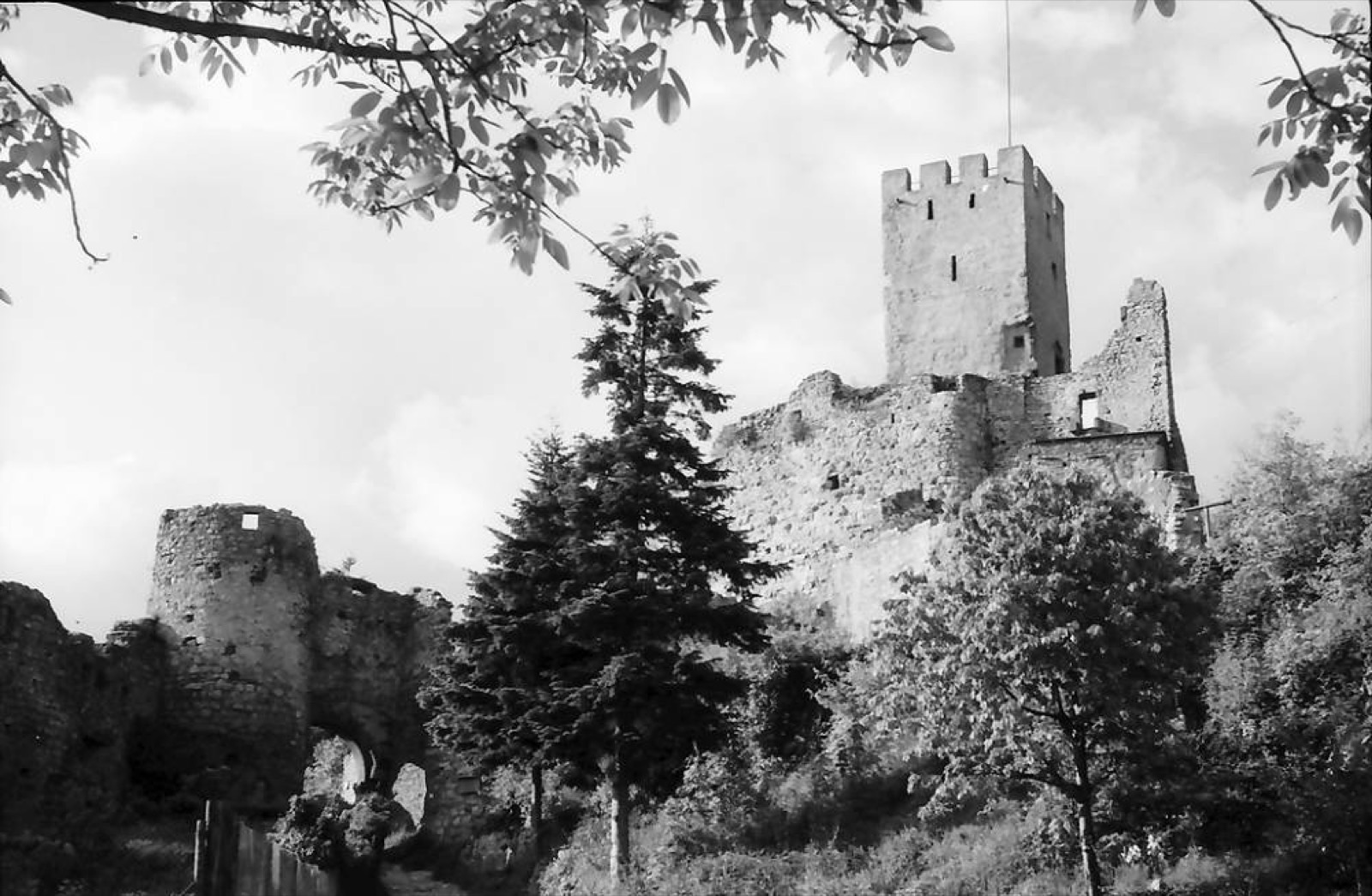
Rötteln: Burg Rötteln von unten
· State Archives of Baden-Württemberg (via Europeana)
CC BY
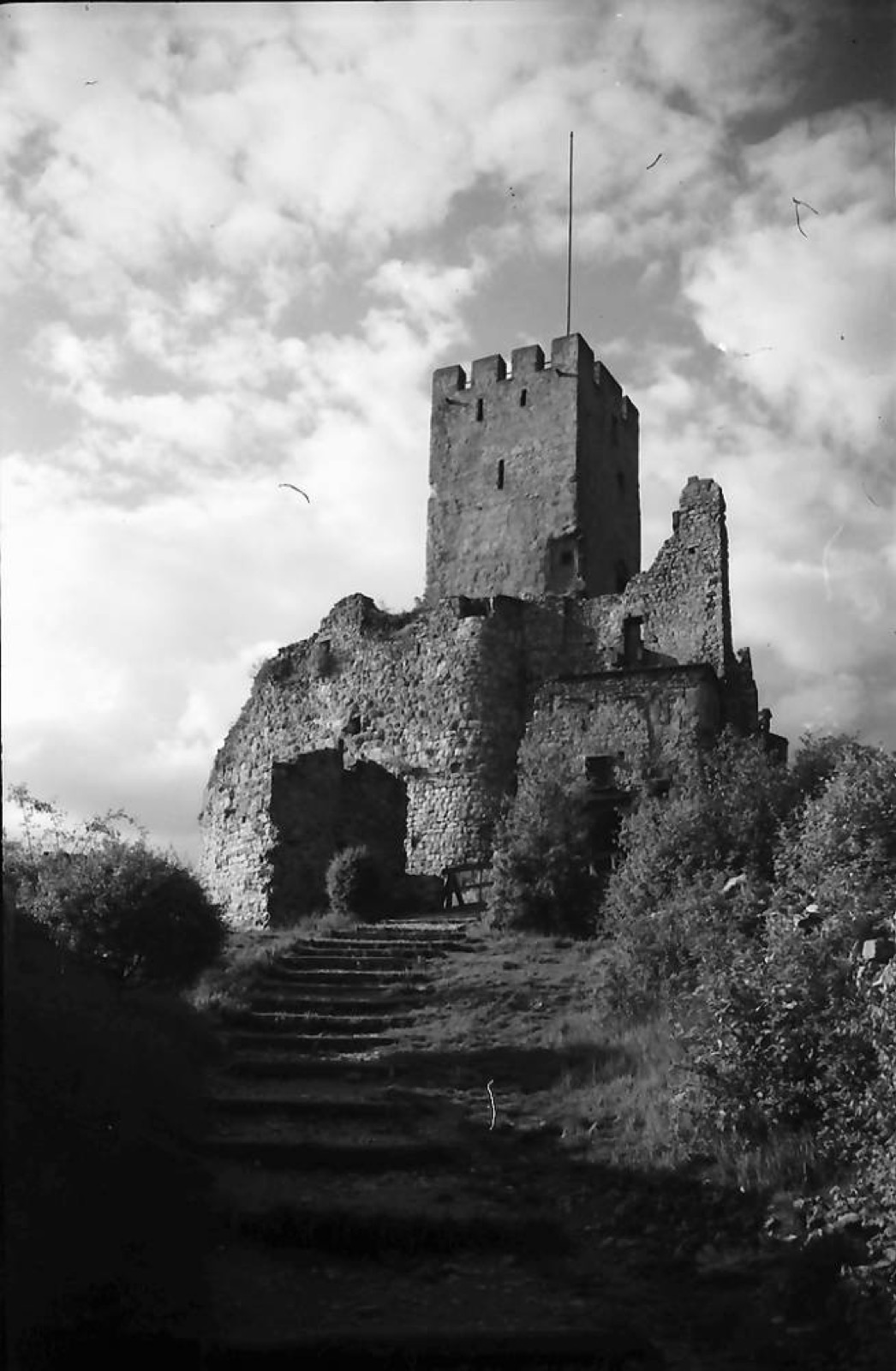
Rötteln: Burg Rötteln von unten
· State Archives of Baden-Württemberg (via Europeana)
CC BY