Germany · Restored
Sparrenberg Castle
Sparrenburg
Sparrenberg Castle (Sparrenburg) is a restored hilltop fortress in Bielefeld, Germany, sited on the Sparrenberg hill above the city. Erected before 1250 and substantially rebuilt into an artillery fortress in the 16th century, its visible form today reflects major works finished in the 1570s with later 19th-century additions and restorations.
First raised
1250
Its prime
1578
Today
Restored
As it stood in 1578
What Sparrenberg Castle looked like in its prime.
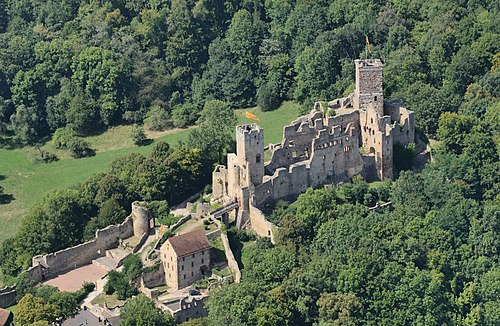
Perched on a wooded hill above the town, the fortress presents a broad sloping stone glacis and a continuous high curtain wall punctuated by large round and one pointed bastion at the corners. A tall cylindrical tower rises from the inner terrace; low pitched-roof service buildings sit within the courtyard behind the walls. Masonry is grey dressed stone; bastions are thick, rounded masonry with artillery embrasures and earthen fills, and the whole complex occupies a cleared plateau above the pass.
Its story
The story of Sparrenberg Castle.
The Counts of Ravensberg above the Bielefeld Pass, before 1250–1511
The Sparrenburg was raised before 1250 by the counts of Ravensberg on the Sparrenberg hill in the Teutoburg Forest, above Bielefeld. It guarded the Bielefeld Pass, served as the counts' ruling seat and covered the town below, founded in the early 13th century. Because a protective castle as a rule preceded the founding of a town, an older predecessor on the hill is now suspected; once the Sparrenburg stood, the Neustadt was laid out between it and the old town. The first record of the castle is in 1256.
Count Bernard of Ravensberg died childless in 1346, and the house of Calvelage-Ravensberg with him. The castle passed by marriage to Count Gerhard I of Jülich-Berg, husband since 1338 of Bernard's niece Margaret, and its role as a ruling seat largely lapsed. Emperor Charles IV spent the night of 18 November 1377 there, and from 1410 to 1428 the castle was a ruling seat one last time, for Count William II of Ravensberg. When William IV, duke of Jülich-Berg and count of Ravensberg, died in 1511, county and castle went to his son-in-law John III, duke of Cleves.
Pasqualini and the Scherpentiner Bastion, c. 1530–1578
As gunpowder artillery spread, the dukes of Cleves had the castle built out into an early-modern fortress able to stand bombardment and work guns of its own. Around 1530 a gun tower went up to the west, linked to the castle only by a stone bridge, from which the pass could be swept. From 1535, on John III's orders, the work became a planned system of roundels (Kiekstatt at the north corner, Schuster and Marien on the south-east) joined by curtain walls. A new fortress gatehouse went up thirty metres in front of the old castle gate, and the ground between inner castle and rampart was vaulted into casemates and connecting passages and then filled with earth almost to the top of the curtains.
The earlier gun tower stood on an unfavourable spot and left the west corner weak. In 1556 the Italian fortress engineer Alessandro Pasqualini was called to Bielefeld and designed for that corner the bastion known as the Scherpentiner, taking the gun tower in as its flank. The name Scherpentiner can be shown nowhere else, and goes back to the serpentina, the Feldschlange or culverin, a light artillery piece of the 15th and 16th centuries. The rebuilding was finished in 1578 and made the largest fortress in Westphalia, and one of the best-preserved Renaissance fortifications in northern Germany.
Dutch, Spanish, Swedish and French Garrisons, 1609–1679
In 1609 John William of Jülich-Cleves-Berg, the last duke of Jülich, died without male heirs, and the joint government agreed that year between John Sigismund of Brandenburg and Wolfgang William of Palatinate-Neuburg broke down into the War of the Jülich Succession. An earthquake damaged the castle in 1612. The Treaty of Xanten of 1614 ended the dispute and handed the Sparrenburg to Brandenburg-Prussia, which at once granted occupation rights to its Dutch confederates; their garrison arrived in November 1615. The years of conflict brought war, bandits and arson to the castle.
In 1623, five years into the Thirty Years' War, the Dutch fell back before the Spanish advance under Count John of Rietberg. Colonel Gent of Brandenburg tried in 1625 to retake it with the Ravensberg peasants, and failed. Swedish and Hessian troops besieged the Spanish garrison for nearly a year from 1636 before it surrendered the fortress in 1637, and in 1642 they left it to their French allies. The Peace of Westphalia confirmed Brandenburg-Prussian possession in 1648. The Great Elector Frederick William used it afterwards as a Westphalian secondary residence, and two of his children were born there. In the Franco-Dutch War the Sparrenburg withstood its last sieges, by Münster in 1673 and by French troops in 1679.
Prison, Quarry and the Committee for the Tower, 1690s–1900
By the end of the 17th century the fortress no longer met military requirements. It was used partly as a prison and partly left to decay, and the outer walls and buildings were pulled down. At the instance of King Frederick II, the 55th barracks on Hans-Sachs-Straße was built from the rest in the 1770s.
In the castle romanticism of the 19th century a Bielefeld committee had the tower rebuilt in 1842–43, the new round lookout tower raised over the lower, still teardrop-shaped part of the old keep. In 1879 the city bought the complex from the Prussian state for 8,934.90 Marks against an assessed value of 70,000 Marks. After long argument over the design, a new palas to the architect Eberhard Hillebrand's plans was begun in 1886, and the neo-Gothic building, with great hall, restaurant and museum rooms, was handed over on 24 April 1888. A monument to the Great Elector by Fritz Schaper was set up in the courtyard in 1900, in the presence of Emperor William II, nominally the last count of Ravensberg.
Air Raid, Restoration and the Bats in the Casemates, 1944–2014
Used as a flak emplacement in the Second World War, the Sparrenburg was heavily damaged in the air raid on Bielefeld of 30 September 1944; only the tower came through unhurt. Clearance and restoration ran almost continuously from 1948 to 1987, and from 1955 the rebuilt domestic range held the German Museum of Playing Cards.
Repair work from 2007 uncovered on the northern Kiekstatt roundel an earlier floor of the defences, three metres below the present level, and a stair leading down into the casemates. In 2008 the plan of a large rectangular building of about 1500, divided into five rooms, was exposed in the main castle, and two square ventilation shafts fifty centimetres across were found near the outer wall between the Kiekstatt and Windmühlen roundels, dropping more than eight metres; one opens through the outer wall, the other into a vault not known before, its floor twelve metres down, and the purpose of both is largely unclear. To pay for the upkeep of the complex, the campaign Ein Stein für die Burg let donors adopt a stone of the castle wall, 3,100 in all, and closed at the end of 2006 when the engraved stones had paved the roundels; the restoration was costed at 7.5 million euro.
The complex is a listed monument in North Rhine-Westphalia. A visitor centre designed by Max Dudler opened at the edge of the courtyard on 17 September 2014. The above-ground fortress can be visited year-round, the rest daily from April to October, including the tower and part of the 285 metres of casemates; the north-western passages are closed but for three guided tours a year, because bats shelter in the vaults. The buildings and the parkland around them are designated a habitats site of some six hectares; about ten species of bat quarter in the underground vaults, among them Bechstein's bat, the pond bat and the greater mouse-eared bat, which winter in the castle.
Step inside
8 places to explore in 1578.
The record describes 8 distinct spots at Sparrenberg Castle, including 2 interiors: cylindrical main tower (keep) and summit view, entrance to casemates (subterranean corridor). Create your own photoreal reconstruction and explore every one, more scenes means more rooms, more angles, and more of the place to stand in.
Build Your Own Castle
Recreate Sparrenberg Castle with AI to explore it.
The artist rebuilds it as it stood in 1578, a photoreal reconstruction that belongs to you alone. Pay with coins, no subscription needed.
Recreate this castle →Defend this castle →Whose castle
Clans who held Sparrenberg Castle.
The families that held Sparrenberg Castle for a decade or more across its history, follow a name to its clan.
Ravensberg
Erected before 1250 by the counts of Ravensberg, their ruling seat until the line was extinguished in 1346.
Jülich-Berg
Passed by marriage to Count Gerhard I of Jülich-Berg in 1346.
Cleves
Held by the dukes of Cleves, who rebuilt it as an artillery fortress, until the line died out in 1609.