Germany · Ruin
Harzburg
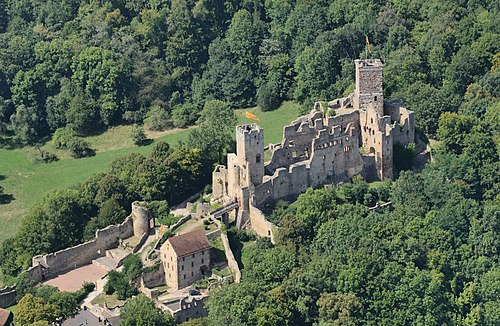
The Harzburg (Große Harzburg) is a former imperial hill castle on the summit of the Großer Burgberg above Bad Harzburg in Lower Saxony, Germany. Built from 1065 and rebuilt in the 12th–13th centuries, it later fell into decay; today only foundation walls, tower fragments and the castle well remain open to the public. The site crowned the conical summit and commanded wide views over the northern Harz foreland.
First raised
1065
Its prime
1218
Today
Ruin
As it stood in 1218
What Harzburg looked like in its prime.
Perched on a conical hilltop, the Harzburg in its prime presented an enclosed stone fortress of pale grey-brown rubble with high curtain walls running up to the steep rock face. Two bergfrieds dominated the silhouette, a square keep that survives partially reconstructed, and the plateau contained clustered ranges of halls, a collegiate church and service buildings around a central courtyard with the deep castle well. A wide, rock-cut moat split the complex into east and west wings, crossed by a linking bridge.
Its story
The story of Harzburg.
Henry IV Builds the Hartesburg, 1065-1071
The Salian emperor Henry III had made the imperial palace of Goslar one of his favourite residences. He drew the disfavour of the local Saxon nobility and the Billung dukes all the same, both for his Franconian descent and for the expense of maintaining his court. He died in 1056 at Bodfeld Castle. During the minority of his son and the regency of Agnes of Poitou the Saxon nobles strengthened their position; Otto of Nordheim, the local count and duke of Bavaria from 1061, was among those involved in the young king's abduction at the Coup of Kaiserswerth in 1062. When Henry IV came of age in 1065 he renewed the Saxon conflict, laying claim to a string of domains around the Harz.
The Große Harzburg was raised from 1065 to 1068 as part of a large-scale castle building programme in the Duchy of Saxony, and appears as Hartesburg in a deed of 1071. Henry's architect, Bishop Benno II of Osnabrück, sited it to cover the imperial palace at Goslar and the mines of the Rammelsberg, its walls carried right up to the steep face of the conical hilltop; by the standards of the day it was reckoned impregnable. It was also unusually palatial for a fortress, with a three-roomed great hall and a collegiate church into which Henry had many relics transferred. He built a sort of family vault there as well, and laid in it the remains of his brother Duke Conrad II of Bavaria and of his son Henry, both of whom died young.
Siege, Slighting and the Road to Canossa, 1073-1077
According to the chronicler Lambert of Hersfeld, the Saxon Rebellion opened on 29 June 1073 when several nobles marched on the king at the Goslar palace. Henry fled with the imperial regalia inside the walls of the Harzburg. The besieging force under Otto of Nordheim and Bishop Burchard II of Halberstadt allegedly numbered 60,000 against a garrison of 300 men. In the night before 10 August the king slipped away to Franconia, by legend through the well of the besieged castle and a secret passage, and the tale has his crown falling into the shaft as he went. On the neighbouring Sachsenberg a ditched rampart enclosure of some 60 by 95 metres survives, read either as a siege work thrown up in 1073 or as an unfinished forward bastion of the castle; the question is unsettled and the earthwork is now barely legible.
The German princes gave Henry little support at first, and in the Peace of Gerstungen of 2 February 1074 he was forced to agree to the slighting of his castles, the Harzburg among them. He dragged the demolition out, throwing down only the walls and towers while the buildings were left standing. In the spring of 1074 angry peasants of the district plundered the Harzburg and destroyed it completely. The collegiate church was not spared and the royal family vault was desecrated. The settlement of Krodotal, earlier called Schulenrode, served the castle as a supply farm and may have taken in the wrecked collegiate foundation as a second site.
The outrage over the desecration gave Henry his cause to move against the rebellious Saxons with all his force, and on 9 June 1075 they were beaten in the battle known as Homburg on the Unstrut, also recorded as Langensalza. Henry IV never returned to the Harzburg. Pope Gregory VII, who was to become his bitter enemy in the Investiture Controversy, laid a ban on the devastated site, and in January 1077 the king made the Walk to Canossa to have his excommunication revoked.
Barbarossa's Rebuilding and the Death of Otto IV, 1076-1218
In January 1076 Henry the Lion had claimed enfeoffment with Goslar and the Rammelsberg mines in return for his support against the rebellious cities of the Lombard League. The Welf duke was deposed in 1180, and the rebuilding of the imperial castle belongs to that quarrel between him and the Hohenstaufen emperor Frederick I: the work is dated as running up to 1180 by some accounts and as following the duke's fall in that year by others, Frederick judging it necessary to shield Goslar against Henry's forces. The counts of Wohldenberg were enfeoffed with the Harzburg and the imperial estate attached to it.
The new complex was finished under Henry the Lion's son, the emperor Otto IV, who became sole King of the Romans on the removal of his rival Philip of Swabia in 1208 and was crowned Holy Roman Emperor by Pope Innocent III the following year. The two fell out soon afterwards; banned by the pope, Otto had to watch the Hohenstaufen scion Frederick II elected in September 1211, and after his defeat by King Philip II of France at Bouvines in 1214 he withdrew to his Saxon homelands. He died at the Harzburg on 19 May 1218. The castle lost its immediate function as an imperial seat when Otto's brother Henry of Brunswick had to surrender the imperial regalia to the Hohenstaufen.
Pledged, Fought Over and Pulled Down, 1222-1650
In 1222 the Harzburg was granted the title of castrum imperiale again, and its character as an imperial fortress held largely intact through the existing system of castle fiefs until the Hohenstaufen line died out. In 1269 the Wohldenbergs pledged the imperial fief to the counts of Wernigerode. With it went a large part of the Harz forest between the Harzburg and Goslar, manorial holdings in the villages of Bovingerode, Westerode, Bündheim, Lochtum, Harlingerode and Vienenburg, and the ministerial seat of Sudburg.
The centuries that followed brought frequent changes of ownership. About 1370 the Welf duke Otto of Brunswick-Göttingen occupied the castle during the War of the Lüneburg Succession and entrusted it to his ministerialis Hans von Schwicheldt, against fierce protest from the Wernigerode counts. In the early 15th century it was pledged as a fief to Hans von Schwicheldt's three sons, who turned it into a robber baron's castle and ravaged the surrounding Brunswick, Hildesheim and Halberstadt lands.
The importance of the fortress fell away steadily and the fabric declined with it; a rebuilding planned in the 16th century was never carried out because of the cost. During the Thirty Years' War the castle changed garrisons several times, though it came through undamaged. This type of fortification had been made insignificant by the changed nature of warfare, and in 1650 demolition of what was left of the ruin began. Since then the site has amounted to little more than foundation walls, fragments of the towers and the well.
The Canossa Column, the Naming of Bad Harzburg and the Ruin Today
The viewpoint on the northern edge of the castle plateau carries the Canossa Column, 19 metres high, put up in 1877 during the Kulturkampf in honour of Chancellor Otto von Bismarck on the 800th anniversary of King Henry's Walk to Canossa. The urban settlement of Neustadt at the foot of the Großer Burgberg, the core of the present town and earlier called Neustadt unter der Harzburg, took the castle's name in 1892, a renaming that paid tribute to the spa tourism then growing fast. A Harz folktales memorial hall was built on the former castle grounds between 1928 and 1932.
The ruin is recorded as a cultural heritage monument in Lower Saxony, in the district of Goslar. The remains on the Großer Burgberg summit are open to the public and can be visited freely, with the layout of the castle explained on information boards at the site.
Step inside
10 places to explore in 1218.
The record describes 10 distinct spots at Harzburg, including 2 interiors: collegiate church, three-roomed great hall. Create your own photoreal reconstruction and explore every one, more scenes means more rooms, more angles, and more of the place to stand in.
Build Your Own Castle
Recreate Harzburg with AI to explore it.
The artist rebuilds it as it stood in 1218, a photoreal reconstruction that belongs to you alone. Pay with coins, no subscription needed.
Recreate this castle →Defend this castle →Whose castle
Clans who held Harzburg.
The families that held Harzburg for a decade or more across its history, follow a name to its clan.
Wernigerode
The castle was pledged to the Counts of Wernigerode in 1269.
From the archive
Harzburg on paper: the measured plan and period views.
The survey plan and photographs below are the ground truth this page's reconstructions are checked against, drawn and photographed while the castle was still a working garrison. Every image is public-domain or openly licensed, with its source named.
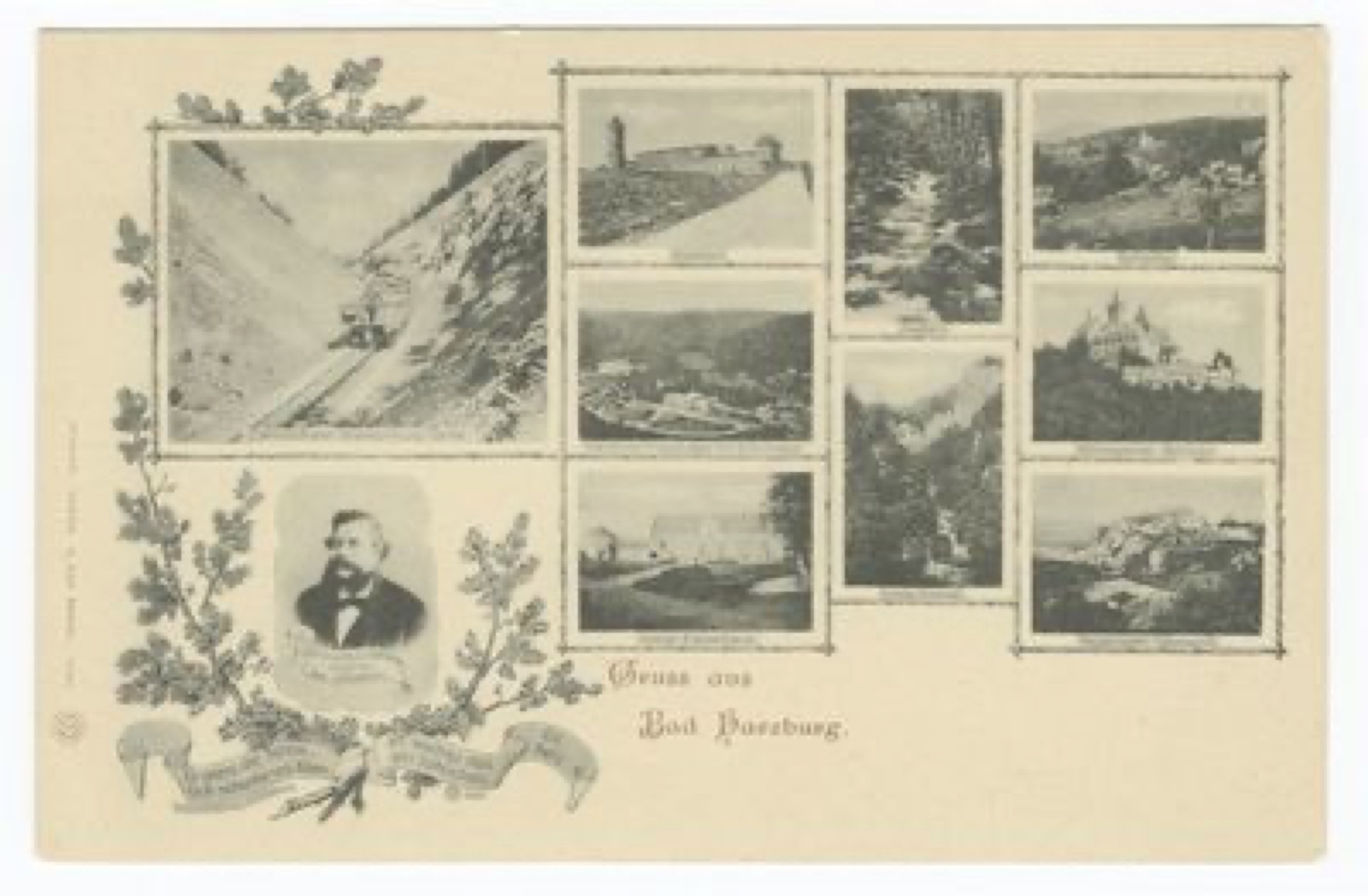
Bad Harzburg
1830 · Kassel University Library (via Europeana)
CC BY-SA