
Germany · Ruin
Falkenstein Castle
Burgruine Falkenstein
Falkenstein Castle (Neu-Falkenstein) is a ruined 14th–15th century hill castle on a rocky wooded summit above the Taunus near Königstein. Substantial remains include a tall square bergfried with a later round turret, lengths of the enceinte and shield wall, a reconstructed gateway and traces of domestic buildings within the inner ward.
Its prime
1500
Today
Ruin
As it stood in 1500
What Falkenstein Castle looked like in its prime.
Perched on a rocky wooded knoll, the castle presents a tall square bergfried of roughly coursed grey-brown rubble with a later small round turret atop; its elevated entrance sits several metres above the rock. Sections of the curtain wall and shield wall survive in irregular rubble, with two short artillery towers flanking the enceinte. The inner ward is an elongated 90 by 30 metre enclosure with remnants of an east-side building and a reconstructed pointed-arch gateway at the lower approach.
Its story
The story of Falkenstein Castle.
Falkenstein Castle, New Falkenstein, was built in the mid-14th century by the lords of Bolanden-Falkenstein, whose family home was Falkenstein Castle on the Donnersberg hill in the Palatinate. It stands at 450 metres in the Taunus, immediately next to Nüring Castle, which probably dates from the 11th century, above what is now the climatic spa of Falkenstein, a quarter of Königstein.
The counts of Sponheim were followed by Philip of Nassau in 1385, then by the lords of Hattstein and the lords of Kronberg, who were initially vassals and then owners. In the early 17th century the castle passed into the possession of the lords of Staffel, and parts of it were still occupied until about 1780 by the lords of Bettendorf, before it was demolished.
Well-preserved remains include the enceinte, part of the shield wall, two artillery towers and the 18-metre bergfried, its elevated entrance four metres up on a base of 6.75 metres square, the square tower is 14th-century, the round turret on top 15th-century. The inner ward measured about 90 by 30 metres, and the ruin is now a stop on the Taunus Club's "Three Castles Way" linking Königstein, Falkenstein and Kronberg.
Step inside
10 places to explore in 1500.
The record describes 10 distinct spots at Falkenstein Castle, including 1 interior: underground cellar (uncovered interior). Create your own photoreal reconstruction and explore every one, more scenes means more rooms, more angles, and more of the place to stand in.
Build Your Own Castle
Recreate Falkenstein Castle with AI to explore it.
The artist rebuilds it as it stood in 1500, a photoreal reconstruction that belongs to you alone. Pay with coins, no subscription needed.
Recreate this castle →Defend this castle →Whose castle
Clans who held Falkenstein Castle.
The families that held Falkenstein Castle for a decade or more across its history, follow a name to its clan.
Falkenstein
The lords of Bolanden-Falkenstein built New Falkenstein in the mid-14th century.
Sponheim
The counts of Sponheim held the castle before Philip of Nassau took possession in 1385.
Kronberg
The lords of Kronberg, initially vassals, became owners of the castle.
Staffel
The castle passed into the possession of the lords of Staffel in the early 17th century.
Bettendorf
The lords of Bettendorf occupied parts of the castle until about 1780.
From the archive
Falkenstein Castle on paper: the measured plan and period views.
The survey plan and photographs below are the ground truth this page's reconstructions are checked against, drawn and photographed while the castle was still a working garrison. Every image is public-domain or openly licensed, with its source named.
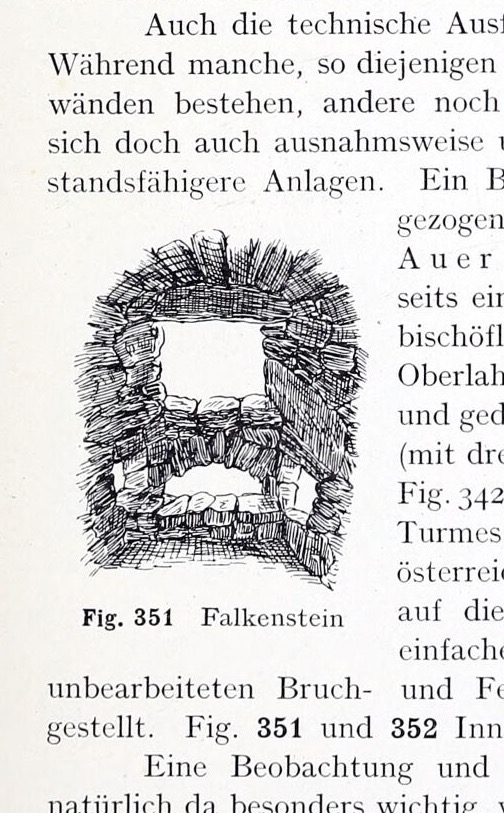
Fig. 351 Falkenstein
1912 · Otto Piper, Burgenkunde (1912)
Public domain
Nearby


