
Germany · Restored
Godesburg
The Godesburg is a hilltop castle above Bad Godesberg (now part of Bonn), Germany, originally built in the early 13th century and heavily fortified and expanded through the 16th century. Largely destroyed in 1583, the ruin was rebuilt in the 20th century and today includes a restaurant and residential spaces integrated into the old walls.
First raised
1210
Its prime
1580
Today
Restored
As it stood in 1580
What Godesburg looked like in its prime.
Dominated by a tall, cylindrical bergfried with a flat, crenellated summit and flagpole, the castle sits on a steep wooded volcanic hill. Thick, rounded curtain walls of grey-brown volcanic stone enclose lower residential ranges and irregular ruined fragments; narrow vertical arrow-slit windows puncture the tower and walls. The silhouette is compact and vertical, the tower rising clearly above the surrounding treeline and terraces built into the slope; at its prime the curtain was continuous and the inner buildings complete.
Its story
The story of Godesburg.
The Foundation Stone of 15 October 1210
The Godesberg is a volcano that went out in prehistoric times, and the only marked rise in the funnel of the Rhine valley around Bad Godesberg. People were on it long before the archbishops: a Roman altar stone was later found built into the masonry of the castle, and in 722 the hill is named in a charter as the Ubian cult place Woudensberg, or Wotansberg. A refuge fort is thought to have stood there, raised by the Franks, and nineteenth-century historians of the Heimat movement supposed that in pre-Christian times the peak was used to call on the god Wotan, from which supposition grew the idea that the fort stood on an ancient cult site.
On 15 October 1210 Dietrich I of Hengebach, Archbishop of Cologne, laid the foundation stone of a new building; he was himself in disputed possession of the electorate and fighting to hold his position. He did not see it finished; after his death in 1224 his successors completed the fortress, and in the chronicles of the thirteenth to fifteenth centuries it appears as both a symbolic and physical embodiment of the archbishop's power in his long contest for regional authority with the patricians of the imperial city of Cologne.
Raising the Bergfried
Archbishop Konrad von Hochstaden enlarged the castle in 1244 with the first five storeys of the bergfried; Walram von Jülich carried the tower up to 32 metres and built the outer bailey. The keep was cylindrical rather than square in the manner of many medieval donjons, and successive archbishops kept adding to it: stronger walls, wider moats, further levels on the tower, a small residence, dungeons and a chapel within the inner works, a curtain wall, better roads. By the late fourteenth century the fortress held the Elector's valuables and archives, and by the middle of the sixteenth it was popularly reckoned the Lieblingssitz, the favourite seat, of the Electors of Cologne.
Five Weeks Against the Count of Cleves
In the time of Siegfried II of Westwald (1275–1295) the castle held out through a five-week siege by Count William of Cleves. By the 1580s it had become an elaborate stone fortress, improved in part in the style made popular by Italian military architects: the hilltop would not take a star-shaped trace italienne, but its cordons of thick, rounded walls and massive iron-studded gates still made it a formidable adversary, and the steepness of the peak made artillery fire difficult.
The Cologne War and the Latrine, 17 December 1583
Gebhard I von Waldburg, Archbishop of Cologne, broke the Peace of Augsburg when he married Countess Agnes von Mansfeld and went over to Calvinism, and so set off the war known in Germany as the Truchsessischer Krieg. In 1583 the troops of the newly elected Elector, Ernst of Bavaria, invested the Godesburg. The wall was blown up in the course of an attack, and on 17 December 1583 a Catholic mercenary found his way into the castle through the latrine; others followed by the same road, and the garrison, threatened within and without its partly ruined walls, had to surrender. A Roman votive stone of about AD 200, dedicated to the healing gods Aesculapius and Hygieia, was found at the Godesburg that same year.
From the Emperor's Gift to Böhm's Rebuilding
In 1891 the German emperor Wilhelm II made over the ruin to what was then the municipality of Godesberg, and an air-raid shelter was driven in beneath it during the Second World War. In 1959 the ruin was reworked to plans by Gottfried Böhm, an extension taking a hotel and restaurant; the hotel tract was afterwards broken up into flats. Bonn spent 2.7 million euros on the restaurant premises to 2003, and work on the bergfried was completed in June 2006, a small centre on the castle's history being fitted inside the tower.
Step inside
8 places to explore in 1580.
The record describes 8 distinct spots at Godesburg, including 3 interiors: inner courtyard (inner bailey), castle chapel, underground dungeons and vaults. Create your own photoreal reconstruction and explore every one, more scenes means more rooms, more angles, and more of the place to stand in.
Build Your Own Castle
Recreate Godesburg with AI to explore it.
The artist rebuilds it as it stood in 1580, a photoreal reconstruction that belongs to you alone. Pay with coins, no subscription needed.
Recreate this castle →Defend this castle →From the archive
Godesburg on paper: the measured plan and period views.
The survey plan and photographs below are the ground truth this page's reconstructions are checked against, drawn and photographed while the castle was still a working garrison. Every image is public-domain or openly licensed, with its source named.
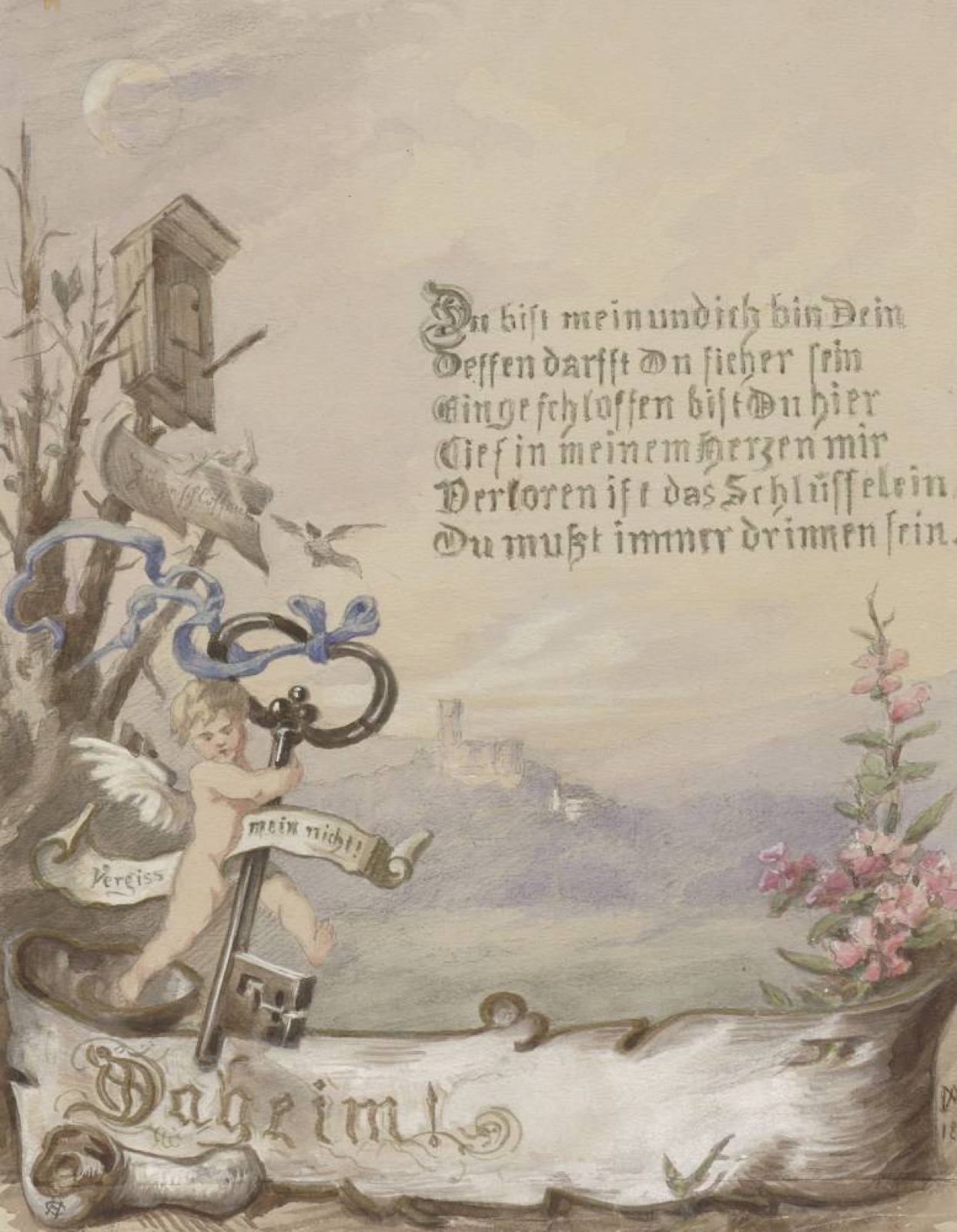
Schmuckbild mit Godesburg und Reim
· State Archives of Baden-Württemberg (via Europeana)
CC BY
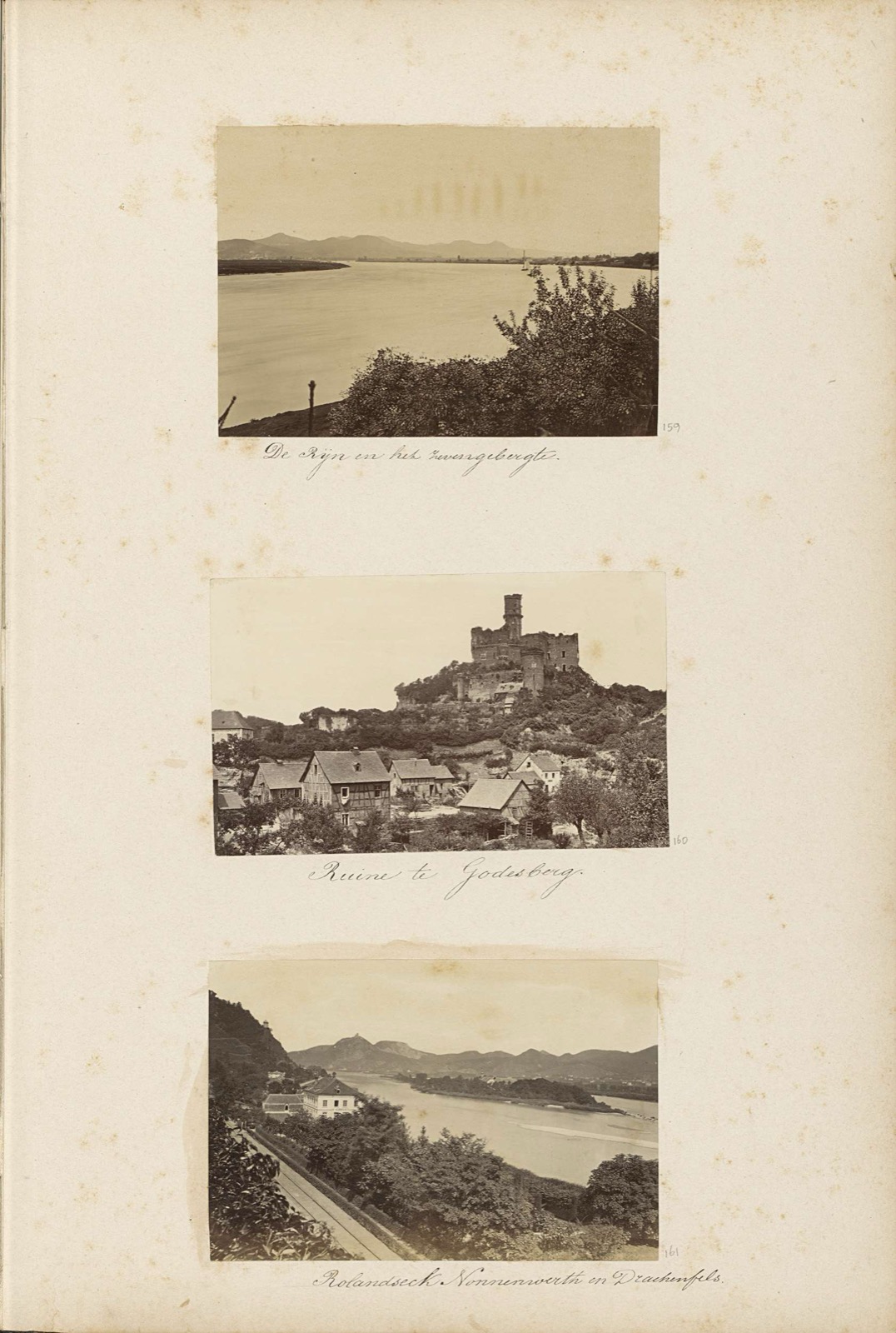
Gezicht op vakwerkhuizen en de kasteelruïne van Godesburg
· Rijksmuseum (via Europeana)
Public domain
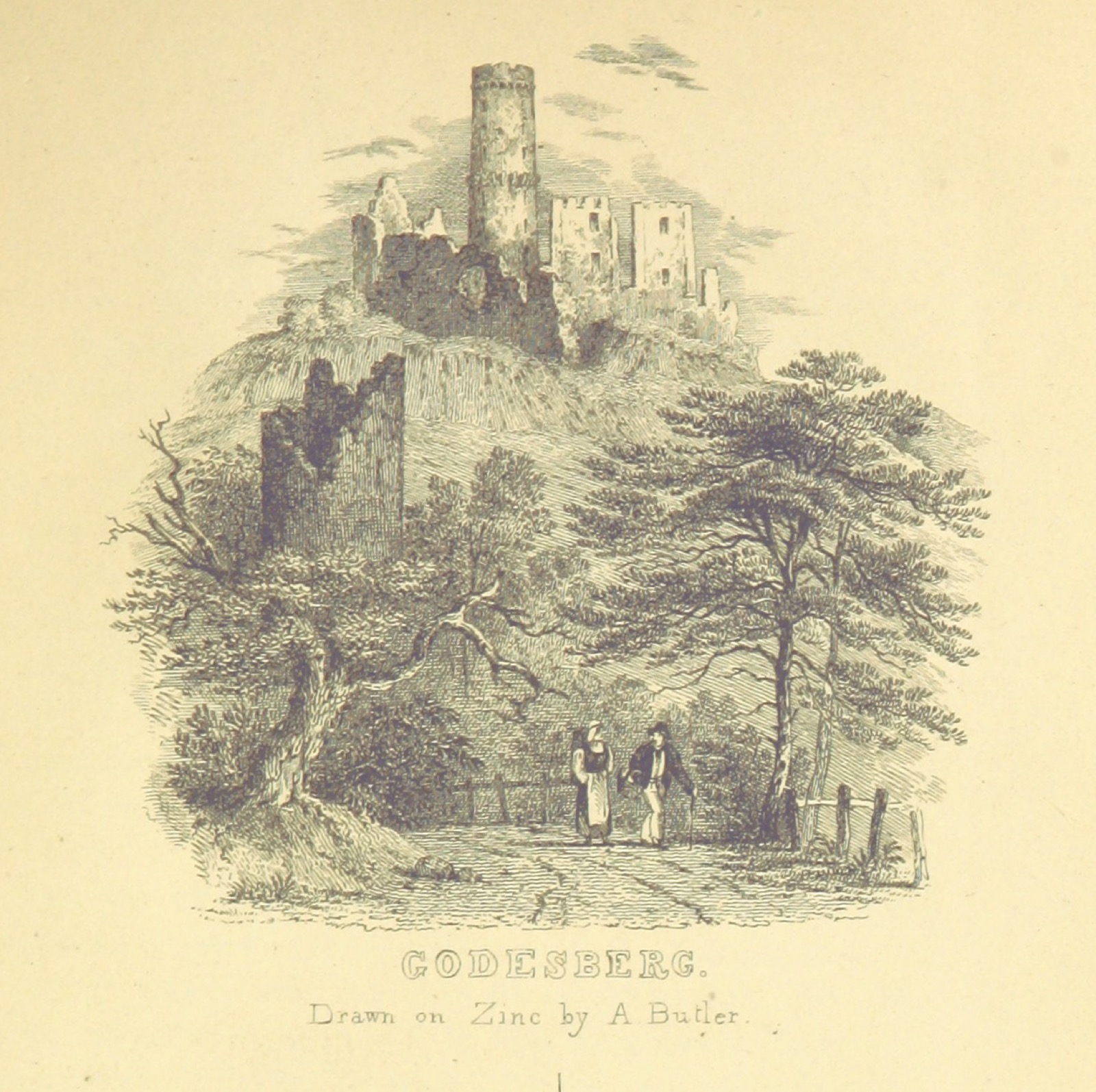
Godesburg Castle from "The Rhine: legends, traditions, history, from Cologne to Mainz".
1839 · The British Library (via Europeana)
Public domain
Nearby


