Germany · Ruin
Heidelberg Castle
Heidelberger Schloss
Heidelberg Castle is a large hilltop castle complex overlooking the city of Heidelberg on the Königstuhl slope in Baden-Württemberg, Germany. Once the seat of the Electors Palatine, the surviving fabric is a mix of medieval and Renaissance palace buildings now preserved as a ruin and landmark.
Its prime
1650
Today
Ruin
As it stood in 1650
What Heidelberg Castle looked like in its prime.
A sprawling red‑sandstone hilltop stronghold with a long, multi-level west façade of closely spaced rectangular windows and three steep slate roofs with stepped Renaissance gables; a tall square tower at the left end and several lower towers and curtain walls to the right. Broad stone terraces and arcaded lower levels step down the slope, all set against the wooded Königstuhl hillside; at its prime the roofs, gables, battlements and curtain walls were complete and continuous.
Its story
The story of Heidelberg Castle.
The Wittelsbachs on the Jettenbühl
In 1214 the dukes of Bavaria, of the House of Wittelsbach, were enfeoffed with the Palatinate, and a castle at Heidelberg, castrum in Heidelberg cum burgo ipsius castri, enters the written record with Louis I of Bavaria holding it in fief, in a document dated 1214 by some accounts and 1225 by others. A single castle is named for the last time in 1294, and a charter of 1303 lists two: an upper castle on the Kleiner Gaisberg, which lightning destroyed in 1537, and a lower castle on the Jettenbühl, the spur where the ruin stands today.
When Ruprecht III was made King of Germany in 1401 the castle was so cramped that he came back from his coronation with nowhere to put his court and had to lodge it in the Augustinians' monastery, on what is now University Square. He wanted room for his household and defences enough to make the place a fortress; the oldest visible parts of the castle date roughly from his reign. At his death in 1410 the Palatinate went to his eldest son, Ludwig III, who as the emperor's deputy and supreme judge held the deposed antipope John XXIII at the castle in 1415, on Sigismund's orders after the Council of Constance.
The Palatine Fritz and His Three Hostages, 1462
In the Baden–Palatine War of 1462 the castle held three prisoners at once. Elector Friedrich I, the Palatine Fritz, seized Margrave Karl I of Baden, Bishop Georg of Metz and Count Ulrich V of Württemberg and kept them in chains on hard rations until they agreed to pay: Karl handed over 25,000 gulden, pledged his share of the county of Sponheim and declared Pforzheim a Palatine fief, and the bishop of Metz paid 45,000. What mattered most was that Friedrich's claim to the electorship was now secure. Legend has him explaining the want of bread at table by sending his unwilling guests to the window to look down on the country his war had stripped bare, a scene retold in Gustav Schwab's poem Das Mahl zu Heidelberg.
The Winter King, Tilly and Twenty-Four Tonnes of Powder
Frederick V, elector from 1610, married Elizabeth Stuart, daughter of the king of England, for love, and raised the Elizabeth Gate at the castle's Stückgarten for the wedding festivities. He also brought back from England architects in the king's service, Salomon de Caus and Inigo Jones, and began an enormous pleasure garden that had been designed for level ground and then had to be forced onto the side of a mountain; the earthworks alone were reckoned by contemporaries an eighth wonder of the world.
Frederick took the crown of Bohemia in 1619 against the advice of many of his counsellors, and in doing so set the Thirty Years' War going. He lost the kingdom at the White Mountain on 8 November 1620, went under the imperial ban in 1621 and died in exile in 1632, mocked as the Winter King because his reign had outlasted little more than a winter. He had released his troops early, leaving the Palatinate to English auxiliaries with little to set against the Catholic League army under Tilly, who opened his attack on 26 August 1622, took the town on 16 September and the castle a few days later. It was the first time shot had been fired at the walls.
Swedish troops took the town on 5 May 1633 and opened fire from the Königstuhl behind the castle, and the Bavarian commander handed it over on 26 May. After the heavy Swedish defeat at Nördlingen in September 1634, imperial and Bavarian troops retook the town meaning to blow the castle up, and inside a fortnight packed twenty-four tonnes of powder into galleries beneath its walls. In December a French army appeared without warning and they fled, leaving the mines unfired. They came back in July 1635 to take town and castle for good, and Charles Louis, Frederick V's son, moved into the damaged seat of his family on 7 October 1649.
Brûlez le Palatinat, 1688–1693
Charles II died without an heir and the Palatinate-Simmern line ended with him. Louis XIV pressed the claim of his brother Philippe of Orléans, whose wife Elizabeth Charlotte (Liselotte, born in the castle) was Charles's sister. French troops marched into the Palatinate on 29 September 1688 and into Heidelberg on 24 October, the new elector Philipp Wilhelm having already left. At war with an alliance of European powers, the French war council resolved to level every fortification and lay the country waste: Brûlez le Palatinat. Withdrawing on 2 March 1689 they fired the castle and blew the front off the Fat Tower.
Johann Wilhelm had the walls and towers rebuilt as soon as he succeeded in 1690, and the French who came back to the gates in 1691 and 1692 found the defences too good and went away empty-handed. On 18 May 1693 they returned once more and took the town on the 22nd. The castle they could not take, so they destroyed the town beneath it to strip away its base of support, and the garrison capitulated the next day; on 6 September French engineers mined the towers and walls that had survived the first destruction and blew them up. Liselotte watched from the French court as her country was laid waste in her name, and thirty-six years into her life there was still asking why the elector did not have the castle rebuilt: 'It would certainly be worth it.'
Grass on Her Streets: From Quarry to Monument
The Treaty of Ryswick brought peace to the town in 1697. The first plan was to pull the castle down and carry the usable parts into the valley for a new palace; when that ran into difficulty it was patched up instead, and Charles III Philip shelved a complete redesign for want of funds. In 1720 he fell out with Heidelberg's Protestants by handing the Church of the Holy Spirit, until then divided by a partition and shared, wholly to the Catholics, and on 12 April removed his court and all its administrative bodies to Mannheim, with the parting wish that 'grass may grow on her streets'. His successor Karl Theodor meant to bring the court back, until lightning struck the Saalbau twice in succession on 24 June 1764 and the castle burned again. He read it as a sign from heaven and changed his mind.
What came next was slower than fire. The south wall had been quarried since 1767 for stone to build Schwetzingen, and when Heidelberg passed to Baden in the mediatisation of 1803, Grand Duke Charles Frederick thought the castle an unwanted addition to his new territory while townspeople helped themselves to its stone, wood and iron. A Frenchman saved it. Count Charles de Graimberg, an engraver who had fled the Revolution to England, came to sketch the ruin in 1810 and stayed the remaining fifty-four years of his life, fighting a government that dismissed the place as an 'old ruin with a multitude of tasteless, crumbling ornaments' and paying out of his own fortune for the collection of finds that became the nucleus of the Kurpfälzisches Museum. In 1890 a commission of specialists from across Germany settled the rebuilding question: the castle could be preserved as it stood, but neither wholly nor partly rebuilt. Only the Friedrich Building, burnt inside but not ruined, was restored, between 1897 and 1900, at a cost of 520,000 marks.
Step inside
8 places to explore in 1650.
The record describes 8 distinct spots at Heidelberg Castle, including 2 interiors: court chapel (interior), wine cellar and tun (interior). Create your own photoreal reconstruction and explore every one, more scenes means more rooms, more angles, and more of the place to stand in.
Build Your Own Castle
Recreate Heidelberg Castle with AI to explore it.
The artist rebuilds it as it stood in 1650, a photoreal reconstruction that belongs to you alone. Pay with coins, no subscription needed.
Recreate this castle →Defend this castle →Whose castle
Clans who held Heidelberg Castle.
The families that held Heidelberg Castle for a decade or more across its history, follow a name to its clan.
Wittelsbach
Seat of the Wittelsbach Electors Palatine from 1214 until the Thirty Years' War.
From the archive
Heidelberg Castle on paper: the measured plan and period views.
The survey plan and photographs below are the ground truth this page's reconstructions are checked against, drawn and photographed while the castle was still a working garrison. Every image is public-domain or openly licensed, with its source named.
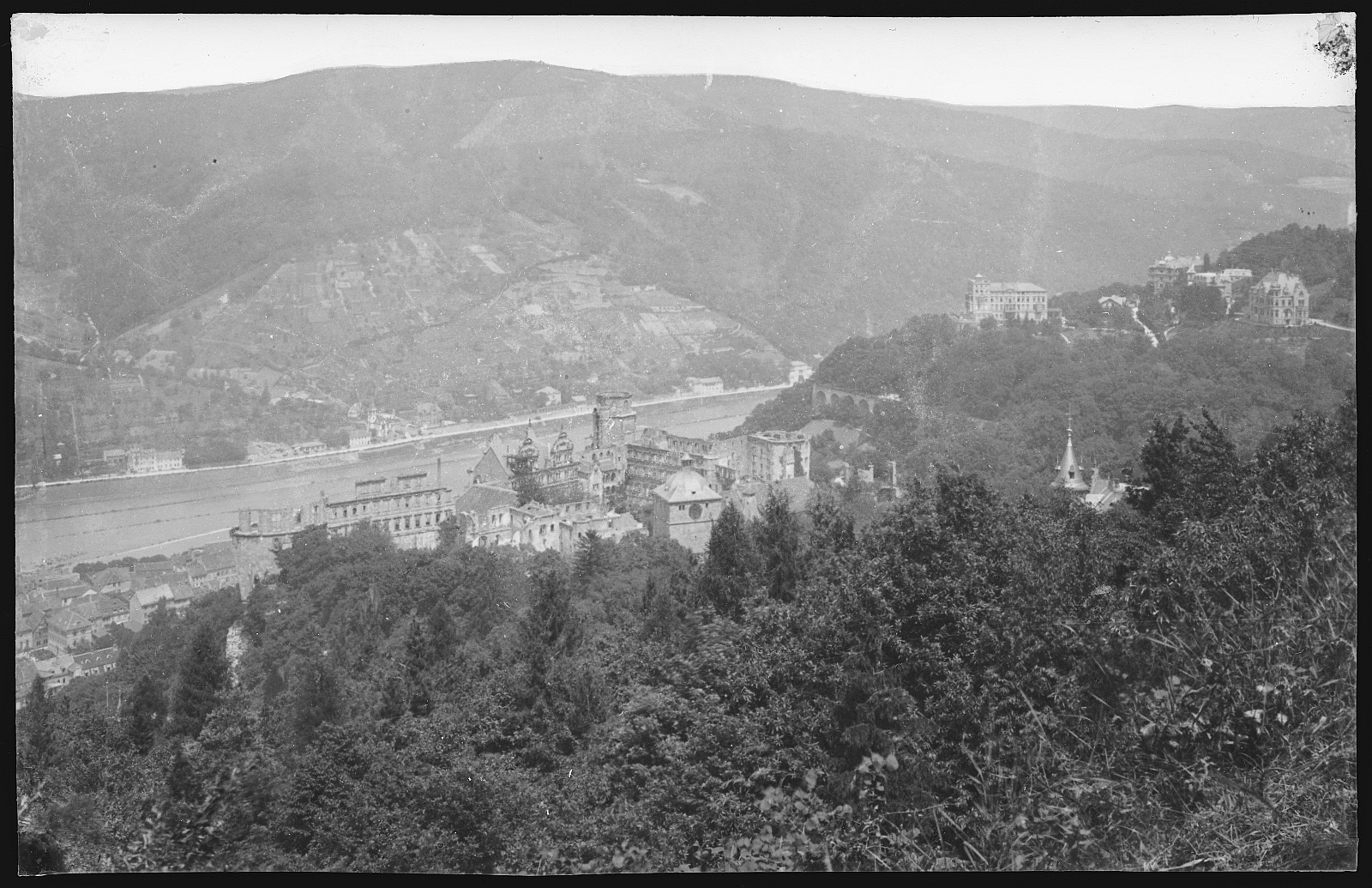
Heidelberg. Schloss
· Deutsche Fotothek (via Europeana)
Public domain
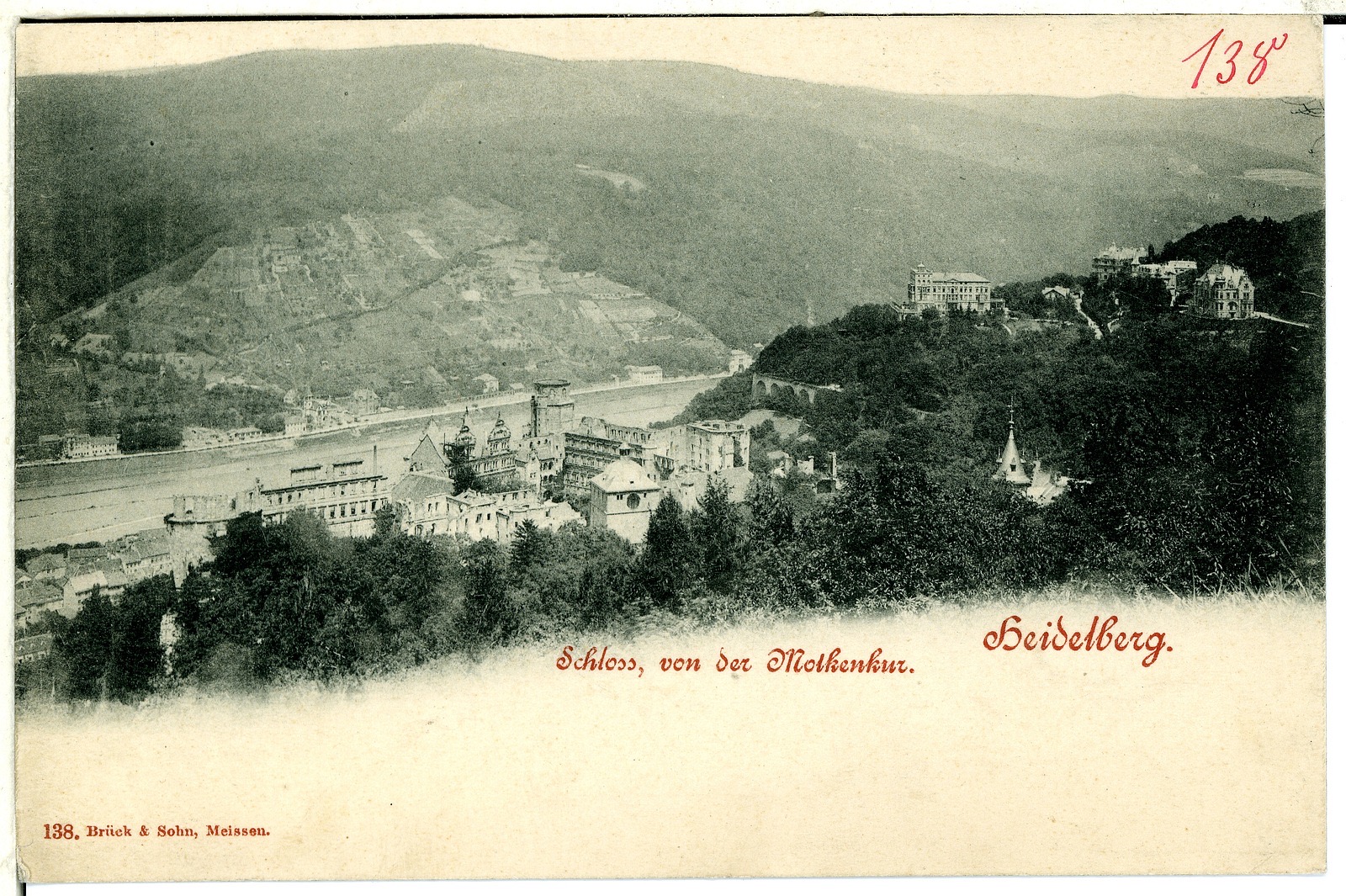
Heidelberg. Castle
· Deutsche Fotothek (via Europeana)
Public domain
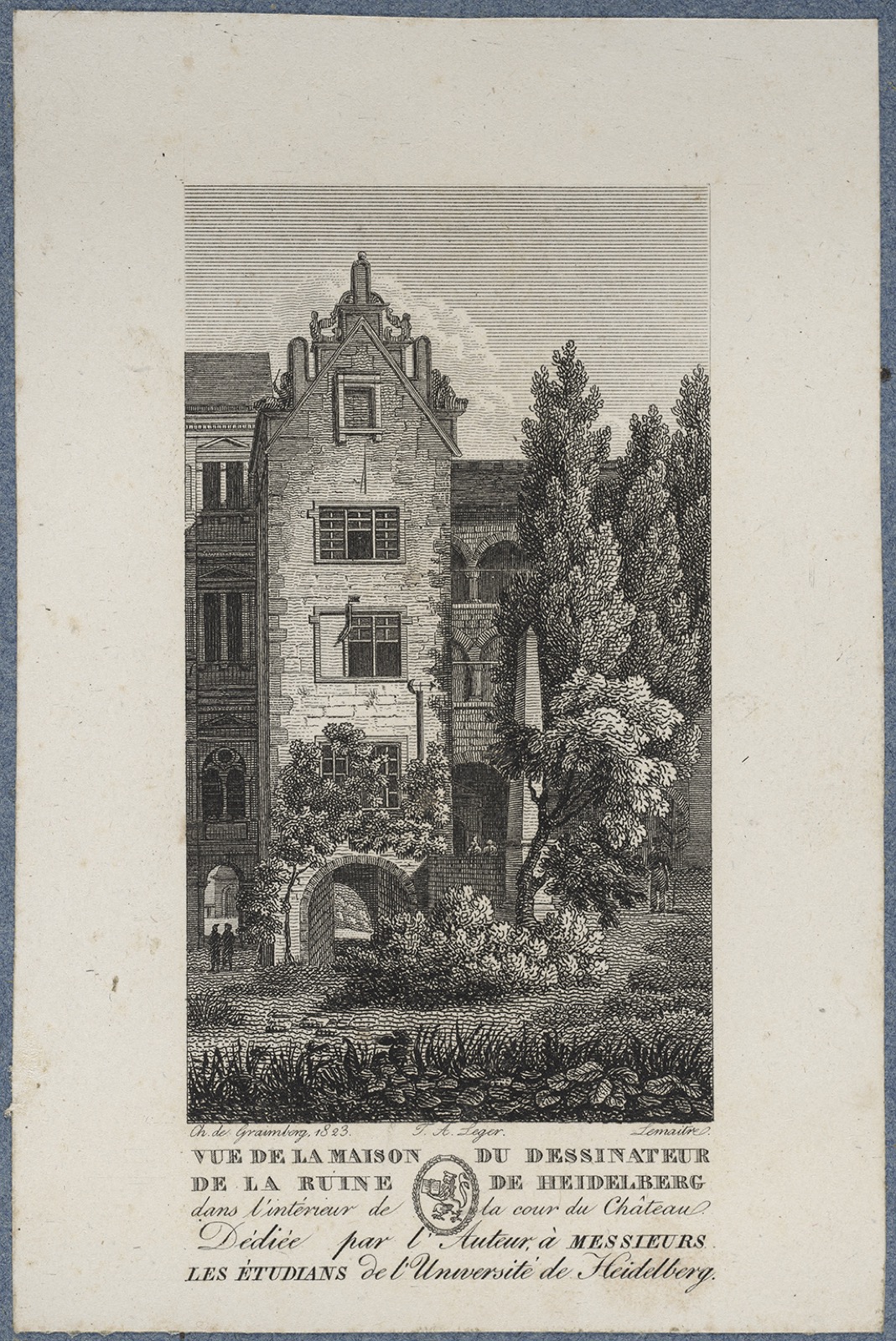
Heidelberg, castle, courtyard
· Deutsche Fotothek (via Europeana)
CC BY-SA

Questions about Heidelberg Castle
What is the history of Heidelberg Castle?
What is inside Heidelberg Castle?
Who owns Heidelberg Castle now?
Why was Heidelberg Castle built?
Does anyone live at Heidelberg Castle now?
Where is Heidelberg Castle?
When was Heidelberg Castle built?
Was Heidelberg Castle ever attacked or besieged?
Which family held Heidelberg Castle?
What did Heidelberg Castle look like in its prime?
Is Heidelberg Castle still standing?
Can you visit Heidelberg Castle?
More castles of Germany


Explore the city