Germany · Partial ruin
Hohenbaden Castle
Schloss Hohenbaden
Hohenbaden Castle (Altes Schloss) is a medieval hill castle above Baden-Baden that served as the margraves of Baden's residence for about four centuries. Built around 1100 and enlarged in the Gothic period, it reached its greatest size in the 15th century before the margraves moved to a new town palace; the hill-top complex was later ruined by fire in 1599. Today substantial masonry and towers remain on the rocky west flank of the Battert.
First raised
1102
Its prime
1453
Today
Partial ruin
As it stood in 1453
What Hohenbaden Castle looked like in its prime.
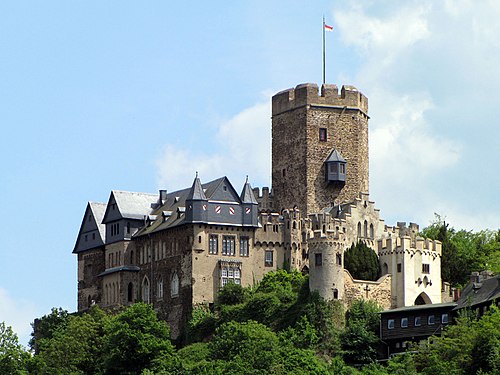
Perched on the west flank of the Battert rock, the castle forms a compact ridge-top complex of warm grey-brown masonry. A tall rectangular (square) keep crowns the highest point with a flagpole, beside a prominent cylindrical tower with a corbelled band beneath its parapet; a long rectangular residential range of multiple vertical window openings runs along the ridge, with curtain walls linking the towers and dense woodland sloping away below.
Its story
The story of Hohenbaden Castle.
Seat of the Margraves of Baden, 1100–1479
Hohenbaden Castle was built as the first seat of the Margraves of Limburg after they shifted their lordship to the Upper Rhine, on the west flank of the rocky Battert above the settlement then called Baden. Construction of the upper castle, the Hermannsbau, is dated to around 1100 under Margrave Herman II; from 1112 the family began calling themselves Margraves of Baden. Under Margrave Bernard I (1372–1431) the Gothic lower castle was added; its most significant part, the Bernhardsbau of around 1400, had a ground-floor column bearing a coat of arms borne by angels that once carried the vault above. Margrave Jacob I, who ruled from 1431 to 1453, expanded the castle further into the margraviate's representative centre, and at its height it had a hundred rooms. Later in the century Christopher I enlarged the New Castle in the town of Baden itself, begun in 1370, and moved the residence there in 1479.
Widow's Seat and the Fire of 1599
The Old Castle then served as a widow's seat. It was destroyed by fire in 1599.
From Secured Ruin to Wind-Harp Landmark, 1830–2014
The ruin was not structurally secured until after 1830. It is now maintained by the Staatliche Schlösser und Gärten Baden-Württemberg administration; entry to the castle and its tower, which gives views over Baden-Baden to the Rhine plain and the Vosges, is free, and a restaurant operates within the walls. The site is a popular starting point for walks on the Battert, with its protected climbing rocks and forest reserve. A large wind harp, 4.10 metres tall with 120 strings, has stood in the ruined knights' hall since 1999, built by the Baden-based musician and harp-maker Rüdiger Oppermann, who described it as the largest wind harp in Europe; an earlier, smaller wind harp occupied the same hall between 1851 and 1920. In 2014 a Stauferstele was erected at the car park below the ruin, marking the Margraves of Baden's historical cooperation with the Hohenstaufen dynasty. The castle is listed as a cultural heritage monument in Baden-Württemberg.
Step inside
5 places to explore in 1453.
The record describes 5 distinct spots at Hohenbaden Castle, including the full exterior approach. Create your own photoreal reconstruction and explore every one, more scenes means more rooms, more angles, and more of the place to stand in.
Build Your Own Castle
Recreate Hohenbaden Castle with AI to explore it.
The artist rebuilds it as it stood in 1453, a photoreal reconstruction that belongs to you alone. Pay with coins, no subscription needed.
Recreate this castle →Defend this castle →Whose castle
Clans who held Hohenbaden Castle.
The families that held Hohenbaden Castle for a decade or more across its history, follow a name to its clan.
Baden
Residence of the margraves of Baden for almost 400 years, from c. 1100 until Christopher I moved to the New Castle in 1479.