
Germany · Still standing
Hohenschwangau Castle
Schloss Hohenschwangau
Hohenschwangau Castle is a 19th-century Gothic Revival palace in southwestern Bavaria, built and remodelled for King Maximilian II of Bavaria and used as the childhood residence of his son Ludwig II. It stands above the village of Hohenschwangau near Lake Alpsee and is owned by the Wittelsbach family. The interior is noted for numerous 19th-century wall paintings depicting Schwangau history and medieval romances such as Parzival and Lohengrin.
First raised
1837
Its prime
1855
Today
Still standing
As it stood in 1855
What Hohenschwangau Castle looked like in its prime.
Perched on a wooded rocky hill above Lake Alpsee, the palace presents a compact, crenellated silhouette of pale yellow plastered masonry with multiple cylindrical and polygonal towers rising from a rectangular central block. The exterior shows neogothic battlements and machicolation-like corbels, red-tile coping along parapets, rows of regular rectangular windows and a columned entrance with an ornamented balcony above. A low curtain wall with tooth-shaped merlons runs along the slope in front of the castle.
Its story
The story of Hohenschwangau Castle.
The Knights of Schwangau and the Castle Called Schwanstein
The first stronghold here was a double castle, Vorder- and Hinterschwangau, on the rock that Neuschwanstein now occupies; it enters the record as Castrum Swangowe in the late eleventh or twelfth century, held by its lords as ministeriales of the Welfs. The knights of Schwangau went on holding Hohenschwangau as an imperially immediate fief until their line failed in 1536. A charter of 1397 gives the first mention of Schwanstein: less defensible, but easier to reach, standing lower down on a rise above the Alpsee. That building is today's Hohenschwangau.
Paumgartner's Castle and the 200-Gulden Demolition Sale
In 1440 Georg von Schwangau sold his inheritance, the Hohenschwangau castles and Frauenstein, to Duke Albrecht III of Bavaria-Munich, and by 1535 the last of the line were selling outright, for 35,000 florins, to a front man acting for the Augsburg patrician Johann Paumgartner. Paumgartner made the neglected castle the seat of his new lordship: his architect, Lucio di Spazzi, kept the outer walls and towers, rebuilt the interior for contemporary living and ringed the residential block with bastions, finishing in 1547. The floor plan he laid down is the one the building still has. The old double castle up on the rock was left to fall in.
The Wittelsbachs used the place for bear hunting and as a berth for younger sons of the house. Austrian troops plundered it in 1743, during the War of the Austrian Succession, and through the coalition wars of 1800 to 1809 it quartered French and Austrian troops and took a short, inconclusive French bombardment. In 1820 it was sold under King Maximilian I for 200 gulden to a local man, for demolition; Prince Ludwig von Oettingen-Wallerstein heard of the plan in 1821, bought it himself for 225 gulden to save it, and had it repaired before selling it on in 1823.
Crown Prince Maximilian's Rebuilding, 1832–1855
Ludwig I intended his son Maximilian to take the Hohes Schloss at Füssen; the crown prince went there in 1829, walked on towards Reutte in Tyrol, and passed through Hohenschwangau on the way. He gave up Füssen, negotiated for three years, and bought the dilapidated Schwanstein in 1832, renaming it Schloss Hohenschwangau, which is how the two castles came to trade names. Rebuilding ran from 1833 to 1837 under the architectural and theatre painter Domenico Quaglio, who gave the exterior its neo-Gothic dress and whom Maximilian put in charge over the architect Georg Friedrich Ziebland. Quaglio, no practical builder, exhausted himself and died shortly before it was finished; Joseph Daniel Ohlmüller and Ziebland saw the work out, and additions went on to 1855.
More than ninety wall paintings went up in 1835 and 1836, after designs by Moritz von Schwind and Ludwig Lindenschmit the Elder, drawing on the history of the Schwangau and on medieval legend: the Nibelungs, the Edda, and the Swan Knight Loherangrîn of Wolfram von Eschenbach's Parzival, which Wagner later worked into Lohengrin. One fresco records a local tradition that Christoph von Langenmantel brought Martin Luther out of Augsburg to Hohenschwangau in 1518 for his safety.
The Boys in the Annexe, and Ludwig's Painted Sky
Hohenschwangau was the summer and hunting residence of Maximilian, his wife Marie of Prussia, and their sons Ludwig and Otto. The king and queen lived in the main building, the boys in the annexe; Marie, who loved to walk in the mountains, made an alpine garden from plants gathered across the Alps and took her sons up to the ruins of Vorder- and Hinterhohenschwangau. When Maximilian died in 1864 Ludwig succeeded and moved into his father's room; as he never married, his mother kept her own floor through the summer months, and he used the castle mostly when she was not in it: the more so after 1869, when work began on Neuschwanstein, his own castle on the rock of the old Schwangau fortress above.
The one thing Ludwig altered here was his bedroom. In 1864 he had a group of rocks built into it with a waterfall running over them, an apparatus for making an artificial rainbow, and a night sky of moon and stars lit from the floor above through a system of mirrors; after his death in 1886 Marie had the room put back as it had been. She stayed on as the castle's only resident and died there in 1889. Prince Regent Luitpold brought electric light and an electric lift to the castle in 1905; after his death in 1912 it opened as a museum. Neither world war damaged it, and in 1923 it passed to the Wittelsbach Compensation Fund, which owns it still.
Step inside
9 places to explore in 1855.
The record describes 9 distinct spots at Hohenschwangau Castle, including 2 interiors: state rooms with historical wall paintings, annex room where the princes lived. Create your own photoreal reconstruction and explore every one, more scenes means more rooms, more angles, and more of the place to stand in.
Build Your Own Castle
Recreate Hohenschwangau Castle with AI to explore it.
The artist rebuilds it as it stood in 1855, a photoreal reconstruction that belongs to you alone. Pay with coins, no subscription needed.
Recreate this castle →Defend this castle →Whose castle
Clans who held Hohenschwangau Castle.
The families that held Hohenschwangau Castle for a decade or more across its history, follow a name to its clan.
Wittelsbach
Rebuilt by King Maximilian II of Bavaria as the childhood home of Ludwig II; still held by the Wittelsbach fund.
From the archive
Hohenschwangau Castle on paper: the measured plan and period views.
The survey plan and photographs below are the ground truth this page's reconstructions are checked against, drawn and photographed while the castle was still a working garrison. Every image is public-domain or openly licensed, with its source named.
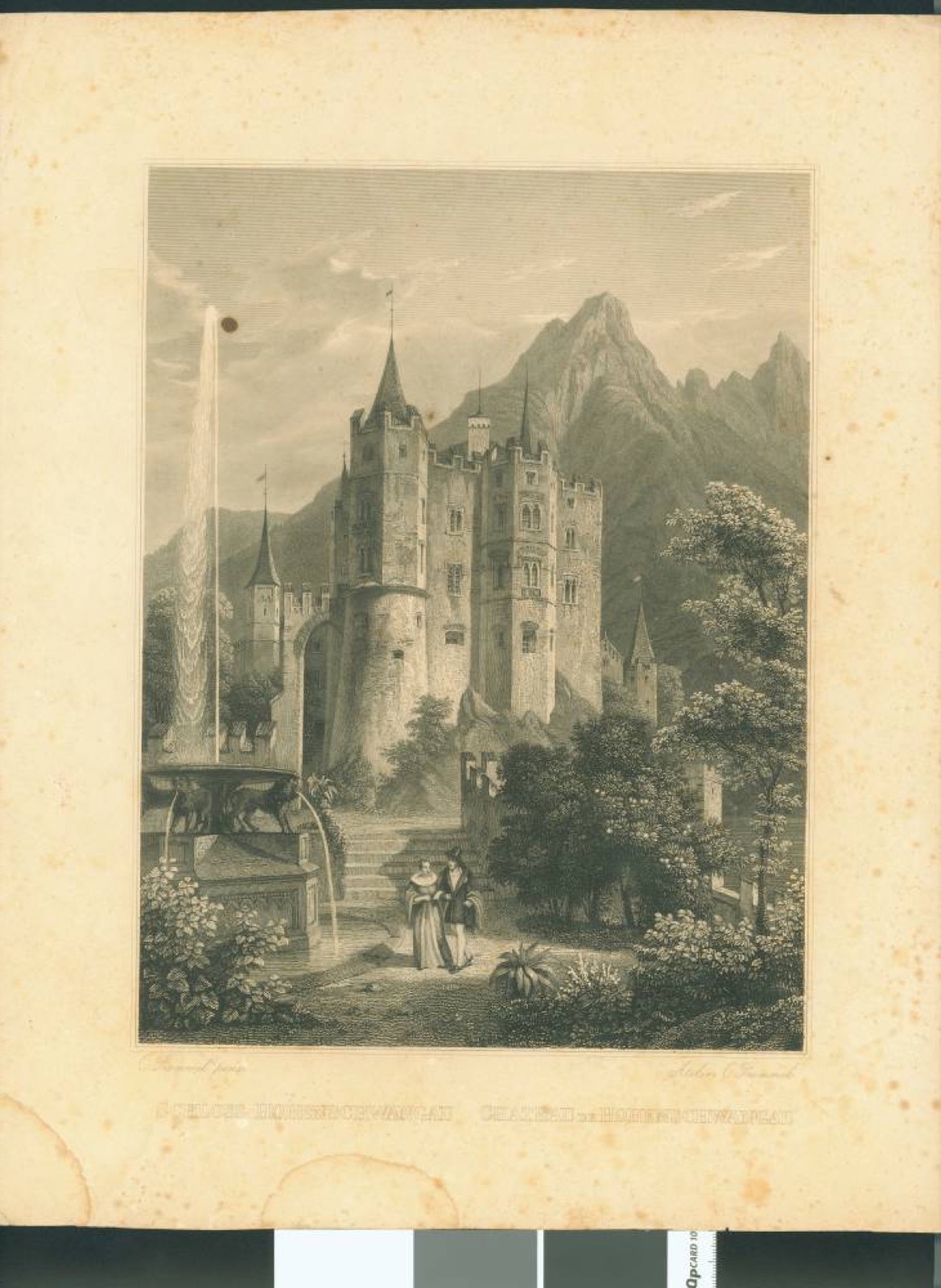
Schloss Hohenschwangau - Château de Hohenschwangau
· State Archives of Baden-Württemberg (via Europeana)
CC BY


