
Germany · Ruin
Lauenstein Castle
Burg Lauenstein (Ith)
Lauenstein Castle is a 13th-century hill castle on a wooded summit of the Ith ridge above the village of Lauenstein in Lower Saxony. It served as the seat of the Homburg Amt and later changed hands among regional rulers before losing military significance; it fell into disrepair and was largely demolished in the early 19th century, leaving a compact ruin on a moated plateau.
First raised
1247
Its prime
1359
Today
Ruin
As it stood in 1359
What Lauenstein Castle looked like in its prime.
Perched on a summit of the Ith ridge, the castle occupies a roughly 50 by 50 metre stone plateau surrounded by steep wooded slopes and a broad moat. A fortified gateway is preceded by a zwinger whose masonry walls reach about four metres in height; a continuous stone enceinte once encircled the plateau. At its prime the gatehouse, inner domestic ranges and service buildings filled the enclosed courtyard, all set within the compact, circular defensive footprint.
Its story
The story of Lauenstein Castle.
Built by the Homburgs, Ceded to Otto the Child in 1247
The barons of Homburg raised Lauenstein on an island-like cone of hill in a narrow valley running down from the Ith ridge, after their victory over the counts of Spiegelberg. The neighbouring castle of Spiegelberg was destroyed in 1226; the building of Lauenstein is put at the beginning of the 13th century by some accounts and at about 1240 by others. What is fixed is 1247, when Heinrich von Homburg made the castle over to the Welf duke Otto the Child with the consent of all his heirs and received it back from him as a fief. The charter of 30 June that year is Lauenstein's first record, and Welf protection was what it bought.
Under that protection, people from villages that had fallen derelict settled on the ground below and founded the village of Lauenstein, first named in a document in 1430. The castle held the seat of the Homburg Amt of Lauenstein, which by 1359 took in forty places in the country between the Ith, the Hils and the Leine.
Pledged to Bishop Magnus of Hildesheim, 1409-1515
The male line of the Homburgs died out in 1409 and the castle passed with all its chattels to the Welf dukes of Brunswick-Lüneburg. Financial difficulty moved them to pledge it in 1433 to Bishop Magnus of Hildesheim, who sublet it on in turn: the brothers von Cramm in 1434, Ludolf von Ruscheplate in 1445, the brothers Böcke von Nordholz in 1456, Bartold von Oberg and the knightly brothers vom Rutenberge in 1495, then Heinrich von Saldern in 1497 and his son Burchard in 1515.
A document of 1456 names the buildings then standing: a cellared Great House, a kitchen, a bakehouse with two chimneys, a zwinger with two bulwarks, and an outer ward with a ditch around it. The gate building carried flanking towers, and the ring wall is said to have been some 3.5 metres thick.
Burchard von Saldern's Fire and the Hildesheim Diocesan Feud, 1515-1521
When Burchard von Saldern and his two brothers took over castle and Amt from their father Heinrich in 1515, the bishop of Hildesheim terminated the contract. The brothers refused to give either up, and demanded 3,000 guilders for what they had invested in the defences. Arbitration in 1518 ruled that the bishop should repay the building costs and that the von Salderns should quit Lauenstein. Burchard would not take the money offered and was driven from the castle that same year, Stacius von Münchhausen being installed in his place as the Hildesheim advocate.
An attempt on the castle failed, and Burchard burned Lauenstein down in revenge, nailing a letter of feud to the castle gate: "Borchert von Salder do bekand; dat ick hebbe jedan dußen Brand; dat bekenne ick mit meiner Hand", Burchard von Saldern makes known that I lit this fire; I confess it with my own hand. The act fed the fighting of the Hildesheim Diocesan Feud. The dukes of Brunswick-Lüneburg took the castle back in 1521 and reinstated Burchard von Saldern in the Amt.
Forced Out in 1587, Plundered in the Thirty Years' War
Burchard's son Heinrich fell out with the dukes of Brunswick-Lüneburg in 1587 and was evicted; after him the castle was managed by bailiffs. During the Thirty Years' War imperial troops under Tilly fell on the village of Lauenstein and did great damage, staying four years as an occupying force. Swedish troops followed in 1637, and in 1640 soldiers from Weimar plundered the place. The castle had counted for nothing militarily since that war, and decayed from then on.
Quarry, Farm and Belvedere on the Castle Hill
When a house fire burned the village of Lauenstein to the ground in 1730, stone from the castle was used to rebuild it. The ground of the outer ward, called the Knabenburg, was bought in 1737 by the Amtmann Niemeyer, who farmed it until 1850, and in 1806 the village was used as billets for Napoleonic troops. At the beginning of the 19th century the last remnants of the castle were pulled down and the castle well filled in.
In the middle of the 19th century a small observation tower was put up on the highest point of the castle hill, since fallen derelict, along with a chapel-like building known as the Teehaus, whose ceiling has now caved in; the thick wood that covers the site was planted when the hill was remodelled. A notice at the entrance now closes the site off, the crumbling walls and steep hillsides bringing a risk of collapse and of falls.
Step inside
6 places to explore in 1359.
The record describes 6 distinct spots at Lauenstein Castle, including the full exterior approach. Create your own photoreal reconstruction and explore every one, more scenes means more rooms, more angles, and more of the place to stand in.
Build Your Own Castle
Recreate Lauenstein Castle with AI to explore it.
The artist rebuilds it as it stood in 1359, a photoreal reconstruction that belongs to you alone. Pay with coins, no subscription needed.
Recreate this castle →Defend this castle →Whose castle
Clans who held Lauenstein Castle.
The families that held Lauenstein Castle for a decade or more across its history, follow a name to its clan.
Homburg
Built by the barons of Homburg in the 13th century; their male line died out in 1409.
Welf
Transferred to the Welf duke Otto the Child in 1247; held by the dukes of Brunswick-Lüneburg after 1409.
From the archive
Lauenstein Castle on paper: the measured plan and period views.
The survey plan and photographs below are the ground truth this page's reconstructions are checked against, drawn and photographed while the castle was still a working garrison. Every image is public-domain or openly licensed, with its source named.
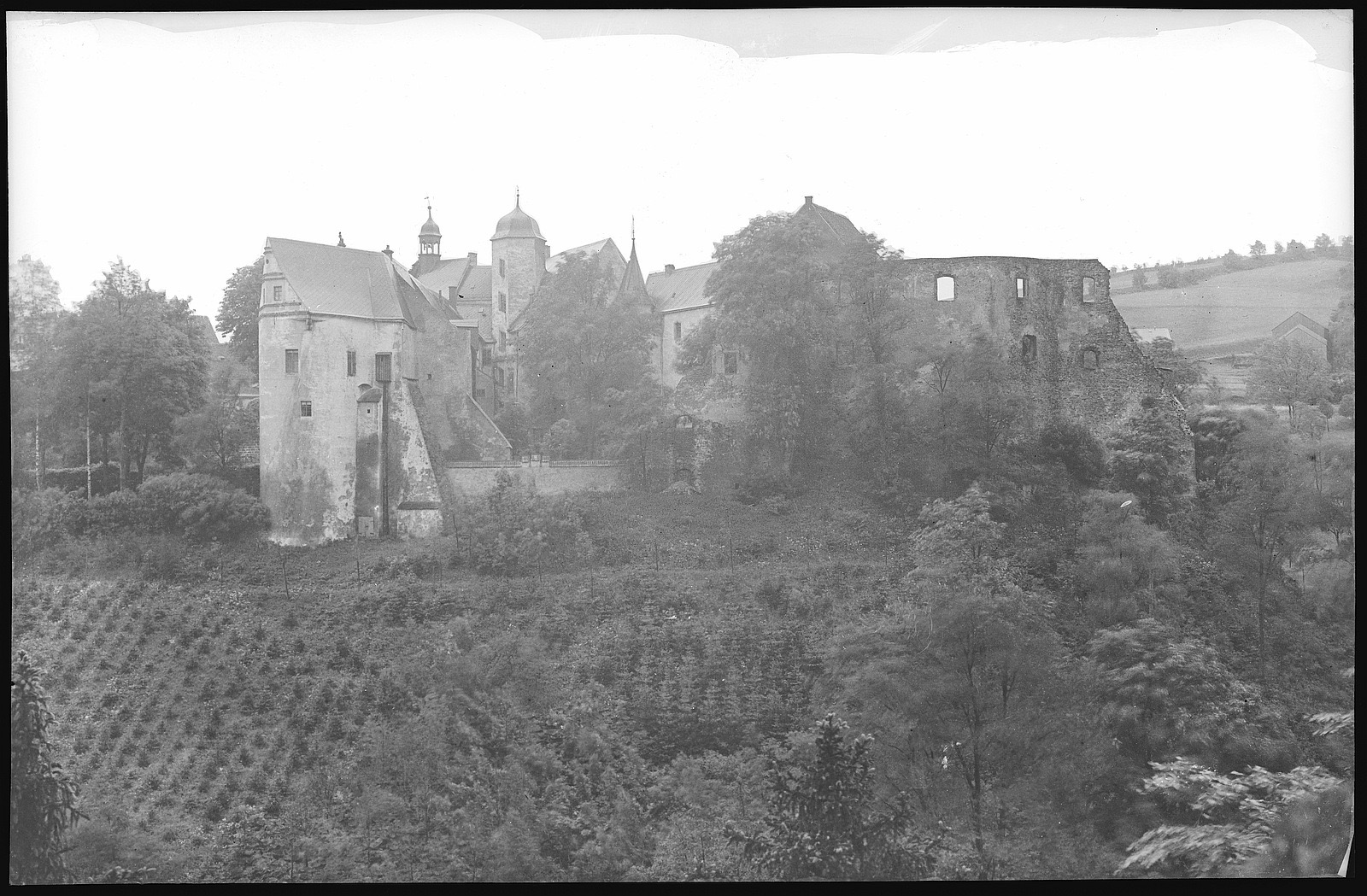
Lauenstein. Schloss
· Deutsche Fotothek (via Europeana)
Public domain
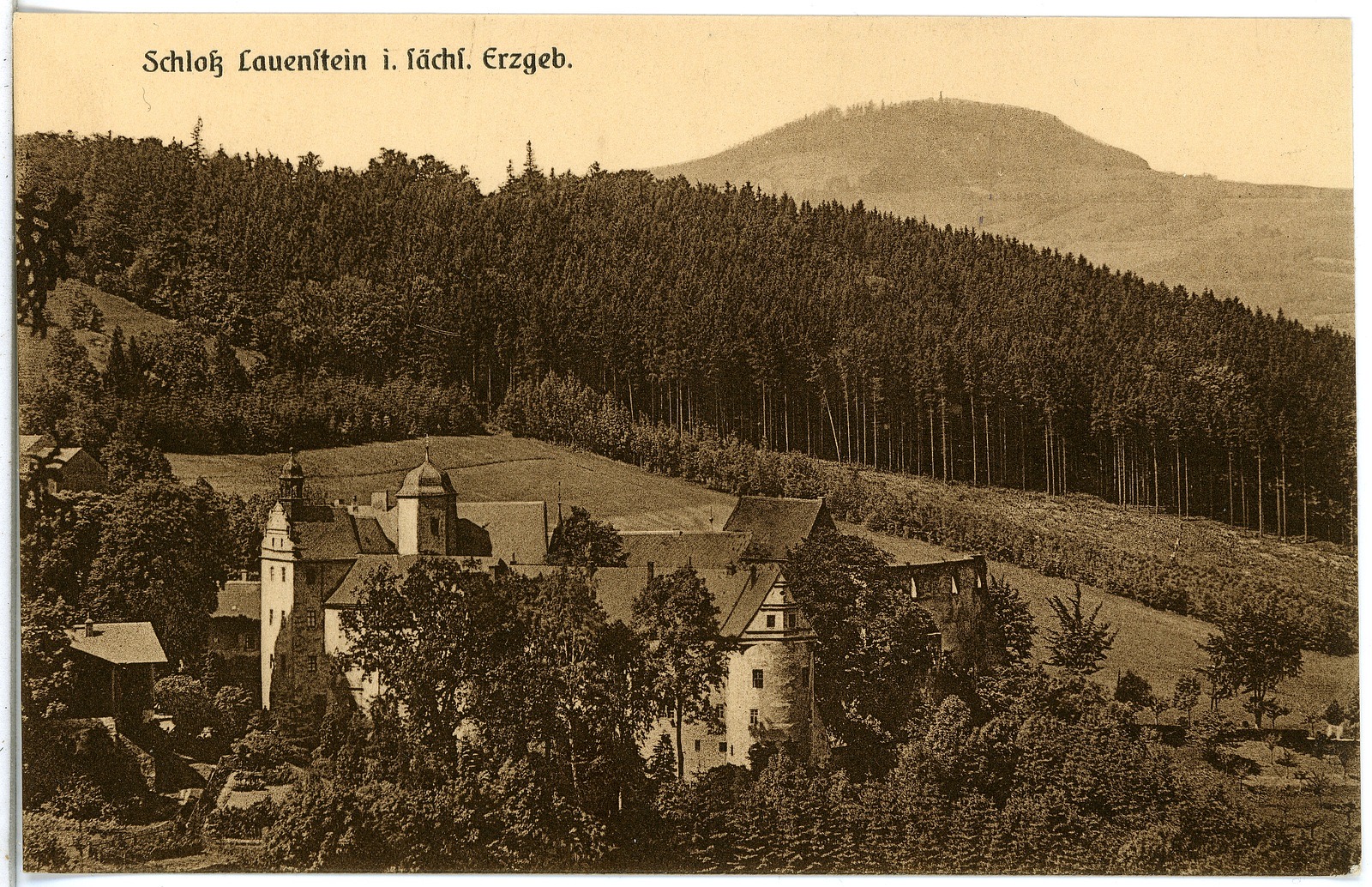
Lauenstein. Schloss
· Deutsche Fotothek (via Europeana)
CC BY-SA
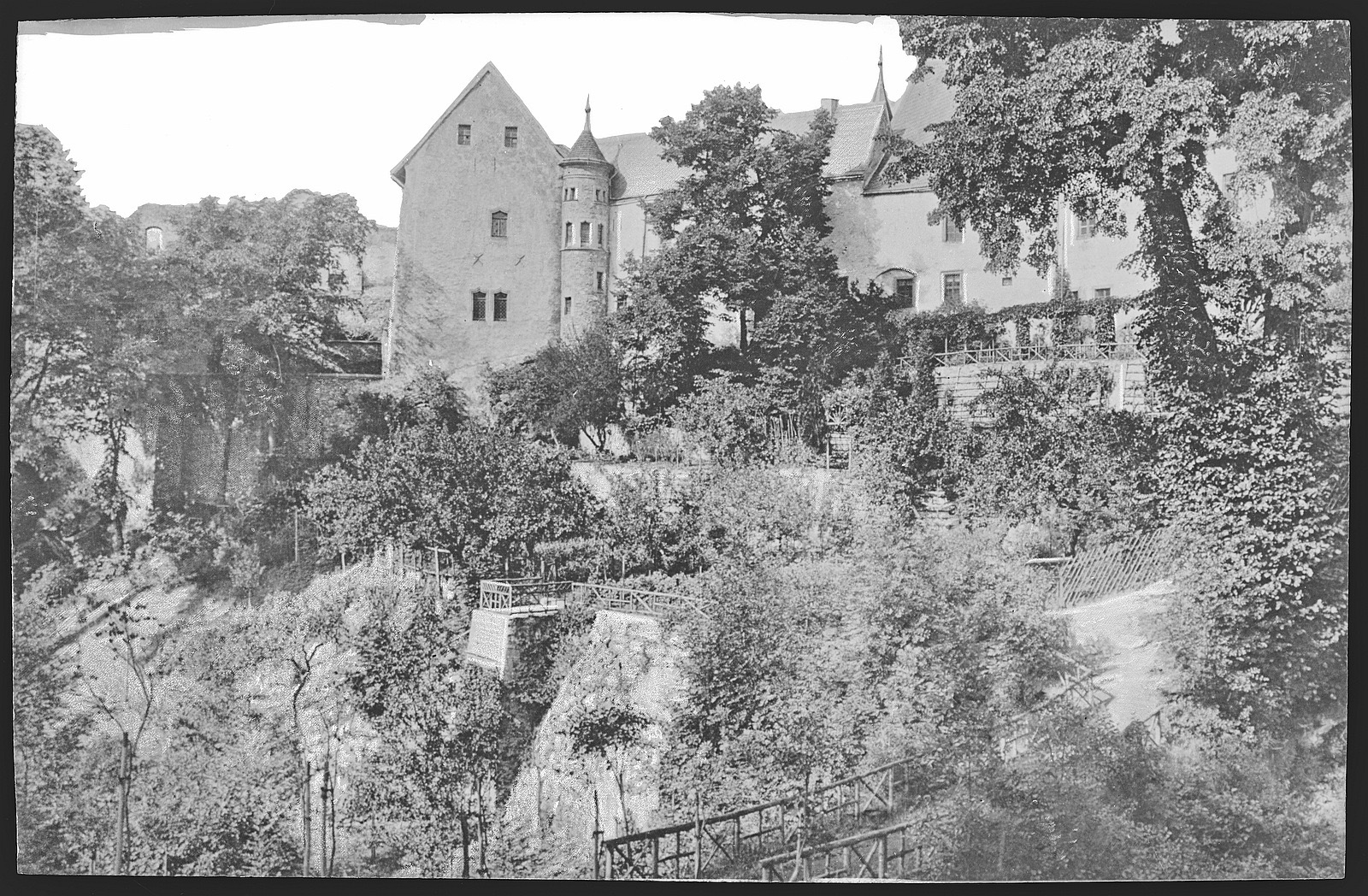
Lauenstein. Schloss
· Deutsche Fotothek (via Europeana)
Public domain


