
Germany · Restored
Marburg Castle
Marburger Schloss
Marburg Castle (Landgrafenschloss Marburg) is a hilltop castle in Marburg, Hesse, Germany, that served as the residence of the Landgraves of Hesse and a site of the 1529 Marburg Colloquy. The site today houses a university cultural history museum and event spaces. The complex sits atop Schlossberg and presents a compact group of connected buildings, a prominent clock-tower chapel façade, and a low outer curtain wall.
First raised
1200
Its prime
1529
Today
Restored
As it stood in 1529
What Marburg Castle looked like in its prime.
Perched on the Schlossberg ridge, the castle presents a compact, rectangular main residential block of warm reddish-brown sandstone with steep slate hipped and gabled roofs punctured by small dormers and corner turrets. A taller central chapel tower with large pointed Gothic windows and a round clock face topped by a lantern rises above the roofline. To the right a separate gabled wing is linked by a double-arched bridge; a continuous low curtain wall and terraced retaining walls step down the hillside.
Its story
The story of Marburg Castle.
Konradiner, Gisonen or Gleiberg: The First Castle
The Schlossberg rises 287 metres above sea level, a sandstone spur whose steep flanks made a strong castle site. Excavations under the west wing in 1989/90 found its core: a rectangular stone building of 16 by 9.5 metres, its west wall surviving four metres high. The archaeologist Christa Meiborg first dated it to Carolingian or Ottonian times, then in 2003 placed it around the year 1000; an origin in the 11th or early 12th century remains possible.
Who held Marburg before the Ludowingers is unclear. The Konradiner, the leading family of the Oberlahngau, are often invoked, but no written source ties them to it. The Gisonen are usually named as founders of castle and town; newer research points instead to the counts of Gleiberg in the second half of the 11th century. The question is left open.
The Ludowingers Fortify the Hill, 1137–c.1250
The Gisonen died out in the male line in 1137 with Giso V, and their inheritance passed to the Ludowingers, landgraves of Thuringia from 1131, through Giso IV's daughter Hedwig, married to Ludwig I, and his widow Kunigunde von Bilstein, married to Heinrich Raspe I in 1122. Marburg is first named in a document of 1138/39, where a Ludewicus de Marburg appears among Ludwig I's ministerials; by about 1140 a mint was working there, which implies a market settlement.
The northern part of the old rectangular building was rebuilt into a square tower 9.5 metres to a side, with a ring wall carried round the west, south and north. The space between wall and tower was packed with heavy layers of red sand, strengthening the exposed western approach and probably shielding the wall from siege engines. The date is argued: around 1100 by one reading, but the stone-working and a timber of 1140/41 point rather to the mid-12th century, when Heinrich Raspe II was also rebuilding Kassel. About 1220 a slender tower, the "nuwe bergfrid" of a 1372 record, rose at the eastern end to cover the gate, and around 1250 a two-storey hall block was set on the southern ring wall.
First Residence of the Landgraviate of Hesse, 1247–1308
When the Ludowinger landgraves of Thuringia died out in 1247, Sophie von Brabant, elder daughter of Landgrave Ludwig IV and Elisabeth of Thuringia, pressed her claims and her son Heinrich's from 1248. The war of succession of 1247–63 split the Hessian portion away as a new landgraviate under Heinrich I, and in 1292 King Adolf of Nassau made him a hereditary imperial prince.
The conversion of Marburg into the Hessian residence in the last third of the 13th century still governs the form of the complex, and the Fürstensaal ranks among the largest and finest secular Gothic halls in Central Europe. Heinrich's son Otto moved the seat to Kassel in 1308, and Marburg's standing fell away.
Philipp the Magnanimous and the Marburg Colloquy, 1458–1604
The castle was a residence again from 1458 to 1500, under Heinrich III and then Wilhelm III. Philipp the Magnanimous, who ruled from 1518 to 1567, moved the main residence of Hesse back to Kassel, but introduced the Reformation in 1526 and founded a university at Marburg the same year. In October 1529 the castle hosted the Marburg Colloquy between Martin Luther and Ulrich Zwingli. After Philipp's death in 1567 it served once more as a residence, under Ludwig IV of Hesse-Marburg, until 1604.
From Tilly's Fortress to the University Castle, 1623 to Today
Tilly's troops took the town and fortress of Marburg in 1623, and after the Hessian war the Hesse-Darmstadt line returned them to Hesse-Kassel in 1648. Marburg counted thereafter only as an administrative seat and military base, though heavy fortress works went up between 1700 and 1740. In the Seven Years' War of 1756–63 the town fell several times over, showing that its defences had fallen behind; slighting began in 1770, and the fortress was abandoned and blown up in 1807 after Napoleon's troops occupied the town.
From 1809 the castle held a prison. Viktor von Meibom, given charge of its Stockhaus in 1851, counted 180 to 240 serious offenders there, many serving life in leg irons or pardoned to that instead of execution. It moved to Kassel in 1869; the Prussian State Archive took the buildings over in 1869/70 and stayed until 1938, and the castle stood largely empty through the Second World War, when the Marburg Files were compiled there in 1945.
In 1946 it passed to the Philipps-Universität Marburg; the Collegium Philippinum has occupied the Marstall, armoury and old smithy since that year. The university's museum of cultural history opened in the Wilhelmsbau in 1981. The castle is open to visitors, the Hessisches Landestheater performs in the Fürstensaal, and guided tours reach the casemates and the Hexenturm.
Step inside
7 places to explore in 1529.
The record describes 7 distinct spots at Marburg Castle, including 1 interior: wilhelmsbau interior (museum/ceremonial hall). Create your own photoreal reconstruction and explore every one, more scenes means more rooms, more angles, and more of the place to stand in.
Build Your Own Castle
Recreate Marburg Castle with AI to explore it.
The artist rebuilds it as it stood in 1529, a photoreal reconstruction that belongs to you alone. Pay with coins, no subscription needed.
Recreate this castle →Defend this castle →Whose castle
Clans who held Marburg Castle.
The families that held Marburg Castle for a decade or more across its history, follow a name to its clan.
Hesse
First residence of the Landgraves of Hesse.
From the archive
Marburg Castle on paper: the measured plan and period views.
The survey plan and photographs below are the ground truth this page's reconstructions are checked against, drawn and photographed while the castle was still a working garrison. Every image is public-domain or openly licensed, with its source named.
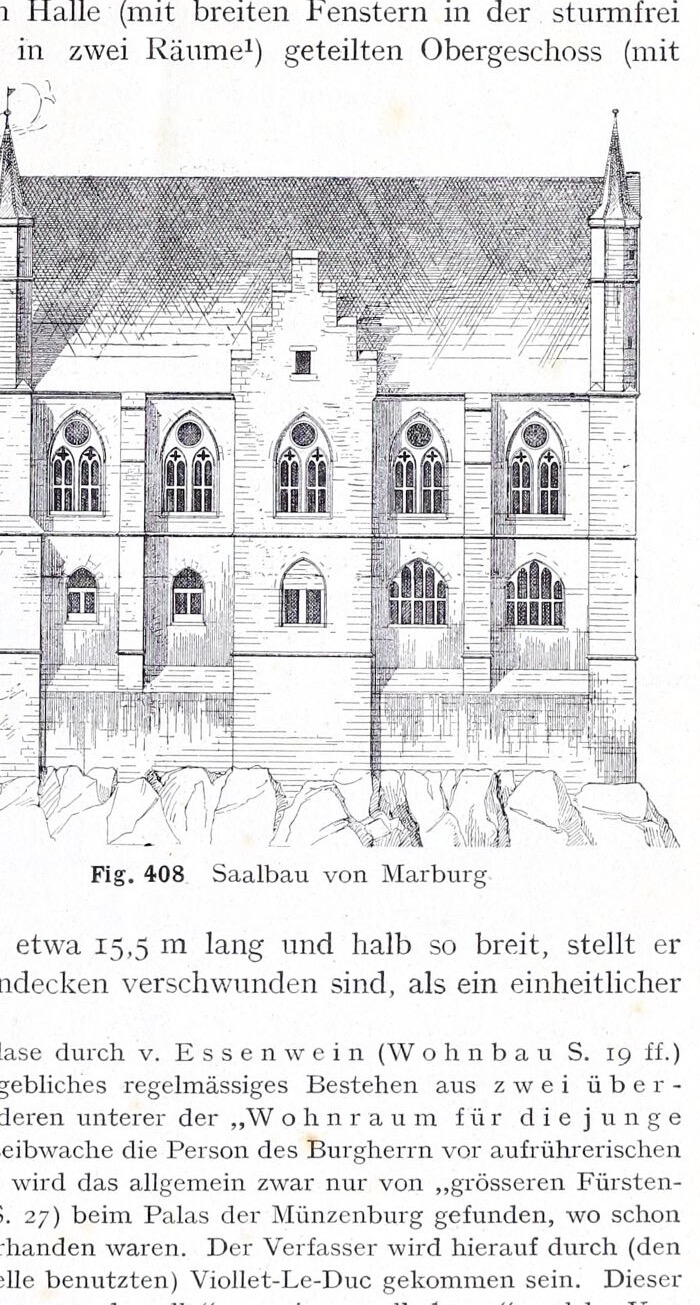
Fig. 408. Saalbau von Marburg.
1912 · Otto Piper, Burgenkunde (1912)
Public domain


