
Germany · Restored
Marksburg
Marksburg is a medieval hill castle above the town of Braubach on the Rhine in Rhineland-Palatinate, Germany. Built and expanded from the 12th–15th centuries as a defensive fortress rather than a royal residence, it features a prominent cylindrical bergfried and extensive curtain walls and bastions and was never destroyed.
First raised
1117
Its prime
1500
Today
Restored
Ranked among Europe’s castles
As it stood in 1500
What Marksburg looked like in its prime.
Perched on a wooded rocky hill above Braubach, Marksburg presents white‑plastered curtain walls with low outer defences and round bastion towers; inner ranges of buildings rise behind with steep dark slate roofs. A tall cylindrical bergfried with a narrower upper turret and crenellated parapet dominates the silhouette. The castle shows triangular curtain outlines, rounded corner towers and pointed bastions with embrasures for artillery; in its prime the compound stands complete and maintained.
Its story
The story of Marksburg.
The Freemen of Braubach and the Eppstein Keep
A fortification was raised around 1117 by the "noble freemen of Braubach" to protect the town and reinforce its customs facilities, though that stronghold may have stood in the town below, and the castle long carried the name Burg Braubach. The hill castle itself is first explicitly documented in 1231, as a palatine fief held by the Lords of Eppstein: one of whose line, Gerhard II, had styled himself Gerhard von Braubach since 1219, suggesting the castle already existed by then. Foundations of a Romanesque chapel discovered in 2014 appear to be twelfth-century work, hinting at an earlier complex of which no other trace remains.
The Eppsteins were among the most powerful families of the High Middle Ages, supplying four archbishops of Mainz in the thirteenth century alone. Their fortress at Braubach was a characteristic castle of the Staufer era: a three-storey tower keep and a simple hall within a triangular curtain wall. The keep, begun under Gerhard II in the late 1230s with walls more than two metres thick, still rises at the highest point of the castle rock.
The Counts of Katzenelnbogen, 1283–1479
When the Eppsteins died out in 1283, Braubach and its castle passed to Count Eberhard I of the younger line of Katzenelnbogen, who inherited through his wife. The wealthy counts made the castle what it is today: Count Johann II, who died in 1357, began the Gothic remodelling and his son Diether VIII completed it; in the course of that work the eastern defensive wall gave way to a two-storey hall used solely for feasts and assemblies. In 1437 the castle chapel of St Mark is first mentioned, when Philipp I the Elder of Katzenelnbogen endowed it with an altar, and in 1468 the same count raised the keep by a fourth storey crowned with the projecting "butter-churn" superstructure that still marks the castle's silhouette.
The saint of that chapel eventually renamed the whole castle, though not until long after the counts were gone: the name "Marxburg" first appears in a document of 1570, coined to distinguish the old fortress from the new Philippsburg by the riverbank.
Guns, Widows and the Philippsburg
In 1479 the county of Katzenelnbogen, and with it the Marksburg, fell to the Landgraves of Hesse, who adapted the castle for artillery; a gun house went up at the corner of the north building early in the sixteenth century, and in 1643–45 came a fresh campaign of bastions, batteries and the great vaulted powder corner. But the castle no longer met the living standards of the nobility: Landgrave Philipp the Younger of Hessen-Rheinfels made Braubach a widow's seat and built the palatial Philippsburg at the town's south end in 1568–71. Landgrave Johann the Warlike, resident at the Philippsburg from 1643 to 1651, had the badly neglected Marksburg repaired towards the end of the Thirty Years War, but it never again served as a noble residence, passing after his death to Hessen-Darmstadt.
Prison, Preservation and the Guns of March 1945
In 1803 the Marksburg went to Nassau-Usingen and in 1815 to the Duchy of Nassau. Officially still a fortress, it served in practice as a state prison and a home for invalid soldiers; prison cells built into the Gothic hall were only removed in 1901, when scrawls left by the imprisoned freedom fighter Germain Metternich could still be read in the chapel. Prussia annexed Nassau after the war of 1866 and undertook no building work at all, and the castle decayed steadily.
In 1900 the run-down castle was sold for a symbolic 1,000 Goldmarks to the German Castles Association, founded the year before, a purchase driven by Bodo Ebhardt and backed by Kaiser Wilhelm II. The association set about returning the Marksburg to its late-medieval appearance, restoring in 1905 the butter-churn top removed in the early eighteenth century, and has had its head office here since 1931. Of the forty hill castles between Bingen am Rhein and Koblenz, the Marksburg is one of only two never destroyed, the other being Maus Castle, though the claim needs one qualification: on 20 and 25 March 1945 American artillery firing from across the Rhine half-collapsed the butter-churn tower and stripped nearly every roof on the river side. Restored again, the castle has been part of the Rhine Gorge UNESCO World Heritage Site since 2002.
Step inside
8 places to explore in 1500.
The record describes 8 distinct spots at Marksburg, including 3 interiors: base of the three‑storey tower keep, original hall within the triangular curtain, st mark chapel (gothic interior). Create your own photoreal reconstruction and explore every one, more scenes means more rooms, more angles, and more of the place to stand in.
Build Your Own Castle
Recreate Marksburg with AI to explore it.
The artist rebuilds it as it stood in 1500, a photoreal reconstruction that belongs to you alone. Pay with coins, no subscription needed.
Recreate this castle →Defend this castle →Whose castle
Clans who held Marksburg.
The families that held Marksburg for a decade or more across its history, follow a name to its clan.
Eppstein
Held by the Lords of Eppstein, the castle's first recorded owners in 1231, until the family died out in 1283.
Katzenelnbogen
Inherited by Count Eberhard of Katzenelnbogen in 1283; the counts expanded the castle through the 14th century until their male line failed in 1429.
Hesse
Held by the Landgraves of Hesse from 1429, who added the artillery bastions and round towers of the outer curtain wall.
From the archive
Marksburg on paper: the measured plan and period views.
The survey plan and photographs below are the ground truth this page's reconstructions are checked against, drawn and photographed while the castle was still a working garrison. Every image is public-domain or openly licensed, with its source named.
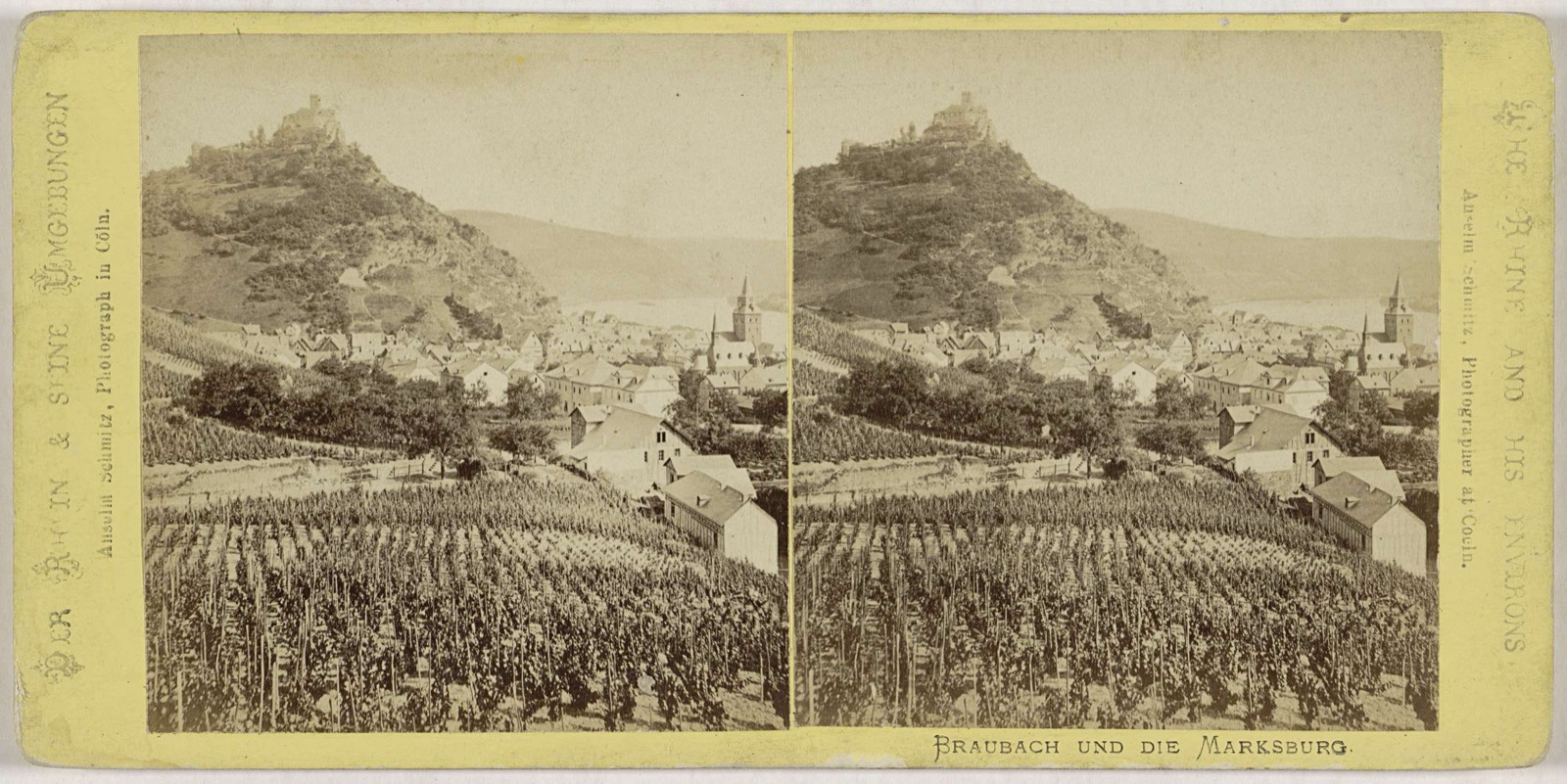
Braubach und die Marksburg
· Rijksmuseum (via Europeana)
Public domain
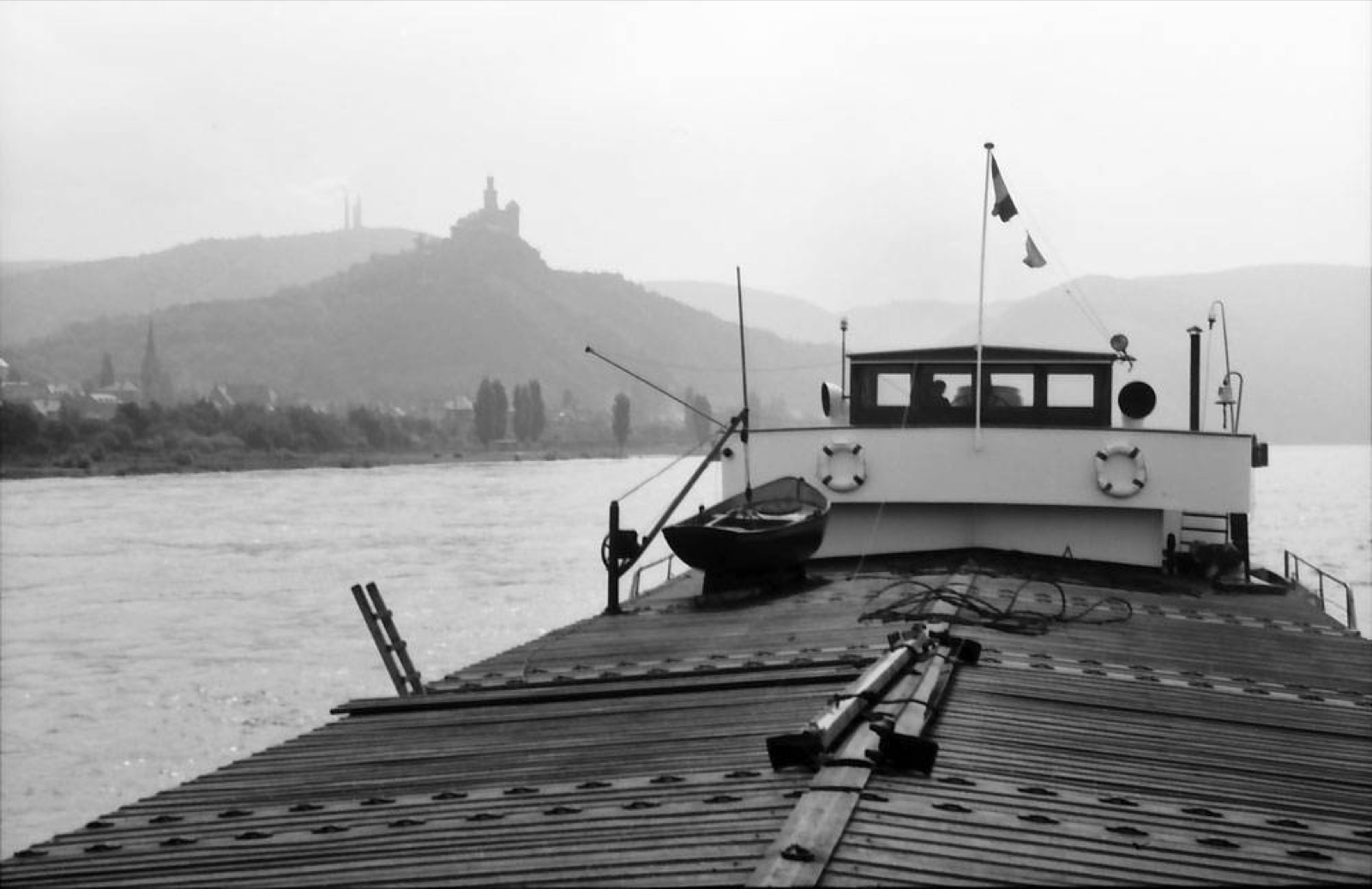
Braubach: Marksburg, im Rückblick
· State Archives of Baden-Württemberg (via Europeana)
CC BY


