
Germany · Partial ruin
Mecklenburg Castle
Mecklenburg Castle was a medieval fortified residence and the seat of the Nakonid and Nikloting princes of the Obotrites, located just south of the modern village Dorf Mecklenburg in Mecklenburg-Vorpommern, Germany. It was an economic and ecclesiastical centre in the 10th–11th centuries and gave its name to the region of Mecklenburg. Today only sections of the earthen rampart survive and the site has been subject to archaeological excavation and memorial planting.
Its prime
1066
Today
Partial ruin
As it stood in 1066
What Mecklenburg Castle looked like in its prime.
In its prime the site formed an oval inner court 95–140 m across, encircled by earthen ramparts that rose up to about 10 m above the surrounding lowland; the castle occupied the tip of a lakeland peninsula near the Bay of Wismar. Within the enclosure were multiple churches and three monasteries and a bishop's residence; the rampart tops were wooded in later memory but originally ringed the open court and controlled approaches along the narrow peninsula track.
Its story
The story of Mecklenburg Castle.
Nakon's Castle South of the Bay of Wismar, 808-995
The stronghold stood at the tip of a lakeland peninsula seven kilometres south of the Bay of Wismar, though when it was first raised is disputed. Excavation has been read as placing a castle here in the 7th or 8th century, possibly Reric, the Obotrite trading emporium destroyed in 808; the Frankish royal annals record for that year a Danish campaign under Göttrik against the Obotrite strongholds, halted by heavy losses at the siege of a larger castle long equated with Mecklenburg. The timber dates cut against it: phase C falls between 929 and 945, phases A and B only slightly earlier, and on that evidence the identification is increasingly doubted.
Obotrite princes held it as a seat by the 10th century at the latest, and its position on the route from Hamburg to Wolin gave it economic as well as political weight. The travelling merchant Ibrahim Ibn Jacub called it Nakon's Castle in 965, after the Nakonid prince who ruled from it. A charter of Otto III dated 10 September 995 carries the first record of the name Michelenburg, Old Saxon for large castle; the Slavic name has not survived, though it was most likely Wiligrad, which means the same. The later duchy and region took their name from the castle.
From Bishop Reinbert to the Killing of Kruto, 991-1093
From 991 or 992 Mecklenburg served as the working seat of the Hamburg diocese for the Slav lands, under Bishop Reinbert and then Bernhard, to 1023. A church of St Peter stood on or beside the castle by the end of the 10th century, with a nunnery whose abbess was the Obotrite princess Hodica.
The castle flourished under the Christian prince Gottschalk, who ruled from 1043 to 1066 and kept the Irish bishop John of Mecklenburg at his seat; by 1066 it contained churches and three monasteries. In the pagan rebellion later that year Gottschalk was killed and his family fled the castle, and Bishop John's head was displayed at the pagan centre of Rethra. Gottschalk's younger son Henry avenged his father by killing the pagan usurper Kruto in 1093, but chose Liubice for his residence, out on the borders of the Wagrians, Polabians and Obotrites, and Mecklenburg began to lose its prominence as the Kingdom of Germany expanded eastward.
Niklot's Fires and Pribislav's Revolt, 1149-1167
The bishopric had stood vacant since 1066 when, in 1149, the Archbishop of Bremen installed a bishop named Emmehard at Mecklenburg, part of Duke Henry the Lion of Saxony's expansion east. In 1160 Henry and King Valdemar the Great of Denmark campaigned against the Obotrite prince Niklot, who burned his own castles at Ilow, Mecklenburg, Schwerin and Dobin rather than be pinned down in sieges. Niklot was killed at Werle during that campaign; the Obotrite territory was partitioned among Saxon ministeriales, Mecklenburg passing to Count Heinrich von Schaten, and the Bishopric of Mecklenburg was replaced the same year by that of Schwerin.
Niklot's son Pribislav raised a Slavic rebellion in 1163 against Henry the Lion and the German lords occupying the Obotrite castles. He overran Mecklenburg in 1164 and the Saxons abandoned it, though the rising was defeated later that year at the Battle of Verchen. Three years on, needing an ally against the Saxon nobility, Henry allowed Pribislav his father's inheritance as prince of Mecklenburg, Kessin and Rostock.
Torn Down for Wismar, Rebuilt for Raiding
Market traffic was still documented in 1168, though most trade passed to Schwerin. Johann I of Mecklenburg had the castle pulled down, in 1256 by some accounts and 1265 by others, to provide building material for the palace going up in the growing town of Wismar. It was raised again in 1277, during the guardianship dispute while Heinrich the Pilgrim was in captivity, and served the Mecklenburg princes and the lords of Werle as a base for raids. Forty-five years later it was destroyed for good. The village of Mecklenburg grew in the mid-14th century out of the outer-bailey settlement, and once the rubble was cleared off, farmers worked the rampart.
Burgwall, Protected Monument and Excavation, from 1839
Friedrich Lisch made the first surveys and diggings on the site between 1839 and 1841; a grand-ducal decree of 1854 under Friedrich Franz II declared the wall a protected monument, and oaks were first planted on it in 1856. The village laid out its cemetery on the burgwall in 1870.
Peter Donat of the Akademie der Wissenschaften led excavations from 1967 to 1971, cutting 52 metres through the southern wall. Seven building phases, A to G, have been distinguished. The earthen wall, still standing up to seven metres, is an archaeological monument of Mecklenburg-Vorpommern, and the street name Am Burgwall keeps the memory.
Step inside
6 places to explore in 1066.
The record describes 6 distinct spots at Mecklenburg Castle, including 2 interiors: bishop's hall and residence, church and monastery precincts. Create your own photoreal reconstruction and explore every one, more scenes means more rooms, more angles, and more of the place to stand in.
Build Your Own Castle
Recreate Mecklenburg Castle with AI to explore it.
The artist rebuilds it as it stood in 1066, a photoreal reconstruction that belongs to you alone. Pay with coins, no subscription needed.
Recreate this castle →Defend this castle →Whose castle
Clans who held Mecklenburg Castle.
The families that held Mecklenburg Castle for a decade or more across its history, follow a name to its clan.
Nakonid
Residential capital of the Nakonid dynasty of Obotrite princes; flourished under Gottschalk, who ruled 1043–1066.
Nikloting
Seat of the Nikloting dynasty of the Obotrites; Niklot's son Pribislav led the Slavic rebellion of 1163.
From the archive
Mecklenburg Castle on paper: the measured plan and period views.
The survey plan and photographs below are the ground truth this page's reconstructions are checked against, drawn and photographed while the castle was still a working garrison. Every image is public-domain or openly licensed, with its source named.
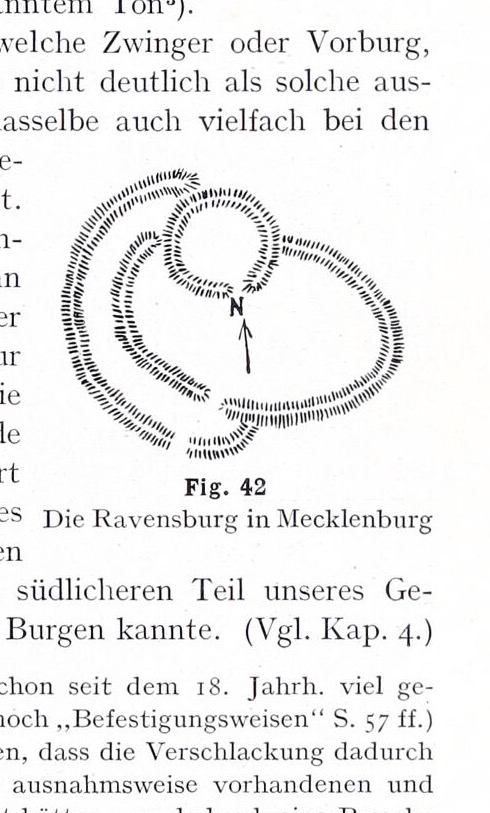
Fig. 42. Die Ravensburg in Mecklenburg
1912 · Otto Piper, Burgenkunde (1912)
Public domain


