
Germany · Restored
Moritzburg
The Moritzburg is a fortified Late Gothic / Early Renaissance residence of the Archbishops of Magdeburg in Halle (Saale), built from quarrystone from the late 15th century. It served defensive and residential functions and today houses an arts museum after extensive restorations. Key elements include a nearly regular quadrangle plan, a prominent chapel, a large round bastion and a gate tower facing the town.
First raised
2000
Its prime
1503
Today
Restored
As it stood in 1503
What Moritzburg looked like in its prime.
An almost-regular quadrangle of pale quarrystone walls about 72 by 85 metres, set behind a broad moat on three sides. Red clay tile roofs cap a mix of forms: a tall steep-roofed chapel with large pointed-arch windows on the south-east, a large circular bastion with conical roof to the south-west, a multi-storey square tower rising above the curtain, and long horizontal façades pierced by small gabled dormers and regular windows.
Its story
The story of Moritzburg.
The Moritzburg was built as the residence of the Archbishops of Magdeburg, who had made Giebichenstein Castle near Halle their principal seat in 1382 after conflicts with Magdeburg's ever more powerful city council. Archbishop Ernest personally laid the cornerstone of his new residence on 25 May 1484 in a ceremonial procession, naming the castle Moritzburg after Saint Maurice, the country's patron saint.
Built in the Early Renaissance style, the castle unified residence and defence: an almost regular quadrangle of about 72 by 85 metres in quarrystone, ringed by a once-swampy moat 20 to 25 metres wide and 10 metres deep, its western side protected by staggered walls towards the river Saale. The courtyard was large enough for festivities, processions and tournaments.
War repeatedly found the Moritzburg: after Charles V's victory at the Battle of Mühlberg in 1547 his military leader the Duke of Alba occupied it, and after the defeat at Breitenfeld the Count of Tilly retreated here, pursued by the Swedes; following the Peace of Prague in 1635 the Emperor acknowledged the Duke of Saxony-Weißenfels as the new Administrator. Since the end of the 19th century the castle has housed an arts museum recognised as being of national importance.
Step inside
8 places to explore in 1503.
The record describes 8 distinct spots at Moritzburg, including 3 interiors: mary-magdalene chapel, interior, west wing, representative hall level, north wing, original main entrance and chambers. Create your own photoreal reconstruction and explore every one, more scenes means more rooms, more angles, and more of the place to stand in.
Build Your Own Castle
Recreate Moritzburg with AI to explore it.
The artist rebuilds it as it stood in 1503, a photoreal reconstruction that belongs to you alone. Pay with coins, no subscription needed.
Recreate this castle →Defend this castle →From the archive
Moritzburg on paper: the measured plan and period views.
The survey plan and photographs below are the ground truth this page's reconstructions are checked against, drawn and photographed while the castle was still a working garrison. Every image is public-domain or openly licensed, with its source named.
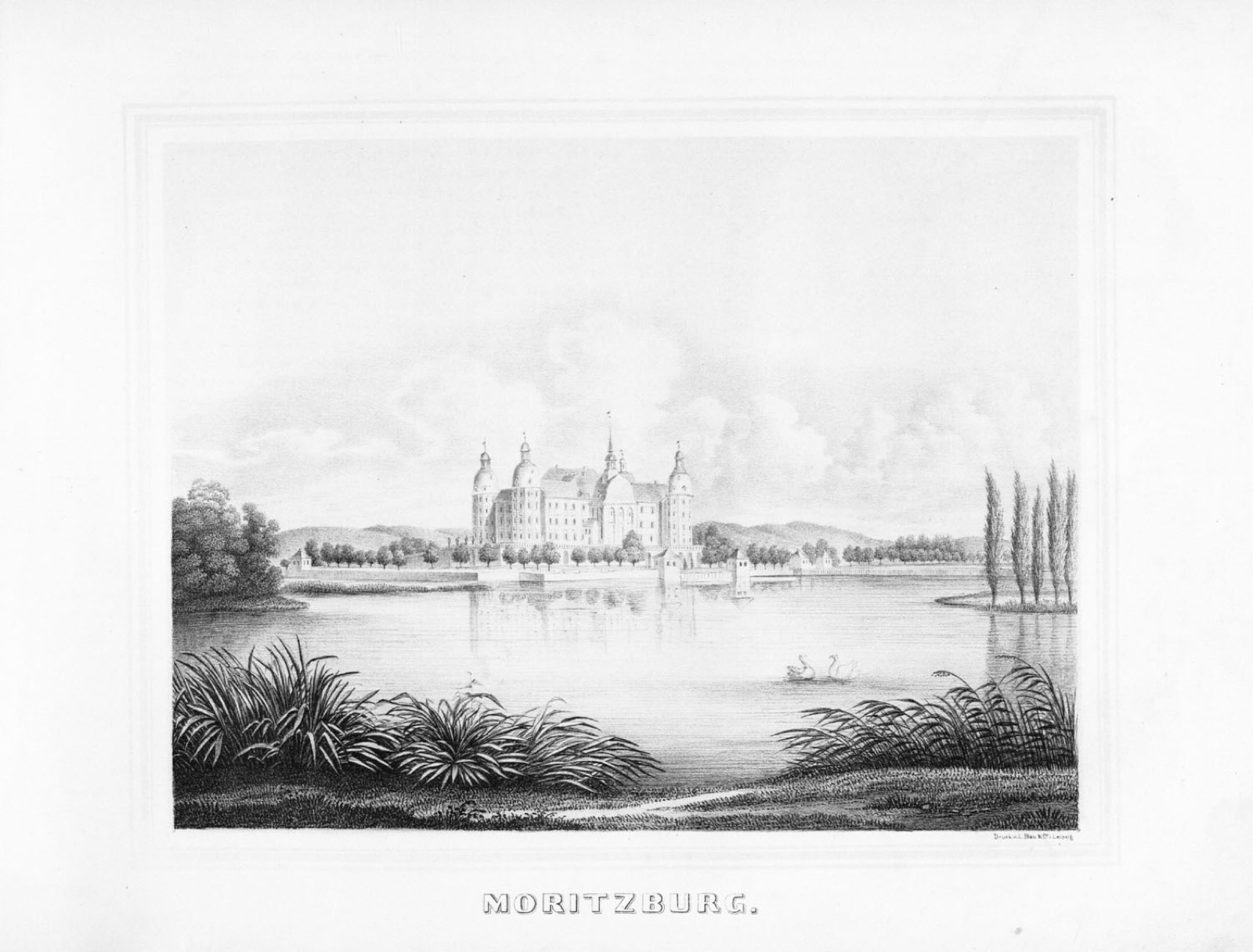
Moritzburg
· Deutsche Fotothek (via Europeana)
CC BY-SA


