
Germany · Restored
Nassau Castle
Burg Nassau
Nassau Castle is a medieval hill castle on a rocky outcrop above the Lahn River in present-day Rhineland-Palatinate, Germany. It was the ancestral seat of the House of Nassau and comprises a late-Romanesque palas, a high multi-sided bergfried and connecting curtain walls; the site today has undergone restoration and partial reconstruction and houses a restaurant in the main building.
Its prime
1350
Today
Restored
As it stood in 1350
What Nassau Castle looked like in its prime.
Perched on a rocky outcrop about 120 m above the Lahn River, the castle presents a rectangular late‑Romanesque palas and a five‑sided bergfried rising roughly 33 m, linked by curtain walls and a gate building. The bergfried is a tall polygonal stone tower with narrow embrasures and, as reconstructed from period depictions, a hipped roof and crenellated merlon with small side towers. The complex sits above the town, with the inner courtyard giving onto the palas façade and tower base.
Its story
The story of Nassau Castle.
Dudo of Laurenburg's Rock, c. 1100
A charter of Laach Abbey dated 1093 names Count Dudo of Laurenburg, and with him the castle, but historians regard the document as a forgery, and the reliable beginnings of Burg Nassau date to around 1100, when Dudo founded a castle on a rock cone 120 metres above the Lahn. In 1120 his sons Rupert I and Arnold I took possession of the castle hill and the residential tower standing on it, and in 1124 they had the complex remodelled and enlarged.
The Quarrel with Worms and a New Name, 1159
The rock the brothers had claimed stood on land belonging to the Bishopric of Worms, and their occupation set off a bitter feud between the Laurenburg family and the cathedral chapter. Even Rupert's inheritance in 1124 of the bishopric's vogtship in Weilburg (whose territory had included the former royal estate of Nassau since 914) did not settle it, and when Rupert began styling himself Count of Nassau after the castle, Worms disputed the title outright.
Resolution came only in 1159, some five years after Rupert's death, through the intervention of Hillin of Falmagne, Archbishop of Trier. The Laurenburgers renounced their allodial claim and received the castle and lordship of Nassau back from the archbishop as a fief; from then on they were Counts of Nassau, a style first recorded in 1160 under Henry I. The dynasty named after this rock counts the present-day monarchies of the Netherlands and Luxembourg among its descendants.
Henry the Rich's Palas and the Brothers' Division, 1255
Between 1220 and 1230 Henry II (Henry the Rich) built the castle's late-Romanesque main residential building, the palas. In 1255 the county of Nassau was divided between his sons Walram II and Otto I in the so-called Brothers' Division, but the castle itself remained the joint possession of both lines, a Ganerbenburg under the old Germanic law of shared inheritance. In the first half of the fourteenth century the 33-metre five-sided bergfried was built; a second tower, mentioned in 1346, no longer exists.
The shared arrangement did not keep the peace. In 1372, during a feud between Rupert the Quarrelsome of Nassau-Sonnenberg, of the Walramian line, and John I of Nassau-Dillenburg, senior of the Ottonian line, the houses of the castle's garrison knights were destroyed.
From Merian's Etching to the Rebuild, 1976–1980
The counts lived at Nassau until the end of the Middle Ages, then gave it up as a residence, and the slow decay of the complex began. Matthäus Merian's seventeenth-century etching still shows an intact palas, bergfried and gate building, but in the final phase of the Second World War the surviving ruins were destroyed further, and when the rectangular ring wall was excavated from 1970, barely any of its fabric remained.
The state castle administration of Rhineland-Palatinate had taken over the site in 1965. From 1976 the bergfried was restored: its hipped roof, battlements and watch-turrets rebuilt to match Merian's etching, and the six-to-eight-metre-high vaults of its interior made good, with the opening to the dungeon in its base cleared. The palas received harsher treatment in 1979–80: its original Staufer-era walls, standing in places to the upper storey, were demolished, and a new palas with a knights' hall was raised in modern materials on the historic foundations, in disregard of the Venice Charter of 1964. Before the demolition, the blocked remains of six Romanesque twin windows were discovered in the south-east wall; a single carved capital with leaf decoration survives from them. The rebuilt palas today houses a restaurant, and the bergfried is open to visitors.
Step inside
10 places to explore in 1350.
The record describes 10 distinct spots at Nassau Castle, including 2 interiors: bergfried, dungeon opening, knights' hall (palas interior). Create your own photoreal reconstruction and explore every one, more scenes means more rooms, more angles, and more of the place to stand in.
Build Your Own Castle
Recreate Nassau Castle with AI to explore it.
The artist rebuilds it as it stood in 1350, a photoreal reconstruction that belongs to you alone. Pay with coins, no subscription needed.
Recreate this castle →Defend this castle →Whose castle
Clans who held Nassau Castle.
The families that held Nassau Castle for a decade or more across its history, follow a name to its clan.
Nassau
Ancestral seat of the House of Nassau from its foundation around 1100 until the counts gave up the castle as their residence at the end of the Middle Ages.
From the archive
Nassau Castle on paper: the measured plan and period views.
The survey plan and photographs below are the ground truth this page's reconstructions are checked against, drawn and photographed while the castle was still a working garrison. Every image is public-domain or openly licensed, with its source named.
![Nassau: [Burg Nassau], Nassau Castle](/heritage/nassau-castle/photo-euro-1.jpg)
Nassau: [Burg Nassau]
· State Archives of Baden-Württemberg (via Europeana)
CC BY
![Nassau: [Burg Nassau], Nassau Castle](/heritage/nassau-castle/photo-euro-2.jpg)
Nassau: [Burg Nassau]
· State Archives of Baden-Württemberg (via Europeana)
CC BY
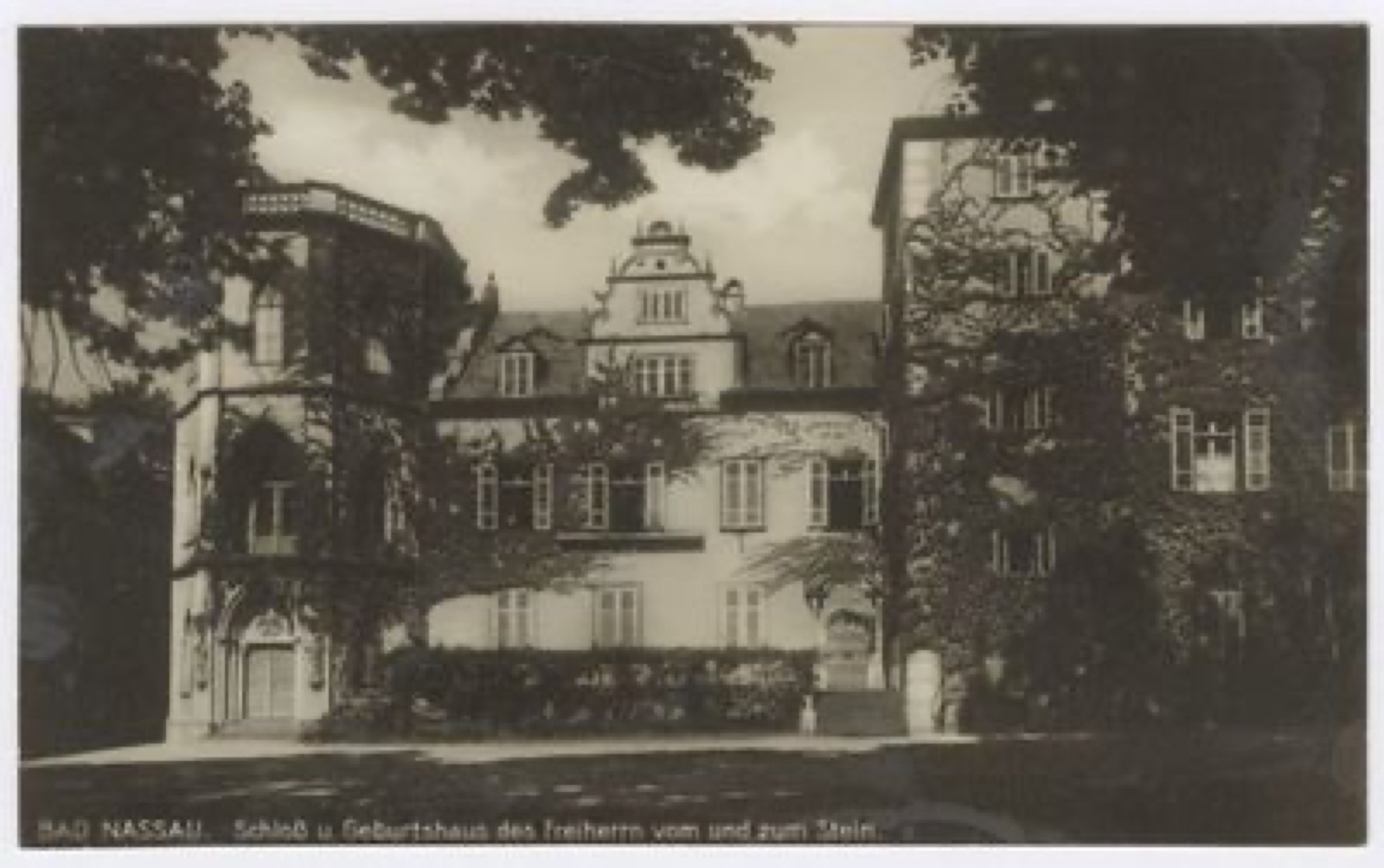
Schloss Nassau
1930 · Kassel University Library (via Europeana)
CC BY-SA


