
Germany · Restored
Pfalzgrafenstein Castle
Burg Pfalzgrafenstein
Pfalzgrafenstein Castle is a toll castle on the small Falkenau island in the Rhine beside Kaub, Germany, first established in 1326/27 to control river traffic. The isolated pentagonal tower with surrounding defensive wall was adapted for artillery in the early 17th century and given its baroque tower cap in the early 18th century; it is preserved today as a public museum.
First raised
1326
Its prime
1756
Today
Restored
Ranked among Europe’s castles
As it stood in 1756
What Pfalzgrafenstein Castle looked like in its prime.
A compact, pentagonal central tower rising about 36 metres with six storeys sits within a low, turreted outer curtain wall; the castle presents white-plastered walls with red-painted quoins and a pinkish stone plinth at waterline. Numerous steep slate roofs and small conical turrets cluster around a larger baroque bell-shaped tower cap with an open lantern. The structure stands alone on a rocky river islet in the Rhine, with two crenellated battlements and a visible gun bastion pointing upstream.
Its story
The story of Pfalzgrafenstein Castle.
Ludwig of Bavaria's Toll Tower and the Pope, 1326–1340
King Ludwig IV of Bavaria built the central tower on Falkenau island in 1326/27 to increase his toll revenue on the Rhine. Standing alone in the current, the tower was built pentagonal to break waves and ice. The new toll enraged the church: Pope John XXII incited his bishops of Mainz, Trier and Cologne to excommunicate Ludwig, fearing the Kaub toll would undermine their own collections at the Mouse Tower at Bingen and at Stolzenfels near Koblenz; he had already attempted to excommunicate Ludwig in 1325 over the toll at Gutenfels Castle. Three times the Pope demanded his bishops act against the toll at Kaub; nothing was done. Around 1340, likely because of this dispute, Ludwig ringed the tower with a six-sided turreted wall twelve metres high, part defence, part ice-breaker.
Chain Booms and the Dungeon in the Well
The toll was enforced with chain booms raised across the narrow passage near the castle; the wider channel on the far side was unusable because of a treacherous stretch of water downstream. A ship that paid saw the chain lowered; one that refused was seized and its crew imprisoned in the castle dungeon, a wooden raft at the bottom of a well into which prisoners were lowered by rope until a ransom was paid. Tolls themselves were collected at a customs house in Kaub, since ships could not dock properly on the island.
In 1339 Ludwig gifted the castle to his nephew Rudolph II, the Elector Palatine, and it served Palatine justice as well as Palatine revenue: a legal record of 1473 recognises Pfalzgrafenstein as a place where the Palatine bailiff could imprison defendants and conduct trials, including capital cases. In 1477 Count Palatine Philip of Wittelsbach handed the castle to the Count of Katzenelnbogen as a deposit expiring on his death; when Philipp I, the last male of the Katzenelnbogen line, died in 1479, the deposit dissolved into an inheritance dispute that ran forty-four years, until 1523.
The Landshut Siege and the Spanish Years, 1504–1632
In 1504, during the War of the Succession of Landshut, Landgrave William II of Hesse besieged Kaub, Gutenfels and Pfalzgrafenstein for thirty-nine days. The island castle came through unscathed, and the Hessians withdrew after heavy losses in men and artillery. In 1607 Elector Friedrich IV modernised the works (a gun bastion pointing upstream, interior arcades, and the completion of the outer wall) making Pfalzgrafenstein the first Middle Rhine castle adapted for modern artillery.
In the Thirty Years' War the castle fell without a fight: Spanish forces under General Spinola occupied it in 1620, after a brief exchange of gunfire at Kaub, and the garrison was permitted to withdraw freely. Hessian forces attacked Kaub and besieged Gutenfels and Pfalzgrafenstein with 400 men in December 1631, and the Spanish capitulated in January 1632. During the War of the Spanish Succession the castle held prisoners of war; the distinctive baroque tower cap went up in 1714, and its present appearance owes much to renovation after a fire in 1756.
Blücher's Crossing and the Last Toll, 1814–1867
In 1793 French Revolutionary forces stripped the guns from Pfalzgrafenstein and Gutenfels, and in 1803 the Electoral Palatinate relinquished the castle to the House of Nassau, its garrison withdrawing. The empty castle then became a key point for the crossing of the Rhine in the campaign against Napoleon: on 1 January 1814, after the French defeat at Leipzig, Russian engineers threw a pontoon bridge across the Rhine at the island, and Field-Marshal von Blücher's army (60,000 men, 20,000 horses and 220 guns) crossed over several days in pursuit of Napoleon.
Prussia annexed Nassau after the Seven Weeks War of 1866, and toll collection ceased in 1867. The castle served as a beacon for river traffic into the 1900s, passed to the state of Rhineland-Palatinate in 1946, and worked as a signal station from 1960. Restoration between 1967 and 1975 repainted the baroque colour scheme, reopened walled-up arrow loops and restored the original gate. Victor Hugo called it "a stone ship, eternally floating on the Rhine"; it is preserved today as a public museum, reached by ferry from Kaub, in a stretch of the Rhine Gorge inscribed as a UNESCO World Heritage Site in June 2002.
Step inside
9 places to explore in 1756.
The record describes 9 distinct spots at Pfalzgrafenstein Castle, including 4 interiors: main gate with portcullis, inner courtyard at base of central tower, dungeon well and wooden raft and more. Create your own photoreal reconstruction and explore every one, more scenes means more rooms, more angles, and more of the place to stand in.
Build Your Own Castle
Recreate Pfalzgrafenstein Castle with AI to explore it.
The artist rebuilds it as it stood in 1756, a photoreal reconstruction that belongs to you alone. Pay with coins, no subscription needed.
Recreate this castle →Defend this castle →Whose castle
Clans who held Pfalzgrafenstein Castle.
The families that held Pfalzgrafenstein Castle for a decade or more across its history, follow a name to its clan.
Wittelsbach
Founded by King Ludwig IV of Bavaria in 1326/27 and gifted in 1339 to his nephew Rudolph II, Elector Palatine; held by the Electoral Palatinate until 1803.
Nassau
Held by the House of Nassau, later the Duchy of Nassau, from 1803.
From the archive
Pfalzgrafenstein Castle on paper: the measured plan and period views.
The survey plan and photographs below are the ground truth this page's reconstructions are checked against, drawn and photographed while the castle was still a working garrison. Every image is public-domain or openly licensed, with its source named.
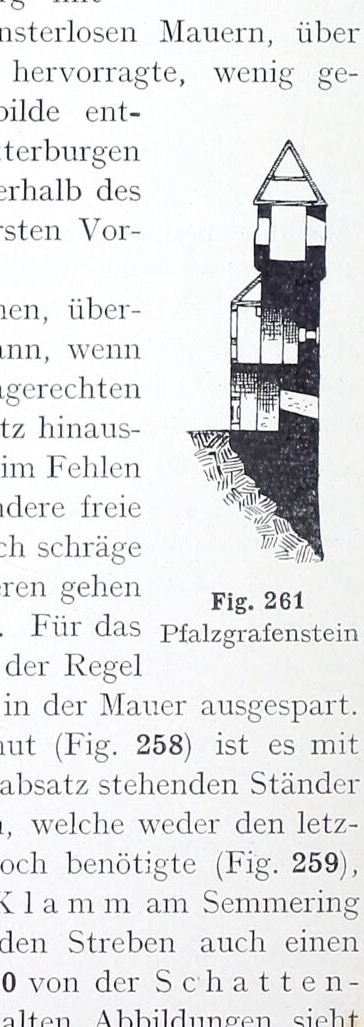
Fig. 261 Pfalzgrafenstein
1912 · Otto Piper, Burgenkunde (1912)
Public domain
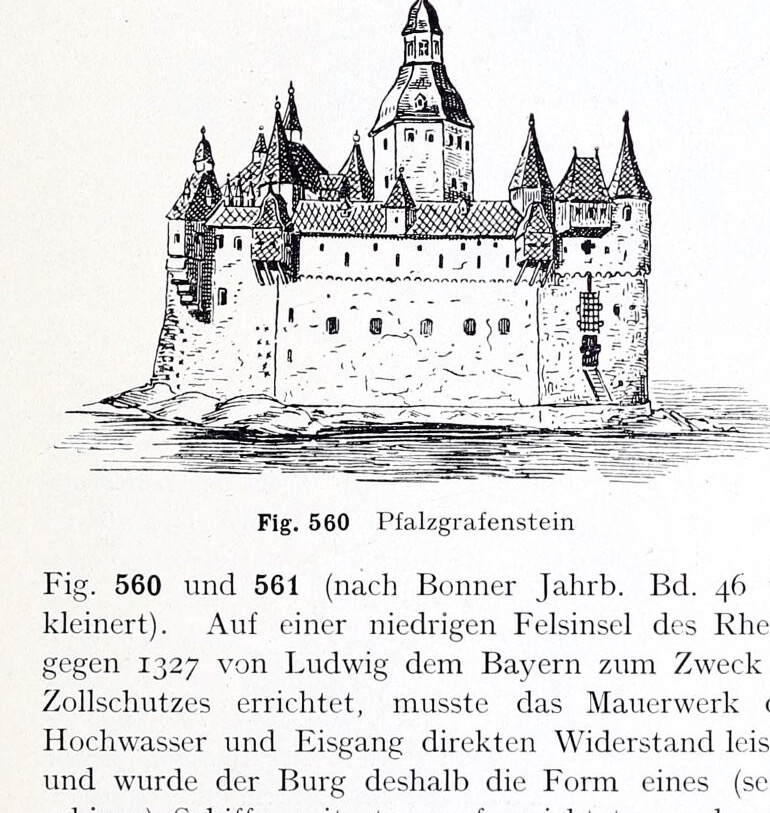
Fig. 560 Pfalzgrafenstein
1912 · Otto Piper, Burgenkunde (1912)
Public domain
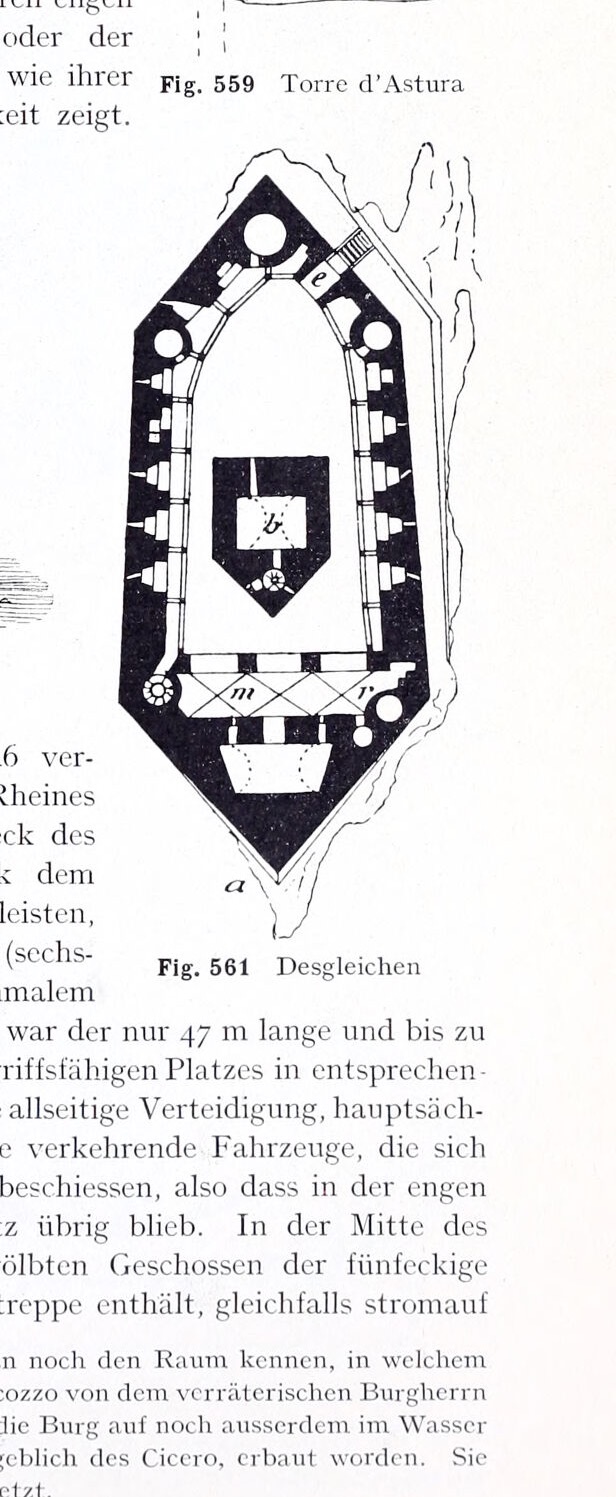
Fig. 561 Desgleichen
1912 · Otto Piper, Burgenkunde (1912)
Public domain


