
Germany · Restored
Plassenburg
Plassenburg is a large hilltop castle and former residence and fortress above the town of Kulmbach in Bavaria. First recorded in 1135, it was rebuilt after mid-16th-century destruction into a massive fortified palace and later used for military and museum purposes. Today it is preserved and functions as a museum and cultural venue.
Its prime
1600
Today
Restored
Ranked among Europe’s castles
As it stood in 1600
What Plassenburg looked like in its prime.
Sits atop a wooded, steep hill above Kulmbach, the complex reads as a broad multi-level fortress: a lower ring of thick, pale stone curtain walls and rounded bastions steps up to a long, rectangular palatial block with many regularly spaced windows and steep red-tiled roofs. A distinctive onion‑domed tower rises above the main roofline. Terraced glacis and woodland slope surround the fortress; stone is light grey to buff, masonry courses visible, ramparts continuous and complete at the fortress's prime.
Its story
The story of Plassenburg.
Berthold of Andechs and the Orlamünde Lords, 1135–1340
The Plassenburg first appears in 1135, when Count Berthold II of Andechs styled himself comes de Plassenberch; he was probably its founder. It began as a central stronghold for the Meranian rulers of the upper Main, held for them by the lords of Plassenberg as ministerials. On the death of the last Andechs-Meranian, Duke Otto VIII, the inheritance was divided and the Plassenburg passed with Kulmbach to the Counts of Orlamünde. Count Otto VI, the only Orlamünde after 1323 to call himself Lord of the Plassenburg, pledged it to Burgrave John II of Nuremberg in 1338, and on his death in 1340 it fell to the Hohenzollern burgraves.
Hohenzollern Seat and Family Prison, 1340–1542
Under Burgrave Frederick V of Nuremberg (1357–1397) the Plassenburg outstripped the Cadolzburg among the burgravial residences, and in 1397 Frederick stepped down from government and chose it for his retirement. It became the centre of the Principality ob dem Gebirg, later the Margraviate of Brandenburg-Kulmbach, and stayed its administrative centre until after the middle of the sixteenth century.
The castle served the dynasty as a prison for its own. Margravine Barbara of Brandenburg was shut up here in March 1493, and in February 1515 Margrave Casimir locked his father in a tower chamber which he did not leave for twelve years. After his release, his younger son George the Pious began in 1530 to turn the castle into a fortress, about ten years' work producing three massive gun rondels, of which the Hohe Bastei was reckoned without equal in the German-speaking lands. Albert Alcibiades took over the principality in 1541 and moved the residence to Bayreuth in 1542.
The Seven-Month Siege and Caspar Vischer's Rebuilding, 1550–1607
Around 1550 the margrave set an Italian master builder and 150 Italian masons to build three modern bastions in the castle ditches. So equipped, the Plassenburg withstood a seven-month siege in the Second Margravian War, which ended with the fortress's capitulation on 21 June 1554. Four months later, on 21 October, the allied estates began its destruction: the works were blown up or brought down with a Nuremberg screw, the buildings fired and the wells poisoned.
Emergency repairs followed in 1557, and Albert's heir Margrave Georg Friedrich the Elder began rebuilding, with Renaissance designs by Caspar Vischer as lead architect. By about 1575 the ranges around the Schöner Hof were largely finished; work on the fortifications ran on until 1607.
Wallenstein's Troops and the Prussian Capitulation, 1603–1807
The old Franconian Hohenzollern line died out with Georg Friedrich in 1603. Margrave Christian returned the residence to Bayreuth but stayed often at the Plassenburg during the Thirty Years' War, when castle and town were besieged twice. Wallenstein's troops closed round the fortress in September 1632, and the commandant Hans Christoph Muffel answered the summons to surrender of 21 September with cannon fire; in autumn 1634 imperial general Lamboy took Kulmbach after a short fight. On both occasions the Plassenburg proved impregnable.
Margrave Alexander sold the Plassenburg to his cousin the King of Prussia in 1792. In 1806, in Napoleon's war against Prussia, it was besieged for the last time: Bavarian troops occupied Kulmbach on 10 October and blockaded the castle, and with almost every other Prussian fortress already surrendered, the Prussian commandant Johann Adam Siegmund von Uttenhofen handed it to the Bavarian besiegers on 24 November. On Napoleon's orders the defences were slighted through the winter of 1806–07.
Penitentiary, Reich School and State Museums, 1810–today
After 1810 most of the Hohenzollern house archive kept at the Plassenburg went to Bamberg. The castle served as a military hospital during the Wars of Liberation, and a penal workhouse opened within its walls in 1817. From 1862 to 1909 it took some 650 prisoners from across Bavaria, in late summer 1914 it became an internment camp for enemy aliens, and after use as a fortress prison from 1919 to 1921 it returned to penitentiary service until 1928. It has been in the care of the Bavarian Administration of State-Owned Palaces, Gardens and Lakes since 1929.
Under National Socialism the National Socialist League of German Technology under Fritz Todt ran the Reich School of German Technology in the castle; the arsenal building was converted for it. After the Second World War hundreds of refugees and expellees from the German eastern territories and the Sudetenland were quartered there. A listed architectural monument in Bavaria, the Plassenburg now holds the German Tin Figure Museum, the Frederick the Great army museum, the Museum Hohenzollern in Franconia and the Landschaftsmuseum Obermain.
Step inside
8 places to explore in 1600.
The record describes 8 distinct spots at Plassenburg, including 3 interiors: inner courtyard (bailey), tower prison (tower room), residential and state rooms repurposed as galleries (museum rooms). Create your own photoreal reconstruction and explore every one, more scenes means more rooms, more angles, and more of the place to stand in.
Build Your Own Castle
Recreate Plassenburg with AI to explore it.
The artist rebuilds it as it stood in 1600, a photoreal reconstruction that belongs to you alone. Pay with coins, no subscription needed.
Recreate this castle →Defend this castle →Whose castle
Clans who held Plassenburg.
The families that held Plassenburg for a decade or more across its history, follow a name to its clan.
Plassenberg
Seat of the Plassenberg family, ministerials of the counts of Andechs, from the 12th century.
Andechs
Central supporting stronghold of the Andechs-Meranien dukes until the death of Duke Otto VIII.
Weimar-Orlamünde
Passed with Kulmbach to Hermann III and Otto III, Counts of Weimar-Orlamünde, on the division of the Meranian inheritance.
Hohenzollern
Fortress and residence of the Hohenzollerns, who governed their Franconian territories from it 1340–1604; sold to the King of Prussia in 1792.
From the archive
Plassenburg on paper: the measured plan and period views.
The survey plan and photographs below are the ground truth this page's reconstructions are checked against, drawn and photographed while the castle was still a working garrison. Every image is public-domain or openly licensed, with its source named.
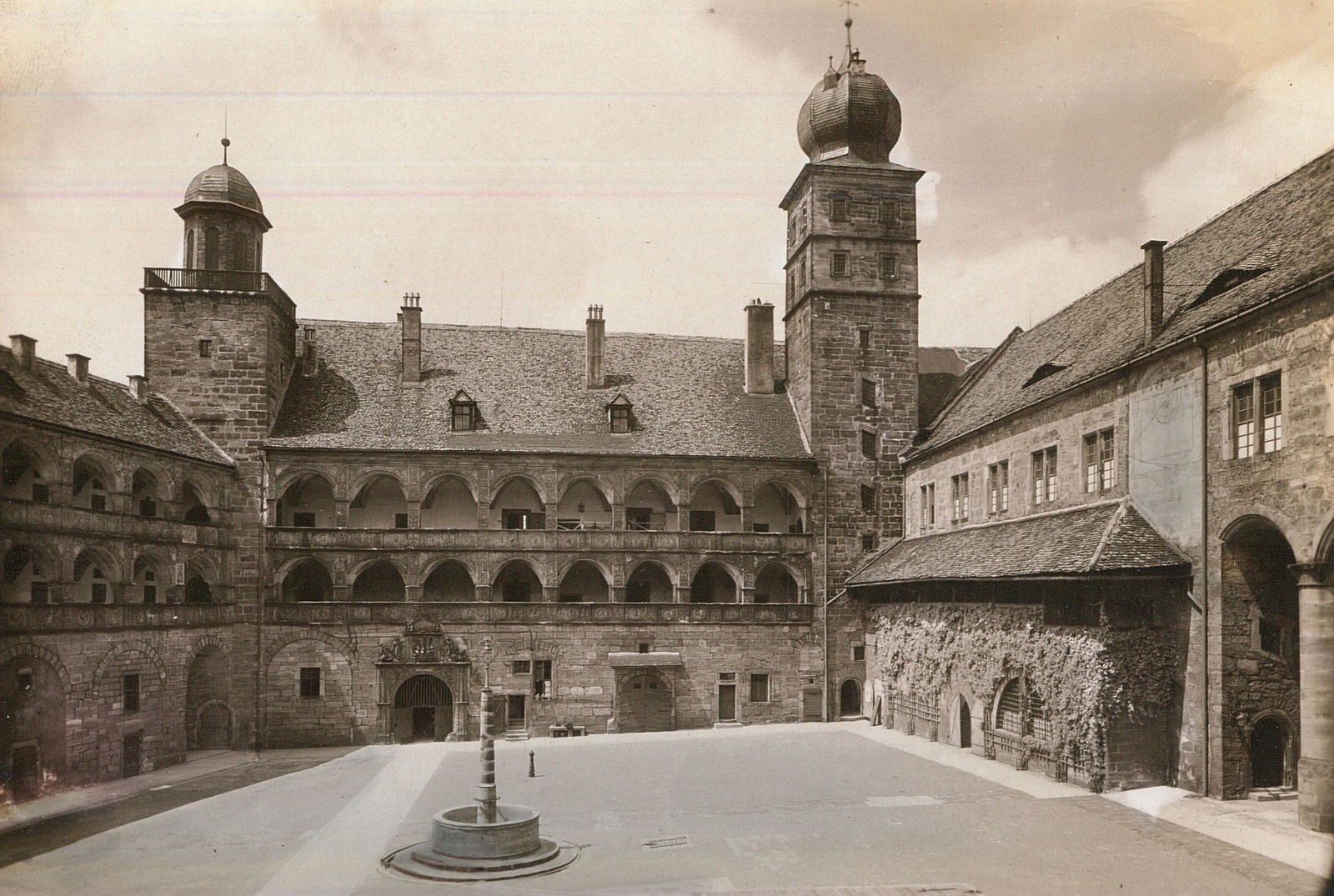
Plassenburg, Schöner Hof
· Deutsche Fotothek (via Europeana)
CC BY-SA
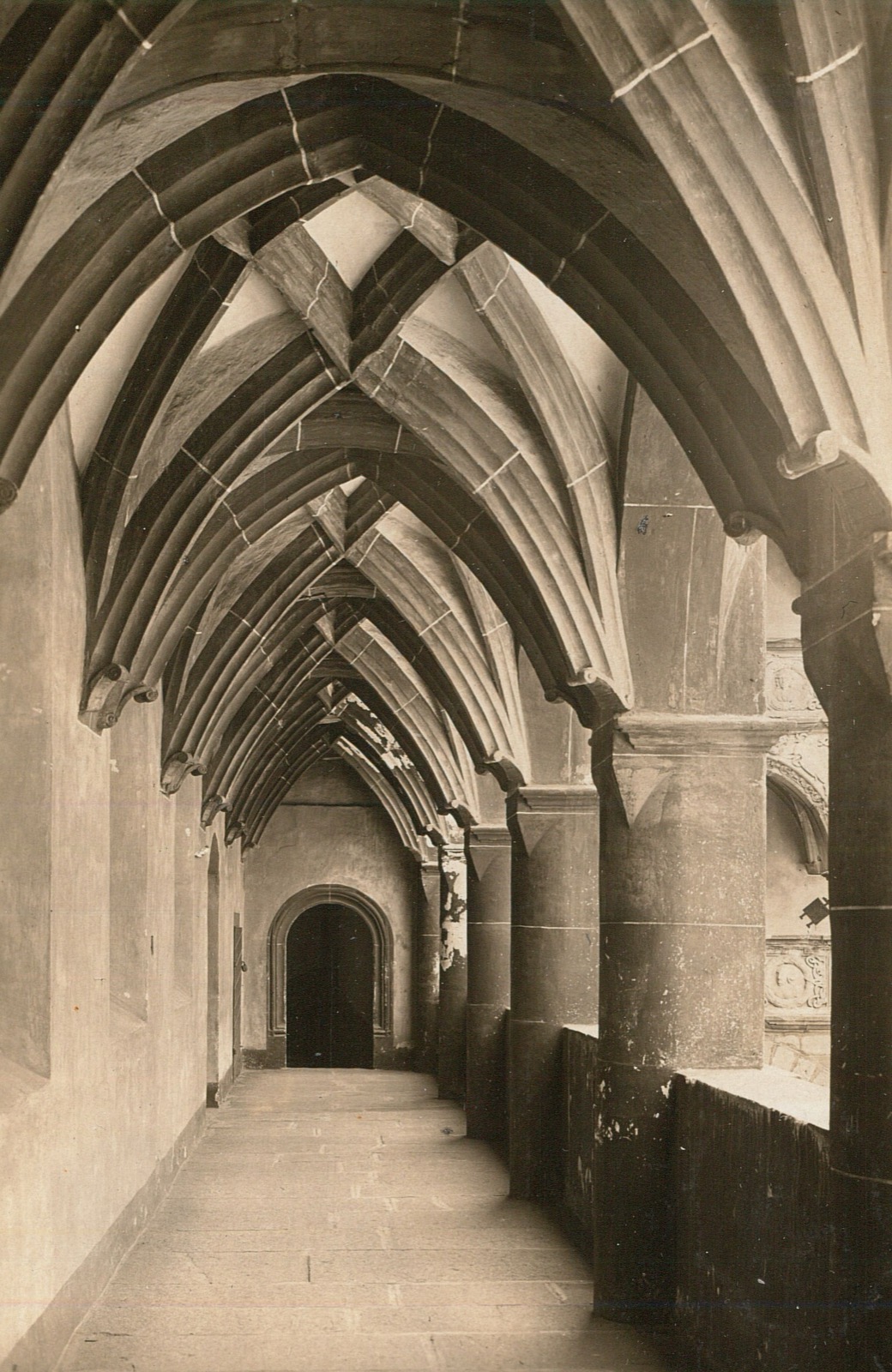
Plassenburg, Scöner Hof
· Deutsche Fotothek (via Europeana)
CC BY-SA
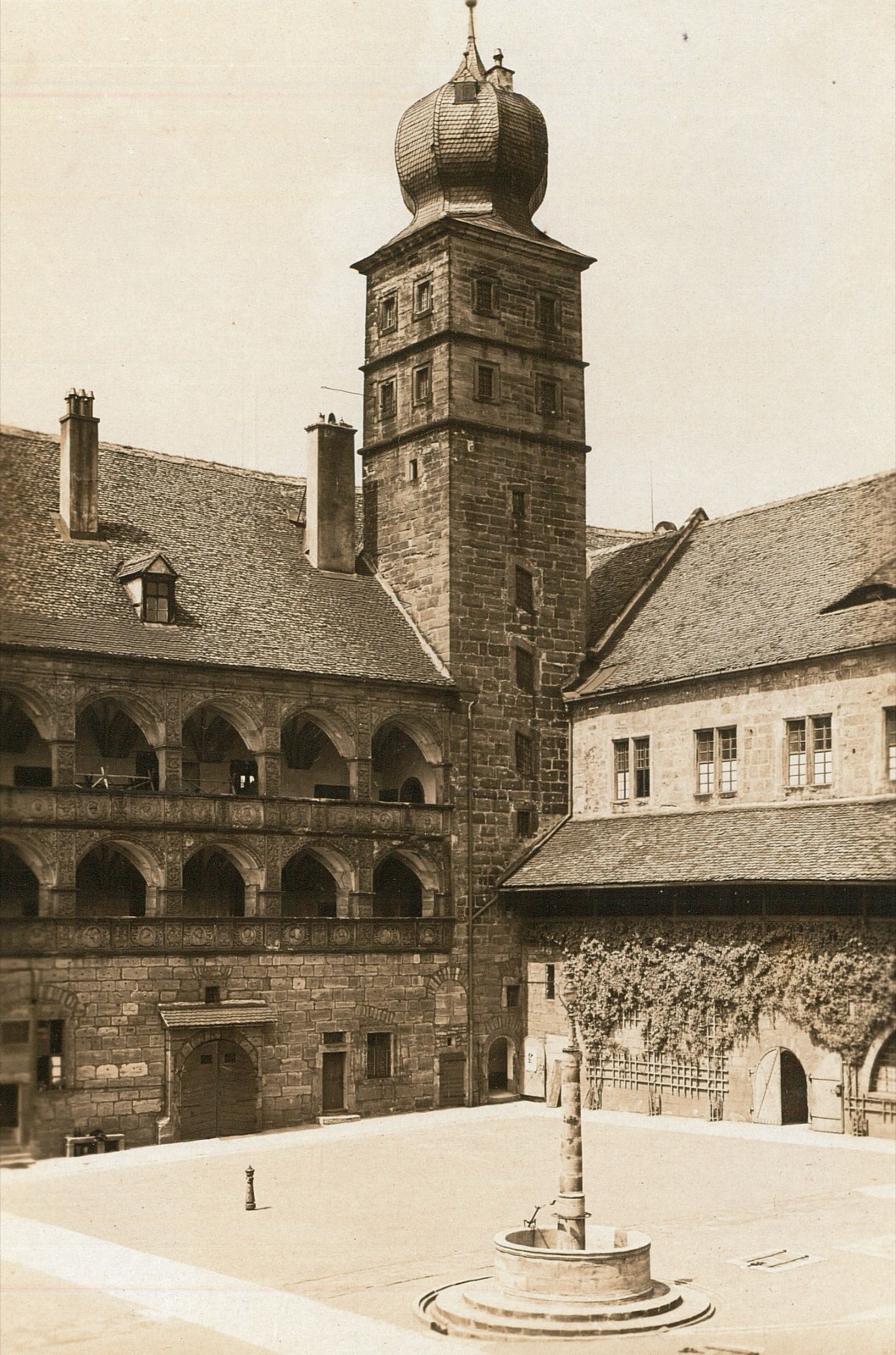
Plassenburg, Schöner Hof
· Deutsche Fotothek (via Europeana)
CC BY-SA


