
Germany · Restored
Rheinstein Castle
Burg Rheinstein
Rheinstein Castle is a medieval Rhine castle near Trechtingshausen, Germany, originally constructed around 1316–1317 and substantially rebuilt in the 19th century. Perched on a steep rocky promontory above the Rhine, it was restored in a neo-Gothic style and contains a chapel, a royal crypt, a courtyard garden and a prominent Knight's Hall (Rittersaal). The castle is open to the public as a museum site.
First raised
1316
Its prime
1844
Today
Restored
As it stood in 1844
What Rheinstein Castle looked like in its prime.
Perched on a sheer rocky promontory above the Rhine, the castle presents a compact conglomeration of brown-reddish sandstone towers and curtain walls with continuous crenellations. A tall rectangular keep with battlemented parapet stands to the rear, paired with a cylindrical seaward tower punctuated by narrow windows; lower domestic ranges show small pitched roofs. The fortified entrance includes a gatehouse with a working drawbridge and portcullis. Terraces and a small enclosed courtyard garden drop directly to the cliff edge, all complete and intact.
Its story
The story of Rheinstein Castle.
Vaitzburg Above the Binger Rheinknie, c. 1290-1323
The spur castle above Trechtingshausen was not called Rheinstein for its first five centuries. It appears in the record as Vaitzburg, Fautsburg and Voitsberg, variants of Vogtsburg, the bailiff's castle. Dendrochronology has dated the oldest timbers in the south wall to 1316 or 1317, and the first mention of the place as a Mainz possession comes in 1323, but building is generally reckoned to have begun soon after 1290.
Its purpose was probably surveillance. In 1286 King Rudolf of Habsburg had destroyed Reichenstein, downstream and within sight, as a robber-knights' nest of the lords of Hohenfels. When the Hohenfels, though Mainz vassals themselves, sold the ruin to the Electoral Palatinate in 1290, Mainz needed a watch on the far bank to see that the ban on rebuilding it was kept. The castle is accordingly attributed to Archbishop Gerhard II of Eppstein, who held the see from 1288 to 1305.
Fiefs of the Archbishops, 1323-1572
A second building phase followed around 1330 and probably a third in the late fifteenth century, though by then the castle's reason for existing had gone: in 1344 the Palatinate renounced Reichenstein in favour of Mainz, and the watch on the opposite ruin no longer mattered. From the fourteenth to the seventeenth century the archbishops granted the castle out as a fief. Matthias, Count of Buchegg, Archbishop of Mainz, held it in 1323; in 1348 it passed to Konrad von Falkenstein, cathedral provost of Mainz, who from 1362 ruled as Kuno II, Archbishop of Trier. In 1459 the Elector Dieter von Isenburg enfeoffed the cathedral scholar Volpert with the castle and with Assmannshausen, the village on the far bank of the Rhine.
The last of the archbishops' tenants was Anton von Wiltberg, custodian and chamberlain of Mainz cathedral, who received castle and estate in 1572. He could not make them pay. The buildings decayed around him, and he lived in them until his death.
Too Ruined to Mine: the War of the Palatine Succession
Decay set in properly at the end of the sixteenth century, for want of money. By the War of the Palatine Succession the walls were evidently so far gone that the French did not trouble to blow them up, as they did with almost every other castle in the valley. The ruin then changed hands for very little: to the privy councillor Freiherr von Eyss in 1779, and on 5 June 1822 from his son to Johann Jacob Freiherr von Coll, for four Laubtaler.
Schinkel's Plans and Prince Frederick's Rebuilding, 1816-1844
The Rhine Province had passed to Prussia at the Congress of Vienna in 1815, and in 1816 the ruin caught the eye of the Prussian architect Karl Friedrich Schinkel, who drew up plans for a romanticised rebuilding. Those plans persuaded Prince Frederick of Prussia, a nephew of King Frederick William III and Queen Luise, to buy the ruin and the rock under it on 31 March 1823. Reconstruction ran from 1825 to 1829 under the castle architect Johann Claudius von Lassaulx and, from 1827, his pupil Wilhelm Kuhn. Schinkel had insisted that the medieval fabric be preserved, and parts of it still stand out clearly from the new work. It was the first of the ruined Rhine castles to be rebuilt, and on completion in 1829 the prince named it Rheinstein for the cliffs it sits on.
By 1842 Rheinstein was Frederick's favourite residence, with Queen Victoria and Alexandra Feodorovna, Tsarina of Russia, among the crowned heads who came as guests. That year he commissioned designs for a chapel with a burial vault beneath it; the neo-Gothic chapel and the crypt for the princely family were consecrated two years later.
The Crypt, the Stripping and the Rescue, 1863-1975
Prince Frederick was buried in the crypt in 1863, his wife Princess Luise in 1882 and their son Prince George in 1902. George had inherited the castle on his father's death; in 1902 it went to Prince Henry of Prussia, brother of Kaiser Wilhelm II, and in 1929 to Henry's wife Irene of Hesse and by Rhine. The last owner from the German high nobility was Barbara Irene, Princess of Prussia and wife of Duke Christian Ludwig of Mecklenburg.
She put Rheinstein up for sale in 1973 and was deceived by a supposed buyer out of England who removed the portable contents and sold them; further sales scattered more of the original furnishings. The fabric was in such poor condition that Rhineland-Palatinate declined to take the castle on, despite its own monuments office recommending the purchase. In 1975 the Austrian-born opera singer Hermann Hecher bought it and spent years putting it back together with a support association and the state conservation office; it remains in private hands, open to visitors, and since 2002 has formed part of the Upper Middle Rhine Valley World Heritage Site.
Step inside
10 places to explore in 1844.
The record describes 10 distinct spots at Rheinstein Castle, including 5 interiors: chapel interior, royal crypt, stairway leading to the rittersaal and more. Create your own photoreal reconstruction and explore every one, more scenes means more rooms, more angles, and more of the place to stand in.
Build Your Own Castle
Recreate Rheinstein Castle with AI to explore it.
The artist rebuilds it as it stood in 1844, a photoreal reconstruction that belongs to you alone. Pay with coins, no subscription needed.
Recreate this castle →Defend this castle →From the archive
Rheinstein Castle on paper: the measured plan and period views.
The survey plan and photographs below are the ground truth this page's reconstructions are checked against, drawn and photographed while the castle was still a working garrison. Every image is public-domain or openly licensed, with its source named.
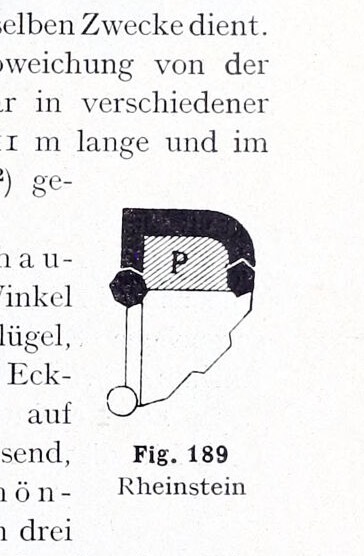
Fig. 189 Rheinstein
1912 · Otto Piper, Burgenkunde (1912)
Public domain


