
Germany · Restored
Schloss Wilhelmshöhe
Schloss Wilhelmshöhe is a late 18th-century Neoclassical palace in the Bergpark Wilhelmshöhe, Kassel, built for Landgrave William IX and later used as a summer residence by Kaiser Wilhelm II. Today it houses the Wilhelmshöhe Castle Museum, including the Gemäldegalerie Alte Meister and other collections. The palace was partly destroyed in World War II and subsequently rebuilt; its dome was not reconstructed.
First raised
1786
Its prime
1910
Today
Restored
As it stood in 1910
What Schloss Wilhelmshöhe looked like in its prime.
A wide, symmetrical Neoclassical palace of light red-brown sandstone set atop a grassy hill in the Bergpark, dominated by a central rectangular block with a tall columned portico and triangular pediment bearing an inscription. Low rusticated ground floor with arched windows supports two higher storeys of regularly spaced rectangular windows. Broad semicircular side wings sweep out from the main block, forming a curved, balustraded roofline; at prime a central dome rose behind the pediment. The facade is formal and monumental, overlooking parkland and the estate water features.
Its story
The story of Schloss Wilhelmshöhe.
Kloster Weißenstein and the Hunting Lodge of Landgrave Moritz
An Augustinian house stood on the slope above Kassel from the twelfth century, a college of canons that later became the nunnery of Weißenstein. Under Philip I, Landgrave of Hesse (1504–1567) it was secularised, and the buildings were afterwards used from time to time as a hunting lodge. Philip's grandson Landgrave Moritz had a new hunting seat put up on the same spot between 1606 and 1610, and his successors enlarged it considerably; the original monastic complex fell victim to the building work.
Du Ry, Jussow and the Palace of Landgrave Wilhelm IX
The present Neoclassical palace was built for Landgrave Wilhelm IX of Hesse-Kassel, who became Elector Wilhelm I in 1803. Simon Louis du Ry designed the Weißenstein and church wings and Heinrich Christoph Jussow the central corps de logis; work began in 1786 and ran through the 1790s. Wanstead House and Prior Park in England are held to be the models. The three blocks stood free of one another to begin with, and the southern wing kept the name of the vanished monastery, the Weißensteinflügel. From 1794 until 1866 the palace was the summer residence of the landgraves and electors of Hesse-Kassel.
Napoléonshöhe: Jérôme Bonaparte and the Return of the Elector
The Napoleonic occupation of 1806 to 1813 gave the palace a new name, Napoléonshöhe. Jérôme Bonaparte, king of Westphalia, appointed his head chamberlain Heinrich von Blumenthal governor with instructions to supervise extensive alterations, and from 1806 single-storey ranges were thrown between the three free-standing blocks. After the Kassel Stadtschloss, where Jérôme and his household lived, burned down in 1811, he used Napoléonshöhe as a residence for a time; among those who visited in these years was his nephew Charles-Louis-Napoléon Bonaparte, the later Napoleon III. The kingdom of Westphalia ceased to exist when France lost the Battle of the Nations on 19 October 1813, and the Elector of Hesse-Kassel returned. Under Elector Wilhelm II the court architect Johann Conrad Bromeis raised the connecting ranges to the height they have now.
Prussian Annexation, a Deposed Emperor and the High Command, 1866–1919
Following the Austro-Prussian War the electorate was annexed by Prussia in 1866, and the palace passed from the House of Hesse to the House of Hohenzollern. After Napoleon III was captured at Sedan in the Franco-Prussian War and deposed, the Prussian king Wilhelm I assigned him Wilhelmshöhe as his residence, and he moved in on 5 September 1870. His wife Eugénie, who had fled to Britain, visited him there on 30 October 1870; on 19 March 1871 he followed her into British exile.
From the 1890s until 1918 the palace was regularly the imperial family's summer residence, and a retreat for Wilhelm II during personal and political crises. After the armistice of 1918 the high command of the German army under Paul von Hindenburg was moved here from Spa in Belgium to organise and lead the withdrawal and demobilisation of the German troops. It stayed at Wilhelmshöhe until February 1919, when it moved to Kolberg.
Bombing, Stripped Interiors and the Museum, 1943–2013
Wilhelmshöhe was struck in the Kassel bombing night of 1943, and the Royal Air Force flew several raids on the city in 1944 and 1945, the palace being bombed again in February 1945. The domed central block was badly damaged by bombs, although on the park side fully fitted rooms survived as high as the second upper floor. The building administration's securing of the site after the war was negligent; under the pretext of clearing rubble the central block was stripped piece by piece of the historic fittings that were left. Some of the palace furniture is now at the Villa Hammerschmidt in Bonn.
The central block was rebuilt under the modernist architect Paul Friedrich Posenenske, the work finishing in 1974. The exterior was reconstructed, but the interior was recast for its new use as an art museum, and the dome was not replaced; a glass roof lights the picture galleries in its stead, and the result remains contested. Between 1994 and 2000 the rooms of the Gemäldegalerie Alte Meister and the antiquities collection were overhauled under Stephan Braunfels.
Only the Weißensteinflügel kept its historic furnishings through the post-war rebuilding, and its rooms can be visited; they hold three writing desks by David Roentgen, Empire furniture from Jérôme Bonaparte's day and seven hunting pieces by Jean-Baptiste Oudry. The palace is a protected Kulturdenkmal held by Hessen Kassel Heritage, and since 23 June 2013 the Bergpark Wilhelmshöhe with its palace has been part of the UNESCO World Heritage list.
Step inside
9 places to explore in 1910.
The record describes 9 distinct spots at Schloss Wilhelmshöhe, including 4 interiors: gallery of the old masters (main exhibition hall), antiquities collection galleries, graphic arts collection room and more. Create your own photoreal reconstruction and explore every one, more scenes means more rooms, more angles, and more of the place to stand in.
Build Your Own Castle
Recreate Schloss Wilhelmshöhe with AI to explore it.
The artist rebuilds it as it stood in 1910, a photoreal reconstruction that belongs to you alone. Pay with coins, no subscription needed.
Recreate this castle →Defend this castle →Whose castle
Clans who held Schloss Wilhelmshöhe.
The families that held Schloss Wilhelmshöhe for a decade or more across its history, follow a name to its clan.
Hesse
Built for Landgrave William IX of Hesse; held by the House of Hesse until Prussia's annexation in 1866.
Hohenzollern
Passed to the House of Hohenzollern in 1866; Kaiser Wilhelm II's summer residence from 1899 to 1918.
From the archive
Schloss Wilhelmshöhe on paper: the measured plan and period views.
The survey plan and photographs below are the ground truth this page's reconstructions are checked against, drawn and photographed while the castle was still a working garrison. Every image is public-domain or openly licensed, with its source named.
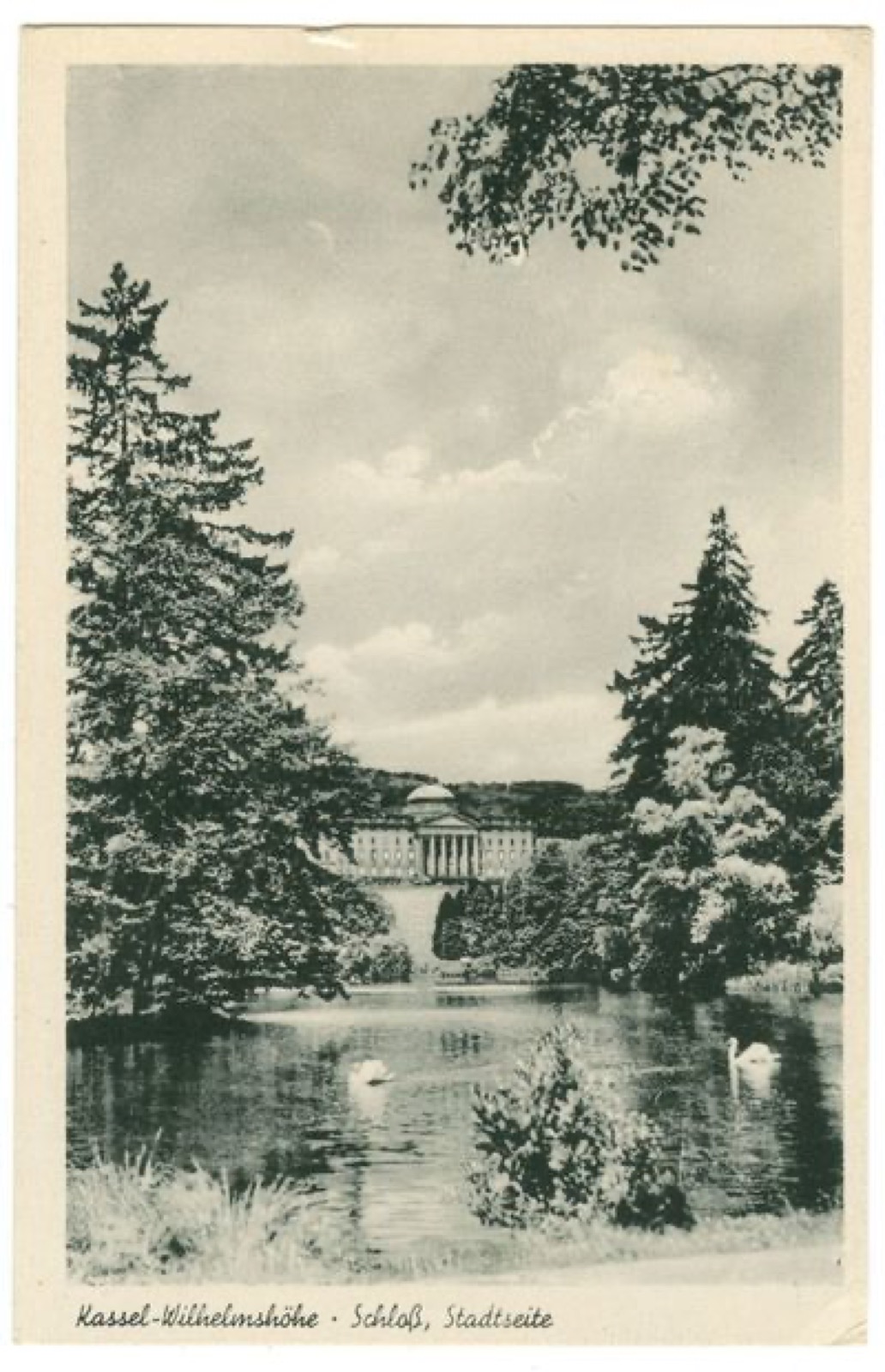
Kassel Schloss Wilhelmshöhe
1930 · Kassel University Library (via Europeana)
CC BY-SA
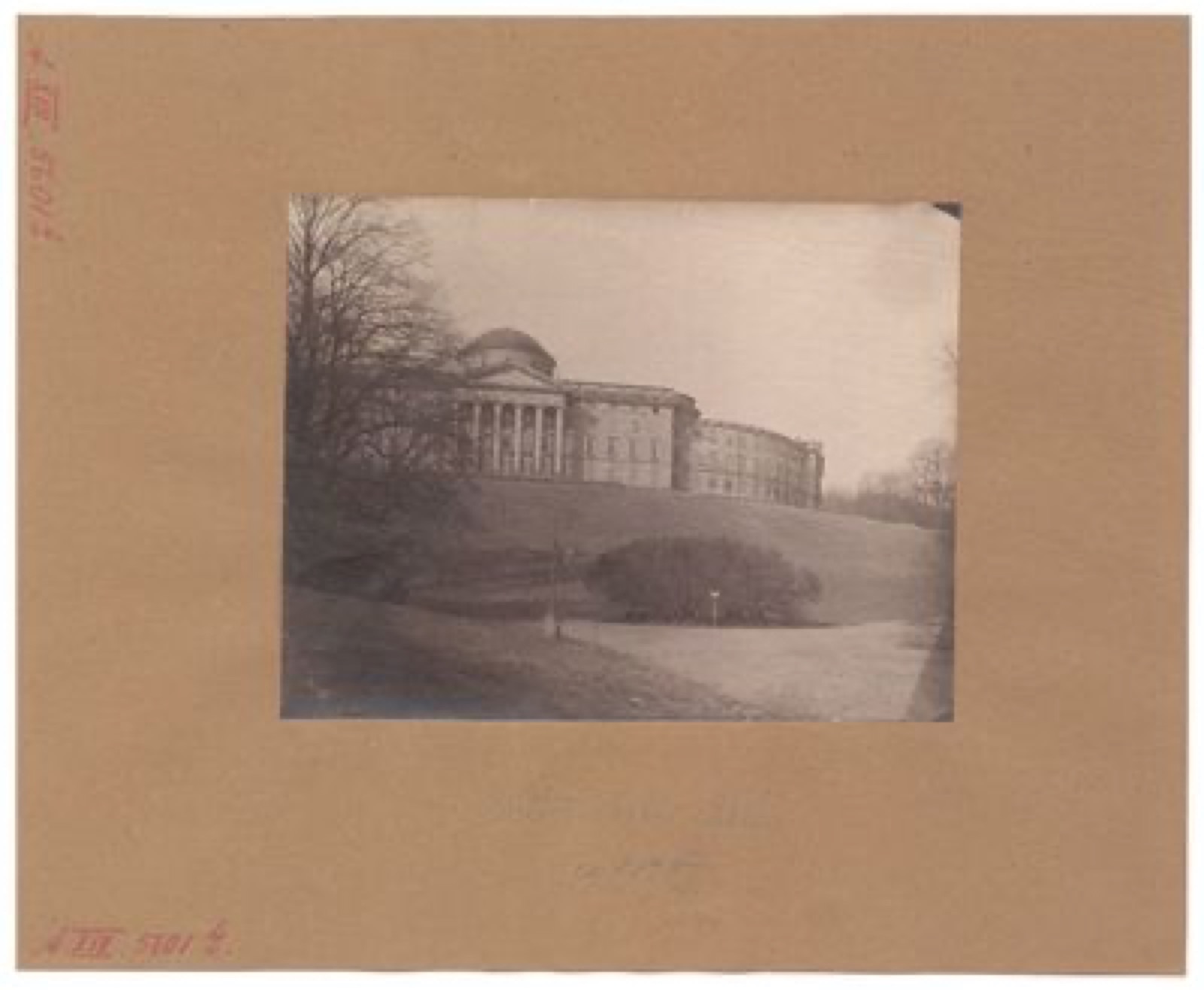
Kassel Schloss Wilhelmshöhe
1891 · Kassel University Library (via Europeana)
CC BY-SA
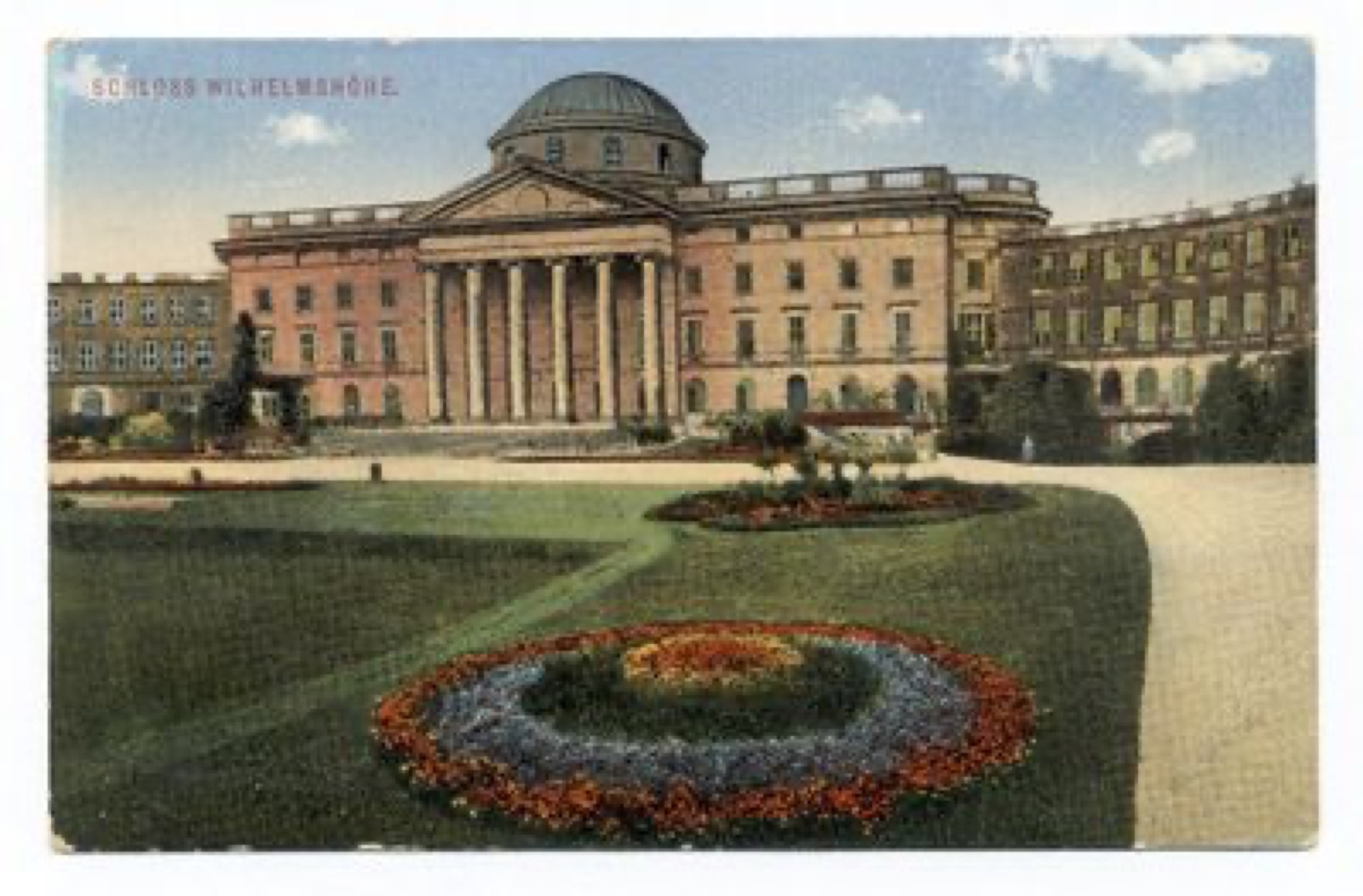
Kassel Schloss Wilhelmshöhe
1895 · Kassel University Library (via Europeana)
CC BY-SA


