
Germany · Restored
Schwanenburg
Schwanenburg (Swan Castle) is a medieval castle on a steep hill at the northern end of the Kermisdahl where it meets the Spoykanal in Kleve, North Rhine-Westphalia. It was the residence of the Dukes of Cleves and is dominated by the tall Schwanenturm (Swan Tower). The site later received a Dutch Baroque renovation and gardens in the 17th century and was rebuilt after heavy damage in World War II.
Its prime
1670
Today
Restored
As it stood in 1670
What Schwanenburg looked like in its prime.
Perched on a steep hill at the confluence of the Kermisdahl and Spoykanal, the castle is dominated by the tall Schwanenturm rising roughly 55 m above surrounding roofs. The complex is a compact cluster of stone buildings and towers with a stepped roofline, an outer courtyard where the medieval knight's hall stood, and nearby formal Forstgarten terraces laid out in 17th‑century Dutch Baroque fashion; the main tower bears a carved inscription above its entrance.
Its story
The story of Schwanenburg.
Count Dietrich's Hill Above the Kermisdahl, 1092-1242
The Schwanenburg was raised, probably in the 11th century, by the counts and later dukes of Cleves on a spur of the Lower Rhine ridge above where the Kermisdahl meets the Spoykanal, once an important link to the Rhine. A Roman post has been suggested here, halfway between Xanten and Nijmegen, but excavations in 1999-2000 found no support for it, historians looking instead to a late-Carolingian fortification beneath the 11th-century castle. Count Dietrich I of Cleves, who probably took his name from the castle, is first recorded in 1092; the castle itself is named indirectly in 1145 and directly in a Siegburg book of miracles of 1184, though a mention in monastery annals of 1020 has been claimed for it.
By then it had a square tuff residence tower of about 1100, ringed from roughly 1150 by a polygonal curtain, and a hall block on the east side holding the knights' hall. Count Dietrich IV founded Kleve west of the castle, granting it town rights on 25 April 1242.
Counts of the Mark to the United Duchies, from 1368
Under Counts Dietrich VII and Johann the castle finally displaced Monterberg, near Kalkar, as the county's fixed seat of government. When the comital house failed in the male line in 1368, county and castle passed by inheritance to the counts of the Mark, and in 1417 Emperor Sigismund raised Adolf II of Cleves-Mark to Duke of Cleves. The dukes stood at the height of their power in the 16th century as rulers of the united duchies of Jülich-Cleves-Berg; that told on the Schwanenburg, for the ducal court was now seldom at Kleve, keeping mostly to Düsseldorf, Jülich or Hambach.
The Fall of the Old Tower and the Building of the Schwanenturm, 1429-1455
Duke Adolf I turned the Spiegelturm into an archive in 1429. On 7 October 1439 the old residence tower collapsed, and Adolf had the ducal master mason Johan Wyrenberg raise a slimmer tower in its place; begun in 1440, it was finished thirteen years later, and in 1455 a gilded swan set on its spire gave the tower its name. A tablet over the entrance records the fall of the old tower on that day and its rebuilding within the year by Adolph, first Duke of Cleves, repeating the story that Julius Caesar built the tower that stood there before.
The Swan Knight in the Cleves Pedigree
Around 1233 the counts of Cleves took the carbuncle into their arms, a reference to the legendary swan knight Helias as founder of their line; that legend named the Swan Tower in the Middle Ages and, in the 19th century, the whole complex. Told of Loherangrin in Wolfram von Eschenbach's Parzival and made famous by Wagner's Lohengrin, it has a knight of the Grail arrive by swan boat and marry the heiress he defends, on condition she never ask his name. Dutch tradition has Elias Lohengrin relieve Count Dietrich's heiress Beatrix at Nijmegen in 715 and marry her; she lived afterwards in a tower near Kleve, remembered as the White Woman of the Swan Tower. Little is reliably known of who held power at Cleves in the early Middle Ages, and what historians have said of it is disputed.
Pieter Post's Baroque Palace and the Courts, from 1649
The death of the childless Duke Johann Wilhelm carried the Schwanenburg by inheritance to Johann Sigismund of Brandenburg, and Kleve became a third Brandenburg residence city beside Berlin and Königsberg. Under the stadtholder Johann Moritz of Nassau-Siegen it had its last great flowering from 1649, when he built Kleve into a garden town of European rank for Elector Friedrich Wilhelm. Between 1663 and 1666 the Dutch architect Pieter Post rebuilt the castle as a plain Baroque palace, stripping out every Gothic element but the towers and adding the range whose gateway, carrying the Brandenburg arms, is the main entrance still.
In the first half of the 18th century town and palace lost importance as Prussia moved residence and government to Berlin and Potsdam; neglect later brought fabric down: the hall block with its knights' hall in 1771, the Johannisturm in 1784. Under French rule it held the administration of the Arrondissement de Clèves. After Kleve returned to Prussia it served from 1821 to 1917 as courthouse and prison.
On 7 October 1944 an Allied raid destroyed the historic centre of Kleve and badly damaged the castle, an aircraft striking the Schwanenturm and exploding. The Bauhütte Schwanenburg, an association of Kleve citizens, rebuilt part of it in 1948-1953, and the Freunde der Schwanenburg, founded in 1986, have carried the restoration on since, vaulting work in the Spiegelturm included in 1988. The Schwanenburg is a listed architectural monument of North Rhine-Westphalia and houses the Amtsgericht and the Landgericht of Kleve, with a geological collection in the Swan Tower.
Step inside
6 places to explore in 1670.
The record describes 6 distinct spots at Schwanenburg, including 2 interiors: upper chambers and stair of the swan tower, outer courtyard and the knight's hall site. Create your own photoreal reconstruction and explore every one, more scenes means more rooms, more angles, and more of the place to stand in.
Build Your Own Castle
Recreate Schwanenburg with AI to explore it.
The artist rebuilds it as it stood in 1670, a photoreal reconstruction that belongs to you alone. Pay with coins, no subscription needed.
Recreate this castle →Defend this castle →Whose castle
Clans who held Schwanenburg.
The families that held Schwanenburg for a decade or more across its history, follow a name to its clan.
Cleves
Residence of the Dukes of Cleves; Duke Adolph I installed the inscription on the rebuilt Swan Tower.
From the archive
Schwanenburg on paper: the measured plan and period views.
The survey plan and photographs below are the ground truth this page's reconstructions are checked against, drawn and photographed while the castle was still a working garrison. Every image is public-domain or openly licensed, with its source named.
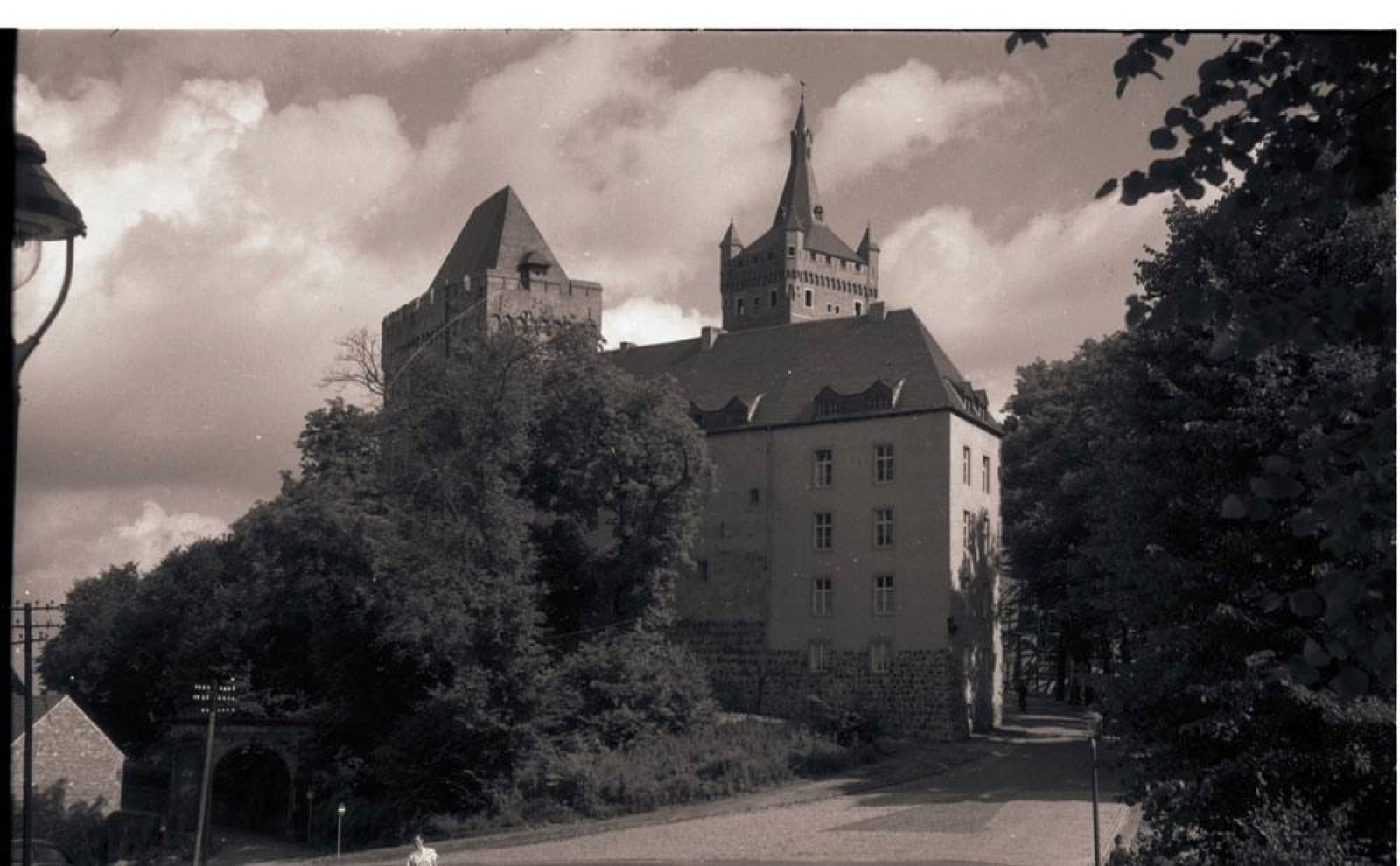
Kleve: Schwanenburg
· State Archives of Baden-Württemberg (via Europeana)
CC BY
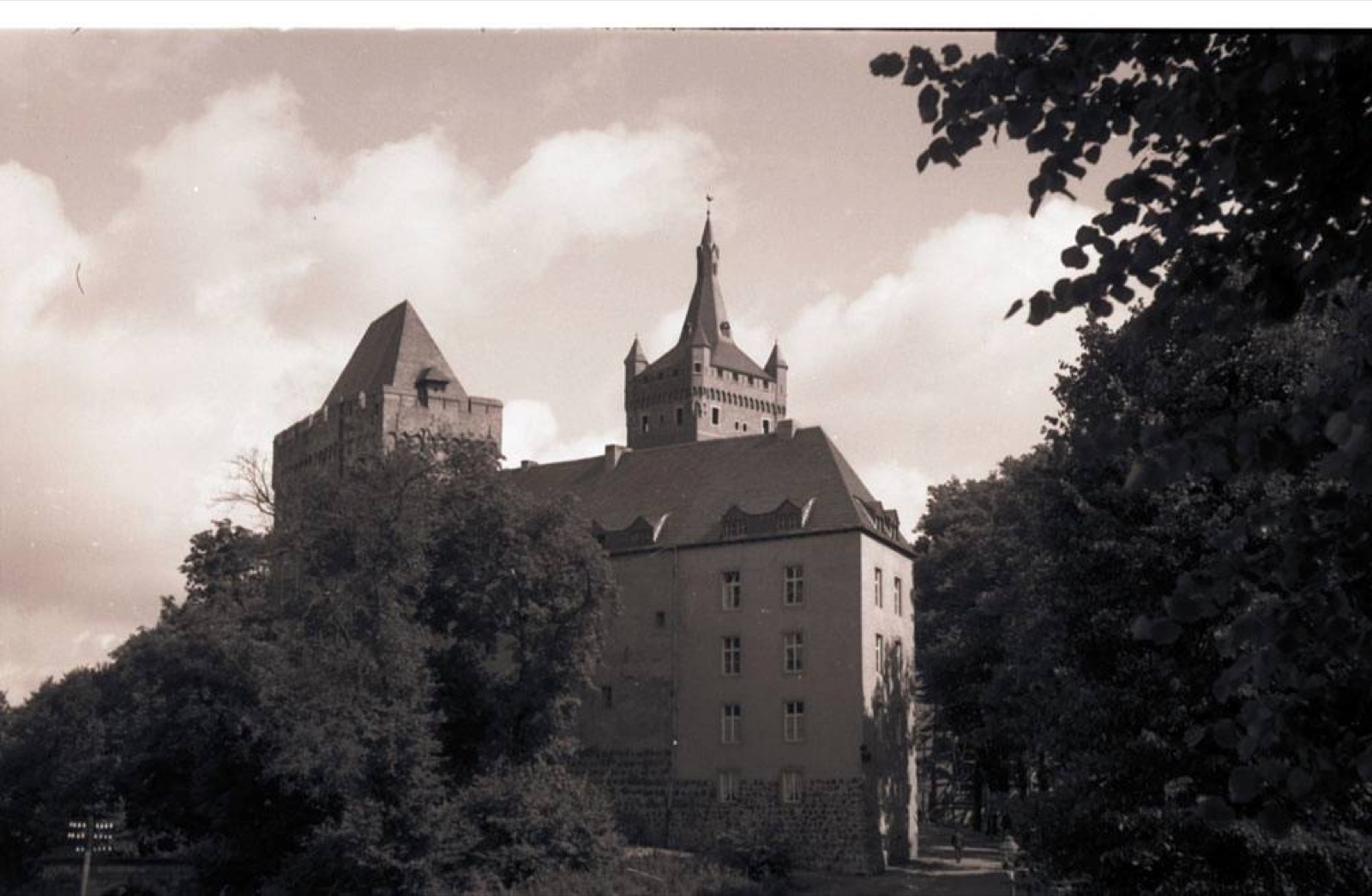
Kleve: Schwanenburg
· State Archives of Baden-Württemberg (via Europeana)
CC BY


