
Germany · Restored
Sooneck Castle
Burg Sooneck
Sooneck Castle is a hilltop castle on a rocky promontory above the Rhine near Niederheimbach in Rhineland-Palatinate, Germany. Largely rebuilt in the 19th century for the Prussian crown princes (completed mid-19th century), it is now a state-owned, visitable castle and part of the Rhine Gorge UNESCO World Heritage Site.
Its prime
1861
Today
Restored
As it stood in 1861
What Sooneck Castle looked like in its prime.
Perched on a steep sandstone crag above the Rhine, the castle presents a tall rectangular main tower with crenellated parapet and narrow slit windows, linked to a lower, long curtain of warm-brown masonry punctuated by smaller square towers and battlemented walkways. Stepped terraces and stone stairways descend the rock; gateways and a visible north gate bear a Prussian royal crest. Rooflines are low and mostly flat behind battlements; the site is tightly packed along the cliff edge with vineyard terraces below.
Its story
The story of Sooneck Castle.
Hohenfels Bailiffs and King Rudolf's Siege, 1271–1290
Sooneck sits on the steep north-eastern slope of the Binger Wald above the Rhine near Niederheimbach, between Bingen and Bacharach. Recent research places its first mention probably in 1271. Like neighbouring Reichenstein, it was administered by the lords of Hohenfels, who held it as bailiffs for the imperial abbey of Kornelimünster near Aachen.
What is certain is the siege of 1282. The troops of King Rudolf of Habsburg took the castle and destroyed it, and a prohibition on rebuilding was laid on the site, which the king expressly repeated in 1290.
The Waldeck Ganerbenburg, 1346–1553
In April 1346 Archbishop Henry III of Mainz granted Sooneck in fief to the knight Johann Marschall zu Waldeck, who had the castle rebuilt over the years that followed. The ban on rebuilding was not lifted until 1349, by King Charles IV, after the property and its bailiwick had fallen to the Electorate of Mainz.
On Johann's death the castle passed as a joint fief to four of his heirs, and Sooneck thereby became a Ganerbenburg, held by several branches of the family at once. Those branches were not always well disposed to one another and quarrelled over their shares of the inheritance; more than once a Burgfrieden, a peace among the castle's inhabitants, had to be concluded. When the Waldeck line died out in 1553 with the death of Philipp Melchior, the family of Breidbach zu Bürresheim, until then co-owners, were enfeoffed with the castle alone.
Destruction in 1689 and the Trechtingshausen Vineyards
When the Breidbach line too was extinguished, Sooneck began to decay. In the course of the War of the Palatine Succession, Sooneck was destroyed in 1689 by the troops of Louis XIV of France, as were almost all the castles on the left bank of the Rhine between Bingen and Koblenz. In 1774 the Mainz cathedral chapter made the ruin over to four inhabitants of Trechtingshausen, who planted vineyards there. The site later came into the possession of the village of Niederheimbach.
A Hunting Lodge the Prussian Princes Never Used, 1834–1861
In 1834 the Prussian crown prince Frederick William IV and his brothers, the princes William, Charles and Albert, bought the wholly dilapidated castle and had it rebuilt as a hunting lodge. The historical structures were largely retained and buildings in romantic style added; the royal Prussian arms over the northern gate, which was not the original approach, date from this campaign. Disputes within the royal family and the effects of the revolution of 1848 meant the castle was never used as a hunting lodge. The rebuilding, to plans by the military architect Carl Schnitzler, was finished in 1861.
State Property and World Heritage, 1918–2002
With the settlement of princely property after the First World War, Sooneck passed into state ownership. After the Second World War it came to the Land of Rhineland-Palatinate, and from 1948 to the state castles administration, today the Generaldirektion Kulturelles Erbe Rheinland-Pfalz, Direktion Burgen, Schlösser, Altertümer. It can be visited on guided tours.
The living rooms are furnished chiefly with neo-Gothic and Biedermeier pieces and hold paintings belonging to the Hohenzollern family and, since 1991, to the Köth-Wanscheid family foundation, along with drawings and sketches by Johann-Caspar Schneider among others. Sooneck has formed part of the Upper Middle Rhine Valley UNESCO World Heritage Site since 2002 and is a protected cultural property under the Hague Convention.
Step inside
9 places to explore in 1861.
The record describes 9 distinct spots at Sooneck Castle, including 1 interior: residential rooms (neo-gothic & biedermeier furnishings). Create your own photoreal reconstruction and explore every one, more scenes means more rooms, more angles, and more of the place to stand in.
Build Your Own Castle
Recreate Sooneck Castle with AI to explore it.
The artist rebuilds it as it stood in 1861, a photoreal reconstruction that belongs to you alone. Pay with coins, no subscription needed.
Recreate this castle →Defend this castle →Whose castle
Clans who held Sooneck Castle.
The families that held Sooneck Castle for a decade or more across its history, follow a name to its clan.
Waldeck
Enfeoffed to John, Knight Marshall of Waldeck, by the Archbishop of Mainz in 1346; his line held Sooneck as a multi-family Ganerbenburg until it died out in 1553.
Breidbach
The Breidbach zu Bürresheim family, long co-tenants, became sole tenants of Sooneck after 1553 and held it until their line became extinct.
From the archive
Sooneck Castle on paper: the measured plan and period views.
The survey plan and photographs below are the ground truth this page's reconstructions are checked against, drawn and photographed while the castle was still a working garrison. Every image is public-domain or openly licensed, with its source named.
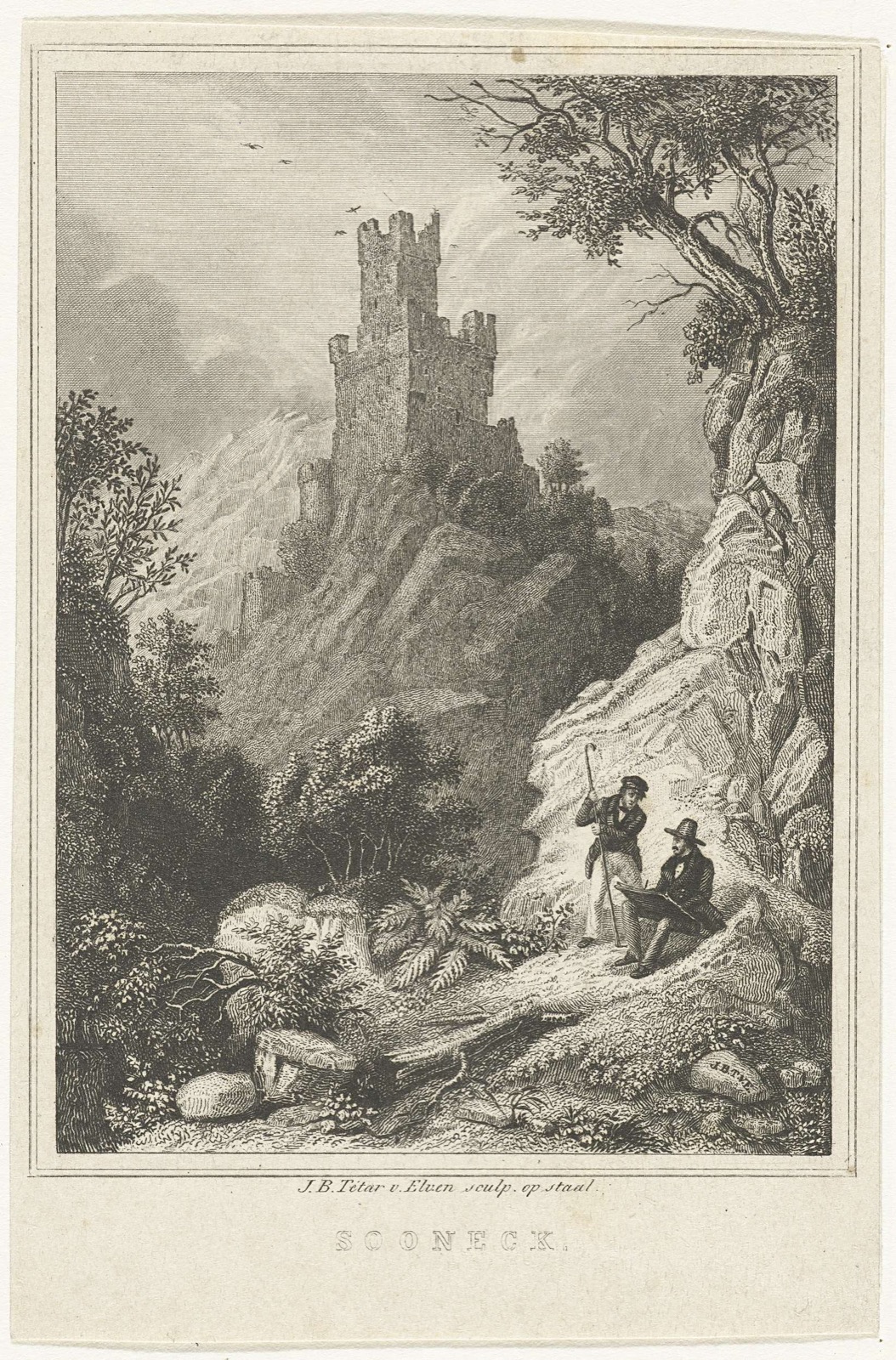
Landschap met burcht Sooneck
· Rijksmuseum (via Europeana)
Public domain
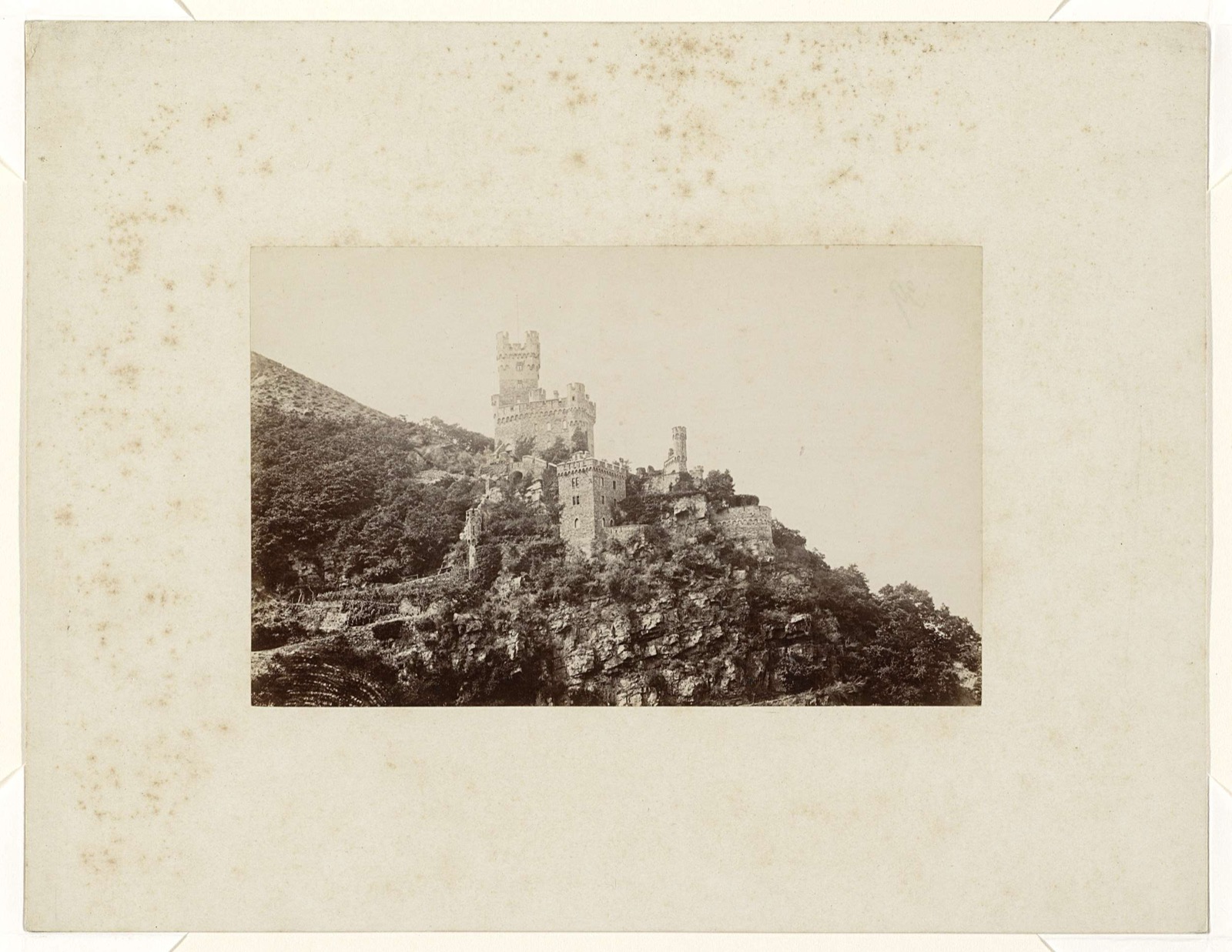
Burcht Sooneck bij Bingen
· Rijksmuseum (via Europeana)
Public domain
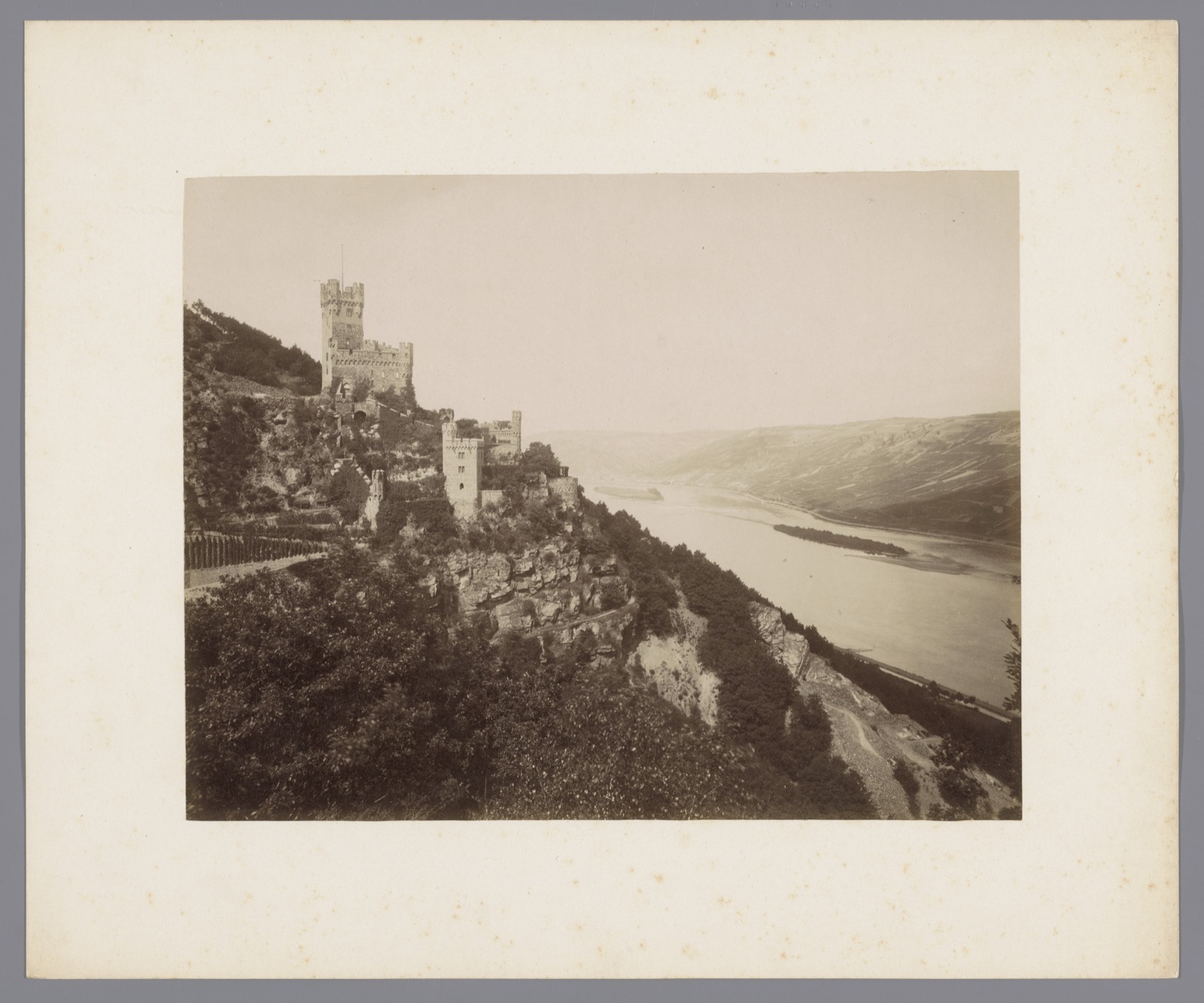
Gezicht op burcht Sooneck, gelegen aan de Rijn
· Rijksmuseum (via Europeana)
Public domain


