
Germany · Restored
Trausnitz Castle
Burg Trausnitz
Trausnitz Castle is a medieval hilltop castle in Landshut, Bavaria that served as the Wittelsbach ducal residence for Lower Bavaria and later as a princely seat. The complex combines high medieval masonry with later Renaissance additions and contains several named ceremonial halls and a chapel now used for museum displays.
First raised
1204
Its prime
1578
Today
Restored
Ranked among Europe’s castles
As it stood in 1578
What Trausnitz Castle looked like in its prime.
A long, multi-wing hilltop castle with steep red-tiled roofs and a mix of white plastered and pale stone facades, punctuated by red-brick defensive towers and curtain walls. The silhouette includes a stepped gable on the Dürnitz wing, a cylindrical corner tower with a conical roof at the front, and a tall square brick keep at the east end. A row of stone round arches (arcades) opens on to an internal courtyard; the whole complex sits above the town on a wooded slope.
Its story
The story of Trausnitz Castle.
Duke Ludwig's Fortress on the Hofberg, 1204–1235
In 1204 Duke Ludwig I of Bavaria, known as Ludwig the Kelheimer, founded the town of Landshut and began building Trausnitz Castle on the spur above it, the Hofberg; he moved his main seat there after his previous stronghold, Burg Wartenberg, had burned down at the end of the twelfth century. The castle was largely complete by 1235, when Emperor Frederick II visited Landshut.
In these same years Trausnitz stood at the centre of imperial politics and Staufer courtly culture: the minnesingers Walther von der Vogelweide and Tannhäuser both visited Landshut, and the dukes' patronage of art ran high enough that they sent to Strasbourg for a sculptor to carve the work that still stands in the castle's chapel, the Burgkapelle. Around 1227 Elisabeth of Bavaria, daughter of Duke Otto II, who had succeeded Ludwig in 1206, was born at the castle; she later became queen of the Holy Roman Empire, Sicily and Jerusalem.
Seat of the Dukes of Lower Bavaria, 1255–1503
After Otto II died, the 1255 partition of his lands between his sons created the Duchy of Lower Bavaria and the Duchy of Upper Bavaria with the Palatinate; Landshut and Trausnitz became the residence of Lower Bavaria, with secondary residences at Straubing and Burghausen. During the fifteenth century the wealthy 'rich dukes' of Bavaria-Landshut, Ludwig IX and Georg the Rich, repeatedly renovated and expanded the buildings, raising and extending the outer ring of defensive walls with new towers and building the Dürnitz hall.
Trausnitz served as ducal seat of Lower Bavaria almost without interruption until 1503.
Renaissance Rebuilding under Wilhelm V, 1516–1579
The castle, whose name Landeshuata was later given to the town itself, took the name Trausnitz during the sixteenth century, traditionally read as 'dare not trust'. From 1516 Duke Louis X had it refitted as a Renaissance palace, though little from this phase survives. Between 1568 and 1578 the painter and architect Friedrich Sustris rebuilt the courtyard for Crown Prince Wilhelm, later Wilhelm V, lining it with three-storey arcades and adding murals in the Florentine Mannerist style; most of these were destroyed by later fires. In the Italian addition to the prince's wing, Alessandro Scalzi, called Paduano, frescoed the spiral staircase between about 1575 and 1579 with life-sized figures from the commedia dell'arte, giving it the name it still carries, the Narrentreppe, or Fools' Staircase.
The Swedish Siege and the Fire of 1961
On 22 July 1634, during the Thirty Years' War, Swedish forces besieged Landshut and the castle, blasting a breach in the east wall of the fortifications; the gate at that spot is still known as the Schwedentor, the Swedes' Gate. The storming damaged the outbuildings of the outer bailey so badly that they had to be demolished afterward and were never rebuilt; the cleared ground is now known as the Schwedenwiese. Between 1675 and 1679 Elector Ferdinand Maria extended the castle's painted decoration further; these paintings have since been destroyed.
Through the eighteenth century Trausnitz served as a barracks and a prison for noble prisoners, and in the early nineteenth century as a hospital. King Ludwig II had a new suite of rooms fitted out in Neo-Renaissance style on the second floor of the prince's wing between 1869 and 1873. On 21 October 1961 a fire broke out in the prince's wing, started by an immersion heater a cleaner had forgotten to switch off; it destroyed nearly all the surviving wall paintings and furnishings of the Palas, including Ludwig II's rooms, though the Narrentreppe and the Georgskapelle survived.
The castle is now managed by the Bavarian Administration of State-Owned Palaces, Gardens and Lakes and is listed as an architectural heritage monument in Bavaria. Since September 2004 its restored apartments have housed the Trausnitz Chamber of Art and Curiosities, a branch of the Bavarian National Museum with some 750 exhibits of artworks, Oriental treasures and Renaissance rarities.
Step inside
9 places to explore in 1578.
The record describes 9 distinct spots at Trausnitz Castle, including 5 interiors: knights' hall (rittersaal), tower terrace (söller / loggia), white hall (dürnitz) and more. Create your own photoreal reconstruction and explore every one, more scenes means more rooms, more angles, and more of the place to stand in.
Build Your Own Castle
Recreate Trausnitz Castle with AI to explore it.
The artist rebuilds it as it stood in 1578, a photoreal reconstruction that belongs to you alone. Pay with coins, no subscription needed.
Recreate this castle →Defend this castle →Whose castle
Clans who held Trausnitz Castle.
The families that held Trausnitz Castle for a decade or more across its history, follow a name to its clan.
Wittelsbach
Home of the Wittelsbach dynasty, founded by Duke Ludwig I in 1204, their ducal residence for Lower Bavaria 1255–1503, and later seat of the rulers of all Bavaria.
From the archive
Trausnitz Castle on paper: the measured plan and period views.
The survey plan and photographs below are the ground truth this page's reconstructions are checked against, drawn and photographed while the castle was still a working garrison. Every image is public-domain or openly licensed, with its source named.
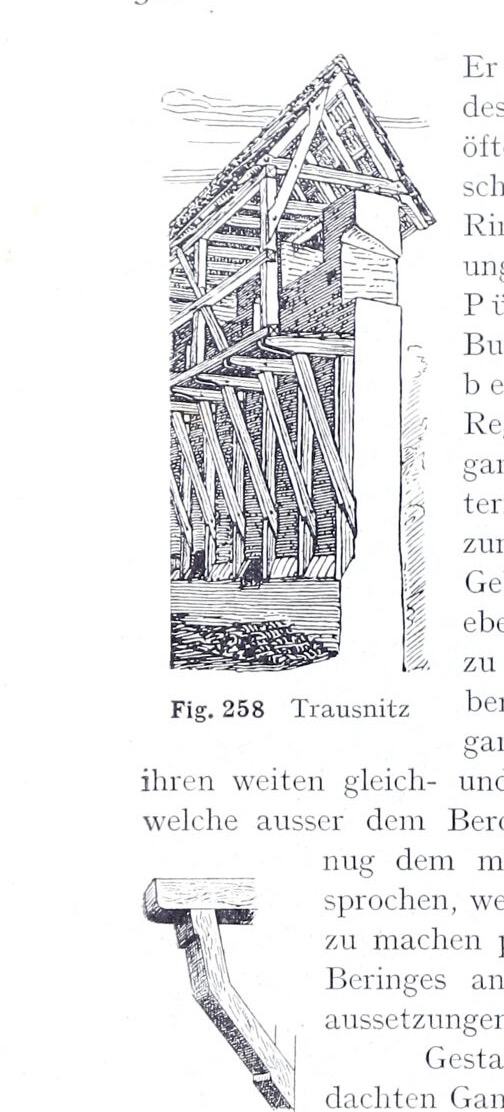
Fig. 258 Trausnitz
1912 · Otto Piper, Burgenkunde (1912)
Public domain


