
Germany · Restored
Trifels Castle
Reichsburg Trifels
Trifels Castle (Reichsburg Trifels) is a medieval hill castle on a red sandstone peak above the Queich valley near Annweiler in the Palatinate Forest. Originally an imperial stronghold and temporary safekeeping place for the Imperial Regalia, it fell into ruin after the early modern period and was gradually rebuilt from the 19th century onward. The present visible ensemble largely reflects 19th–20th century restorations on medieval foundations.
Its prime
1193
Today
Restored
Ranked among Europe’s castles
As it stood in 1193
What Trifels Castle looked like in its prime.
Perched on the crest of a red-sandstone, three-peaked mountain and surrounded by dense forest, Trifels occupies an elongated rocky ridge. A stout, square stone keep and an attached rectangular residential block sit at the highest point, built of reddish sandstone with small vertical window openings and pitched tiled roofs. Ring walls and a narrow outer bailey run along the ridge, joined by stone causeways; a prominent well tower stands outside the main wall, linked by a short bridge, and sheer rock faces fall away from the site.
Its story
The story of Trifels Castle.
Diemar's Donation and the Rise of an Imperial Castle, 1081–1115
Trifels first appears in the record in a 1081 deed of donation, when it belonged to a local noble named Diemar, a relative of Archbishop Siegfried I of Mainz; from him the castle passed to the imperial Salian dynasty. In 1113 Emperor Henry V made it a Reichsburg, a castle held directly by the crown, over the objections of Archbishop Adalbert of Mainz, who claimed it by inheritance. Adalbert had allied himself with Henry's rival Lothair of Supplinburg, and paid for it: the emperor forced him to surrender Trifels and held him prisoner, in part at the castle itself, until 1115.
Guardian of the Empire's Crown Jewels, 1125–1298
When Henry V died in 1125, his nephew Duke Frederick II of Swabia made Trifels the safekeeping place for the Imperial Regalia (the crown, orb and sceptre) of the Hohenstaufen emperors. For close to two centuries the regalia were repeatedly brought back to the castle whenever the throne stood vacant between rulers, kept perhaps in the castle chapel and guarded by Cistercian monks from the nearby abbey of Eußerthal, even after Frederick II of Hohenstaufen moved their primary keeping to Waldburg Castle in Swabia in 1220.
Richard the Lionheart and Later Prisoners, 1193–1207
Trifels is best known as the prison of Richard the Lionheart, King of England, seized by Duke Leopold V of Austria near Vienna in December 1192 as he returned from the Third Crusade and handed over to Emperor Henry VI. Chroniclers document three weeks of his confinement at the castle with certainty, from 31 March to 19 April 1193, though his overall captivity lasted nearly two years and he may have spent as much as a year of it at Trifels. He was freed on 4 February 1194 against a vast ransom. A later legend held that the troubadour Blondel de Nesle found the king and carried word to his friends, recasting the ransomed release as a glorious rescue, though Richard's location was never actually a secret.
A different captive was held there a decade later: Bruno von Sayn, Archbishop of Cologne, was confined at Trifels between 1206 and 1207 by King Philip of Swabia before being moved on to Alt-Ems Castle in the Vorarlberg. Whether prisoners of such rank were actually kept in the dungeon cut into the castle rock is doubtful; confinement at Trifels seems to have meant internment within its walls rather than a cell, with little denied the captive beyond the freedom to leave.
Pledged, Burned and Abandoned, 1330–1786
Trifels lost its standing with the Interregnum that followed the Hohenstaufen dynasty's fall, and the castle was pledged out repeatedly, mortgaged to the Electoral Palatinate in 1330 before finally passing to the Dukes of Palatinate-Simmern and Zweibrücken in 1410. A lightning strike set much of it ablaze in 1602. The ruin still offered shelter through the first half of the Thirty Years' War, but was abandoned for good in 1635 after plague broke out, and the surrounding villages afterwards plundered it as a quarry, carrying off the red sandstone of its residential hall and outer bailey to build their own houses. The castle chapel apparently remained usable even so: in 1786 Baron Joseph von Laßberg was knighted there by his uncle.
Rebuilding a National Shrine, 1840s–1970s
Restoration began under the Wittelsbach kings of Bavaria, to whom the Palatinate then belonged: reconstruction plans were commissioned from the court architect August von Voit in 1851 and a further drawing from Georg von Schacky in 1881, and the Trifels Association (formed to stop further theft of the castle's stone) carried out the first structural work in 1882, including the great arch over the well.
The most ambitious phase came under the Nazi regime. With little known of the medieval building despite an earlier excavation campaign, the Munich architect Rudolf Esterer designed a new residential hall from 1938 in the style of the Hohenstaufens' castles in southern Italy, presented as the "creative preservation" of a national shrine. The aim was less an accurate reconstruction than a glorification of German history, its mixture of medieval and modern styles meant to express continuity between the Nazi "Third Reich" and the medieval "First Reich"; the great two-storey "imperial hall" raised in this campaign never existed in that form on the medieval castle.
Work resumed after a wartime hiatus and continued in phases into the 1970s, hampered repeatedly by further decay and shortage of money; the keep reached its present 32-metre height in 1966. Today the castle displays replicas of the Imperial Regalia and ranks, together with Hambach Castle, among the most visited destinations in the Rhineland-Palatinate.
Step inside
8 places to explore in 1193.
The record describes 8 distinct spots at Trifels Castle, including 1 interior: residential hall (late-romanesque). Create your own photoreal reconstruction and explore every one, more scenes means more rooms, more angles, and more of the place to stand in.
Build Your Own Castle
Recreate Trifels Castle with AI to explore it.
The artist rebuilds it as it stood in 1193, a photoreal reconstruction that belongs to you alone. Pay with coins, no subscription needed.
Recreate this castle →Defend this castle →Whose castle
Clans who held Trifels Castle.
The families that held Trifels Castle for a decade or more across its history, follow a name to its clan.
Salian
Passed from the noble Diemar to the Imperial Salian dynasty, which held it until Emperor Henry V's death in 1125.
Hohenstaufen
Imperial stronghold and safekeeping place of the Hohenstaufen emperors' regalia from 1125 to 1220.
From the archive
Trifels Castle on paper: the measured plan and period views.
The survey plan and photographs below are the ground truth this page's reconstructions are checked against, drawn and photographed while the castle was still a working garrison. Every image is public-domain or openly licensed, with its source named.
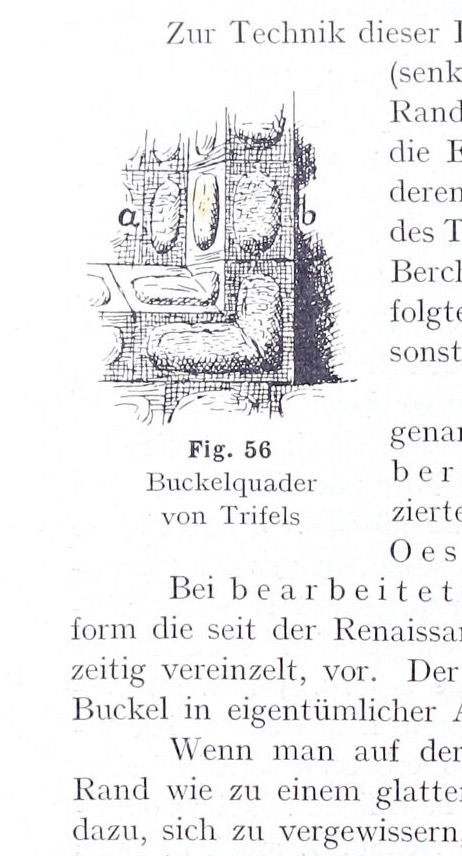
Fig. 56 Buckelquader von Trifels
1912 · Otto Piper, Burgenkunde (1912)
Public domain
Nearby


