
Germany · Restored
Wolfsburg Castle
Schloss Wolfsburg
The Wolfsburg is a medieval lowland water castle in Lower Saxony that was transformed into a four-winged Weser Renaissance schloss and completed in its present form by 1620. It retains a compact quadrangular plan around an inner courtyard with several stair-towers and a massive bergfried integrated into the west wing. Today it is owned by the town of Wolfsburg and used as a public cultural site.
First raised
1302
Its prime
1620
Today
Restored
As it stood in 1620
What Wolfsburg Castle looked like in its prime.
A compact four-sided stone palace surrounding an inner courtyard, built of pale local stone with dark slate pointed roofs; multiple steep gables, lucarnes and corbelled rooflines give a jagged silhouette. A plain, windowless bergfried (roughly square) is set into the west wing and several stair-towers, one hexagonal Wendelstein and taller rectangular Hausmannsturm, rise above the wings. The long north wing forms the main entrance front; the complex sits in a park-like lowland setting formerly protected by moats.
Its story
The story of Wolfsburg Castle.
Wluesborch: The Bartensleben Tower House on the Aller
The von Bartensleben, a ministerialis family from the village of Bartensleben near Helmstedt, were enfeoffed with land here in the thirteenth century. They watched the trade routes at the Aller crossing and needed a fortification to secure their lordship. The castle is first recorded with certainty in 1302, as Wluesborch, in a document issued by four brothers, Borchard, Günzel, Günter and Werner von Bartensleben. The wolf of the castle's name is the heraldic beast of the Bartensleben arms.
Around 1300 the Wolfsburg was no more than a stone tower house beside the Aller; that tower, some 23 metres high and later called the bergfried, is the oldest surviving part of the site, and within the later castle it served as dungeon and prison. Two moats protected the site into the nineteenth century, the inner one, with its drawbridges, making it a water castle and the outer one enclosing the outer ward, where the lord's subjects took refuge in war.
Burg Neuhaus, Cannon and the Feud of 1464
Through the Middle Ages the castle was not an enclosed site but the bergfried with the Altes Haus built against it, and it counted as a strong fortification of strategic importance. When the Bartensleben turned from their liege lord Duke Magnus the Younger by taking a feudal contract with a territorial lord to the east, Magnus built Burg Neuhaus between 1370 and 1372 with help from the town of Brunswick as a counter-castle against the Wolfsburg and Vorsfelde, though Neuhaus too came to the Bartensleben in 1423. A document of 1437 provided for the castle's guns to be increased by ten pieces in the event of war. Tradition records fighting against the castle only once, in the Bartensleben feud with Duke Otto of Lüneburg in 1464, when it is said to have been largely demolished.
Hans the Wealthy and the Weser Renaissance Palace, 1574–1620
In 1574 Hans von Bartensleben, called the Wealthy, began the conversion of the castle. He paid masons, stonecutters and carpenters, while the peasants of the Vorsfelder Werder gave unpaid labour with horses and carts. Hans had the dilapidated Rotes Haus pulled down and the present north wing with the gate raised in its place; when he died in 1583 his kinsman Günzel, Günzel's brother Günther and their uncle Jakob carried on with the ostentatious east wing, then the south wing as knights' house and palas. Only around 1620 was the palace complete in its present form, a four-winged block round a closed courtyard of 50 by 60 metres. Its ornament follows the Weser Renaissance, of which the Wolfsburg is reckoned a typical and the most north-easterly example.
From the Swedish Garrison to the Schulenburgs, 1650–1840
The Wolfsburg came out of the Thirty Years' War as one of the few noble castles left undestroyed, though it was garrisoned almost without a break by troops of the warring parties, the Swedes last of all. The lords of Brunswick and Magdeburg obtained their withdrawal in 1650 by having the castle's owners slight the fortifications. Six years later the von Bartensleben had those defences put back, wanting to keep the military character of the place.
The male line ended with the death of Gebhard Werner von Bartensleben on 6 January 1742. His daughter and sole heiress Anna Adelheit Catharina was married to the Prussian lieutenant-general Adolph Friedrich von der Schulenburg-Beetzendorf, and the property passed in 1746/47 to the von der Schulenburg, whose Wolfsburg branch held it for more than two centuries. The character of a fortified water castle survived until 1840, when the moats were filled in during the regulation of the Aller.
Expropriation, the Volkswagen Town and the Municipal Castle, 1942–1980
The last lord of the castle, Günther Graf von der Schulenburg-Wolfsburg, left on 15 November 1942 for his newly built Schloss Neumühle. The family had to go after large parts of their land were expropriated for the building of the Volkswagen works, which removed the castle's economic basis. On 19 March 1943 the Stadt des KdF-Wagens, the town founded in 1938 for production of the Volkswagen, bought the castle from the count for 560,000 Reichsmarks. On 25 May 1945 the town assembly resolved to rename the town Wolfsburg, after the castle.
The occupying power took the castle over in 1945 and returned it in 1946. Lacking the means to maintain it, the town sold it to the state of Lower Saxony on 11 August 1947, and under state ownership it held welfare and youth homes and, from 1953, refugees from the GDR. The town bought it back in 1961 and renovated the wings in the years that followed. It has served artistic and cultural purposes since 1959; the municipal gallery opened in 1974 and the local museum in 1980. The castle is protected as a Kulturdenkmal.
Step inside
12 places to explore in 1620.
The record describes 12 distinct spots at Wolfsburg Castle, including 5 interiors: watchman's tower (hausmannsturm), upper stage, wendelstein tower spiral staircase, garden hall (gartensaal) and more. Create your own photoreal reconstruction and explore every one, more scenes means more rooms, more angles, and more of the place to stand in.
Build Your Own Castle
Recreate Wolfsburg Castle with AI to explore it.
The artist rebuilds it as it stood in 1620, a photoreal reconstruction that belongs to you alone. Pay with coins, no subscription needed.
Recreate this castle →Defend this castle →Whose castle
Clans who held Wolfsburg Castle.
The families that held Wolfsburg Castle for a decade or more across its history, follow a name to its clan.
Bartensleben
Founded and held by the von Bartensleben family from its first record in 1302 until their line died out in 1742.
Schulenburg
Inherited by the counts of Schulenburg after the Bartensleben line died out in 1742.
From the archive
Wolfsburg Castle on paper: the measured plan and period views.
The survey plan and photographs below are the ground truth this page's reconstructions are checked against, drawn and photographed while the castle was still a working garrison. Every image is public-domain or openly licensed, with its source named.
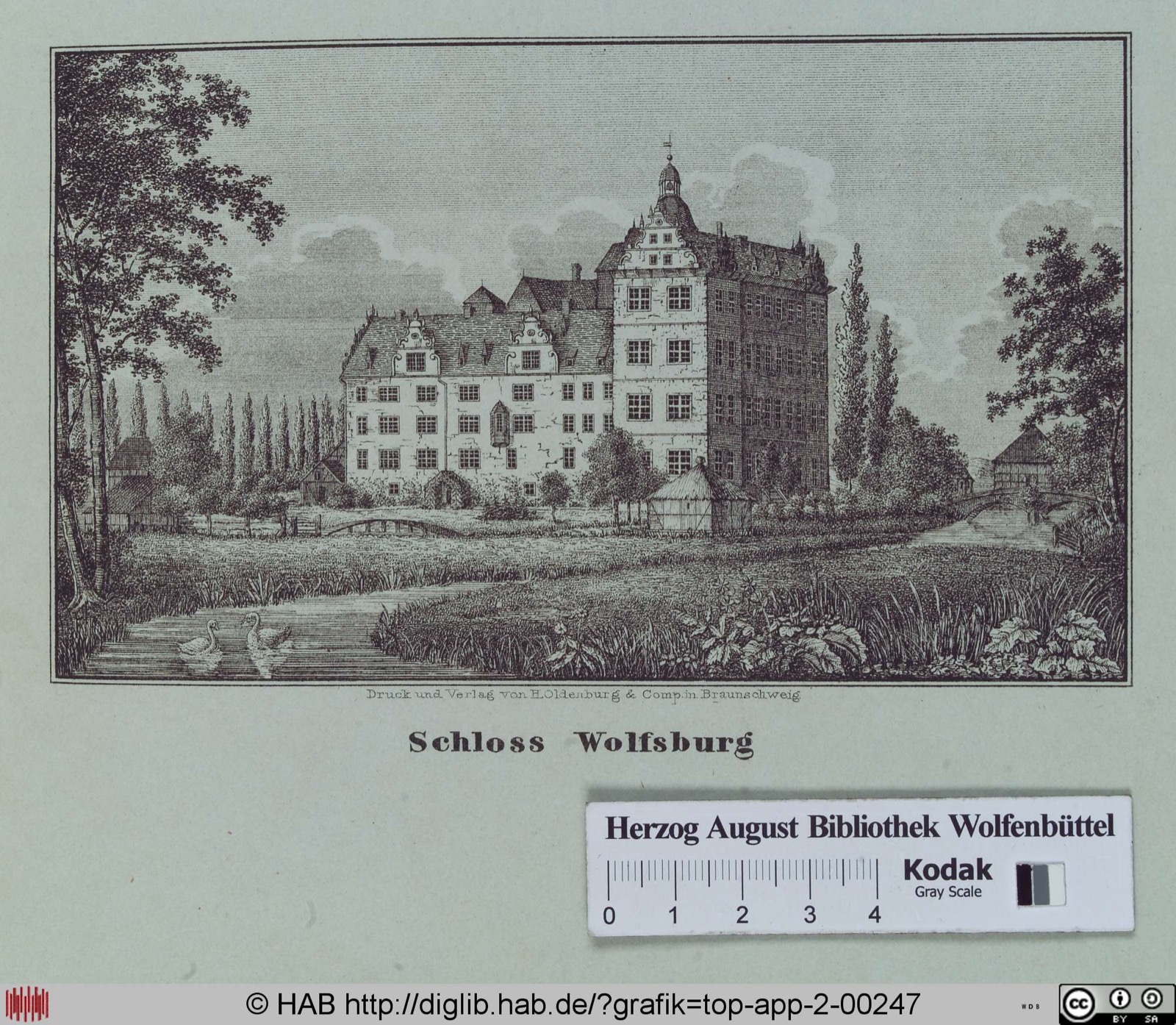
Schloss Wolfsburg
· Herzog August Library (via Europeana)
CC BY-SA


