
Greece · Ruin
Palaiochora
Paliachora is an abandoned medieval settlement and ruined summit castle on the island of Aegina, Greece. It was the island's principal inland habitation from the Middle Byzantine period until the early 19th century, and the peak retains low sections of castle wall, cisterns and numerous small churches among the house foundations.
Its prime
1765
Today
Ruin
As it stood in 1765
What Palaiochora looked like in its prime.
Perched on a rocky 355 m peak, the site is a scatter of low, beige-grey stone ruins running across the east, south and west slopes; the north slope is bare rock. The summit is a rounded rocky outcrop with short lengths of curtain wall surviving to about 1.8 metres, interspersed with collapsed foundations, small church volumes and three cistern openings. Terraced slopes with olive trees and cypress clusters step down toward modern houses and the road below.
Its story
The story of Palaiochora.
Paliachora was the main centre of habitation on Aegina from the Middle Byzantine period until the beginning of the 19th century, built on a peak above the monastery of Agios Nektarios. The north side of the hill was left uninhabited so the settlement could not be seen from the sea, and the castle crowned the summit at 355 metres; it has been nicknamed "the Mystras of Aigina".
After the Fourth Crusade in 1204 Aegina passed into the Venetian empire, and the island is later found under the Duchy of Athens; from 1394 it lay in the domain of the Caopena family.
The castle walls survive to a height of 1.8 metres, with remains of three cisterns. Of the packed small houses of the abandoned town, very few are preserved even as foundations, but 38 Byzantine and post-Byzantine churches still stand, many keeping their internal wall paintings.
Step inside
9 places to explore in 1765.
The record describes 9 distinct spots at Palaiochora, including 2 interiors: cistern remains (interior), interior of a byzantine/post-byzantine church with wall paintings (interior). Create your own photoreal reconstruction and explore every one, more scenes means more rooms, more angles, and more of the place to stand in.
Build Your Own Castle
Recreate Palaiochora with AI to explore it.
The artist rebuilds it as it stood in 1765, a photoreal reconstruction that belongs to you alone. Pay with coins, no subscription needed.
Recreate this castle →Defend this castle →Whose castle
Clans who held Palaiochora.
The families that held Palaiochora for a decade or more across its history, follow a name to its clan.
Caopena
Aegina lay in the domain of the Caopena family from 1394.
From the archive
Palaiochora on paper: the measured plan and period views.
The survey plan and photographs below are the ground truth this page's reconstructions are checked against, drawn and photographed while the castle was still a working garrison. Every image is public-domain or openly licensed, with its source named.
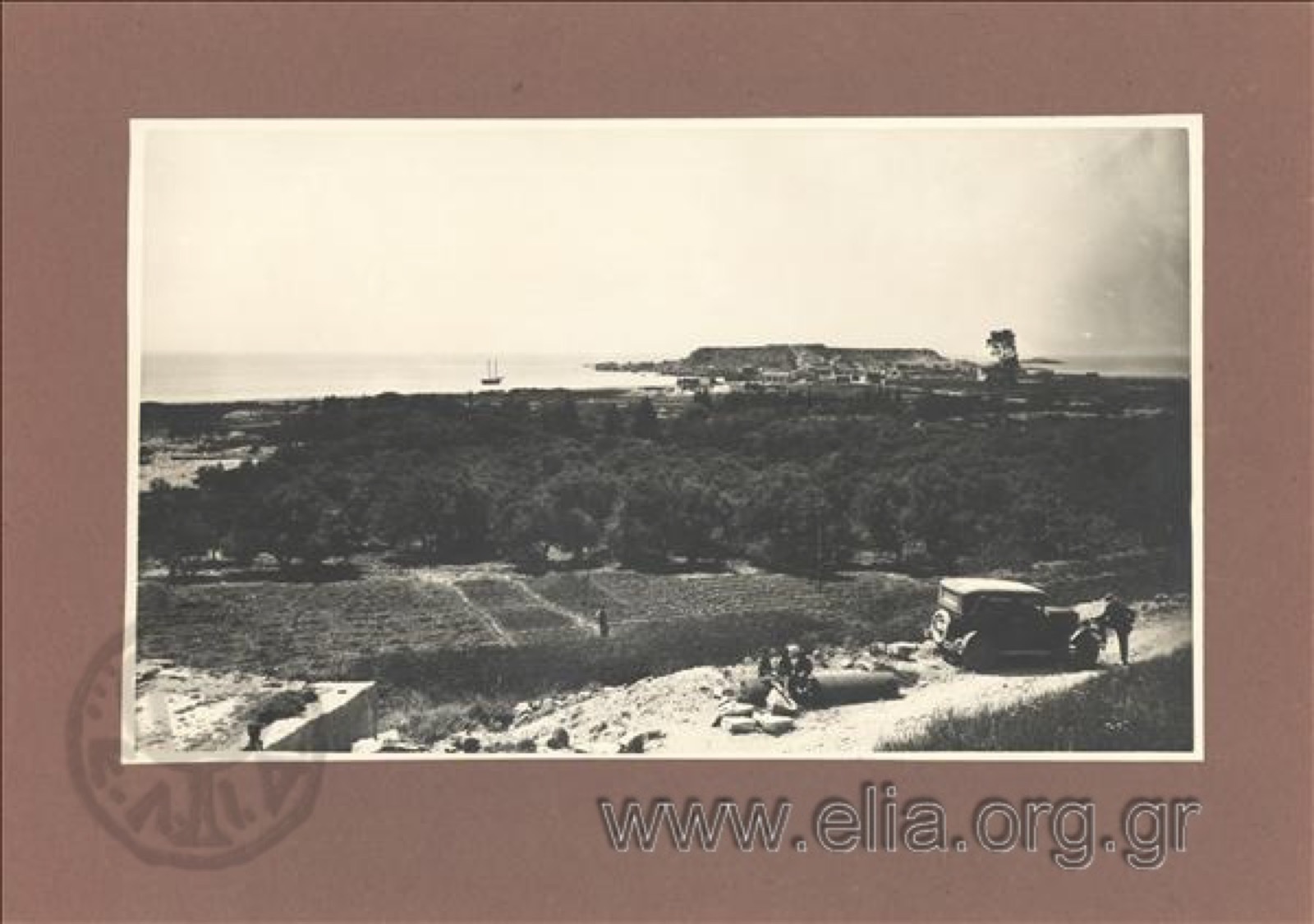
Παλαιοχώρα-Σελίνου.
1932 · Hellenic Literary and Historical Archive - Cultural Foundation of the National Bank Of Greece (via Europeana)
CC BY
Nearby


