Clan Rising
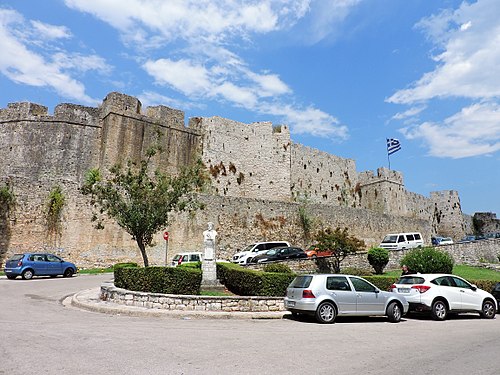
Skiathos Castle today

Greece · Partial ruin

Skiathos Castle

Skiathos Castle (Kastro) is a medieval fortified settlement on the northernmost promontory of Skiathos island in Greece, which served as the island's main town from the mid-14th century until 1829. The site is now abandoned and protected, with several churches and parts of the walls restored. The castle sits on a rocky headland ringed by steep sea cliffs and had its single fortified entrance to the south.

Photograph via Wikimedia Commons

Its prime

1619

Today

Partial ruin

As it stood in 1619

What Skiathos Castle looked like in its prime.

Perched on a rocky northern promontory, the castle is bounded on three sides by steep cliffs falling to the sea and by low stone curtain walls along those edges; its main fortifications face south where a narrow gate and entrance path lie. The remaining fabric is rough local stone; within the enclosure are scattered small stone buildings, several church structures, cistern openings, and fragments of the defensive walls, all set amid low Mediterranean scrub and a narrow ridge path.

Its story

The story of Skiathos Castle.

Skiathos Castle, the Kastro, was the main settlement of the island of Skiathos from the mid-14th century until 1829, a fortified town packed onto a rocky promontory at the island's northernmost tip. Steep sea cliffs guard it on three sides, so the walls there are low; the only substantial defences face south, where a narrow gate was protected by a wooden drawbridge and a cauldron for boiling oil.

Between 500 and 1,500 people lived inside in tightly packed houses, served by twenty churches in four parishes, a chancellery and several cisterns; in the Ottoman period a mosque and a governor's residence were added for the small Turkish garrison.

After the town was abandoned, only the churches of St Nicholas and of the Nativity, the cathedral of the local bishop, remained in use. The site is now protected, and restoration in recent years has recovered the churches of St Marina and St Basil, two cisterns, the mosque, the gate complex and parts of the walls.

Step inside

9 places to explore in 1619.

The record describes 9 distinct spots at Skiathos Castle, including 4 interiors: cathedral of the nativity (interior), church of st. nicholas (interior), ottoman mosque and governor's residence and more. Create your own photoreal reconstruction and explore every one, more scenes means more rooms, more angles, and more of the place to stand in.

Ridge approach and exterior wallsSouthern gate complex and drawbridgeSouthern battlements and inner courtyardDensely built residential quarterCathedral of the Nativity (interior)Church of St. Nicholas (interior)Ottoman mosque and governor's residenceStone cisternsNorthern headland lookout and sea cliffs

Build Your Own Castle

Recreate Skiathos Castle with AI to explore it.

The artist rebuilds it as it stood in 1619, a photoreal reconstruction that belongs to you alone. Pay with coins, no subscription needed.

Recreate this castle →Defend this castle →

Questions about Skiathos Castle

What is the history of Skiathos Castle?

Skiathos Castle was established in the mid-14th century after local inhabitants abandoned the island’s former main settlement because of Turkish pirate attacks. It remained in Byzantine hands until 1453, then passed to Venice and later the Ottomans, who repaired it in 1619. The settlement was abandoned in 1829 after Skiathos became part of the independent Greek state.

What is inside Skiathos Castle?

Inside Skiathos Castle are the Cathedral of the Nativity, the Church of St Nicholas, an Ottoman mosque, a governor’s residence and stone cisterns. The former settlement also contained tightly packed houses, twenty churches in four parishes, a chancellery and several cisterns. The churches of St Marina and St Basil, two cisterns, the mosque, the gate complex and parts of the walls have been restored.

Why was Skiathos Castle built, and what was it used for?

Skiathos Castle was built as a fortified settlement and refuge for the island’s inhabitants. It protected the main settlement from Turkish pirate attacks, with its strongest defences concentrated at the southern entrance. It later served as the island’s main town from the mid-14th century until 1829, accommodating between 500 and 1,500 people.

Does anyone live in Skiathos Castle now?

No one lives in Skiathos Castle today because the settlement was abandoned in 1829. It is now an abandoned, protected site, although several churches and parts of the walls have been restored. The settlement formerly housed between 500 and 1,500 people.

Where is Skiathos Castle?

Skiathos Castle is on the northernmost tip of the island of Skiathos, in Skiathos Municipality. It occupies a rocky promontory surrounded on three sides by steep sea cliffs. The castle was the island’s main settlement until 1829.

When was Skiathos Castle built?

Skiathos Castle dates from the mid-14th century. Its first-raised year is not recorded, while the settlement was in use from the mid-14th century until 1829. The castle was repaired by the Ottomans in 1619.

Was Skiathos Castle ever attacked or besieged?

Skiathos Castle was attacked several times and fell to its attackers. Hayreddin Barbarossa besieged it in 1538, and the inhabitants allowed the Ottomans to enter. The Venetians raided Skiathos in 1655, while Francesco Morosini captured the castle in 1660; Greek rebels under Tsamis Karatasos captured and looted it on 14 July 1826.

What did Skiathos Castle look like in its prime?

In its prime, Skiathos Castle was a fortified settlement on a rocky northern promontory. Steep cliffs fell to the sea on three sides, where low stone curtain walls followed the edge; the substantial defences faced south. A narrow gate, entrance path, wooden drawbridge and cauldron protected the southern approach, while tightly packed stone buildings filled the enclosure.

Is Skiathos Castle still standing, or is it a ruin?

Skiathos Castle survives as a partial ruin. The abandoned enclosure retains the churches of St Nicholas and the Nativity, scattered buildings, cisterns, the gate complex and fragments of the defensive walls. Restoration in recent years has recovered St Marina, St Basil, two cisterns, the Ottoman mosque, the gate complex and parts of the walls.
All castles of Greece · Castles of Europe · the best castles in Europe · explore the finished reconstructions.