
Greece · Restored
Patras Castle
Patras Castle is a medieval fortress built atop the ancient acropolis of Patras on a low hill near the sea. The site comprises a large triangular outer curtain wall with towers and an inner compound on the northeastern corner; it remains a visible, visitable fortification used for cultural events today.
Its prime
1430
Today
Restored
Ranked among Europe’s castles
As it stood in 1430
What Patras Castle looked like in its prime.
A broad, roughly triangular curtain wall of pale, irregular limestone and rubble blocks encloses the hilltop, punctuated by several projecting towers of rectangular mass and lower rounded elements; the wallline is pierced by a few small pointed and rounded arched openings and a central portal, and topped by an uneven parapet and walk. The castle sits on a low outcrop with a wide open forecourt planted with trees, and an inner northeastern ward set behind the outer wall, historically ringed by a moat.
Its story
The story of Patras Castle.
Justinian's Fortress on the Acropolis Hill
The first castle at Patras was raised by the Roman emperor Justinian I after the catastrophic earthquake of 551, on the ruins of the city's ancient acropolis, on a low outlying hill of the Panachaiko about 800 metres from the shore of the Patraic Gulf. Its builders used material from pre-Christian structures; the walls enclose 22,725 square metres, a triangular outer circuit with towers and bastions once ringed by a deep moat, and an inner compound at the north-eastern corner with a moat of its own.
One of the reused pieces, the torso and head of a Roman marble statue set in a recess of the masonry, became the guardian spirit of the town. Local tradition knows it as the "Patrinella", a woman turned into a man in Ottoman times, who keeps the city from epidemics and weeps at night whenever a prominent citizen of Patras dies.
Slavs, Saracens and the Siege of 805
Through the Byzantine centuries the castle was besieged by Slavs, Saracens, Bulgars, Normans and others, and never taken. In 805 the townspeople were shut up inside it by a Slav and Arab army; their victory was credited to a miracle of the city's patron, St Andrew, and it mattered in checking the barbarian raids into the Peloponnese.
Franks, the Latin Archbishop and Constantine Palaiologos
In 1205, after the Fourth Crusade, the Franks took the castle, enlarged it and cut a moat on all three sides. The Principality of Achaea pawned it to the local Latin Archbishop in 1278, and in 1408 the Pope leased it to the Venetians for five years at rent. It stayed in the archbishop's hands until 1430, when Constantine Palaiologos, Despot of the Morea and the future last Byzantine emperor, took it and made extensive repairs and additions to the walls. The Ottomans captured it in 1458, and held it as one of their main seats of power in the Peloponnese through almost the whole of the Tourkokratia.
Morosini, Balya Badra and Kolokotronis, 1687–1828
Venetian forces under Morosini took the castle in 1687 during the Morean War. They repaired it and walled the settlement of the upper town, running the new circuit from the Ottoman bastion round the houses to the Venetian bastion. In 1715 the Turks retook the Morea and the castle with it, calling the place Balya Badra, from the Greek Παλιά Πάτρα, 'Old Patras'. It remained an administrative centre, but gradually lost defensive importance to the more modern castle at Rio, which commanded the strait of the Patraic Gulf.
In the Greek revolt of 1821 the castle was besieged several times by Greek forces under Theodoros Kolokotronis, who came close to carrying it more than once; the attempts came to nothing because of personal quarrels among the Greek captains. It passed into Greek hands only in 1828, when the Turkish garrison surrendered it to the French general Maison during the Morea expedition.
Barracks, Occupation and the Ephorate
After independence the castle served for years as a prison and a military camp, and remained in use by the Greek Army until after the Second World War. From 1941 to 1944 it was held under German occupation, and was freed along with the city of Patras on 4 October 1944.
In 1973 the castle was turned over to the 6th Ephorate of Byzantine Antiquities. It is designated an archaeological site and a protected building, and its building phases record the repairs successive conquerors made to keep it abreast of developments in military technology. Cultural events are held there, chiefly in summer, in a demountable 640-seat theatre inside the inner compound.
Step inside
6 places to explore in 1430.
The record describes 6 distinct spots at Patras Castle, including the full exterior approach. Create your own photoreal reconstruction and explore every one, more scenes means more rooms, more angles, and more of the place to stand in.
Build Your Own Castle
Recreate Patras Castle with AI to explore it.
The artist rebuilds it as it stood in 1430, a photoreal reconstruction that belongs to you alone. Pay with coins, no subscription needed.
Recreate this castle →Defend this castle →From the archive
Patras Castle on paper: the measured plan and period views.
The survey plan and photographs below are the ground truth this page's reconstructions are checked against, drawn and photographed while the castle was still a working garrison. Every image is public-domain or openly licensed, with its source named.
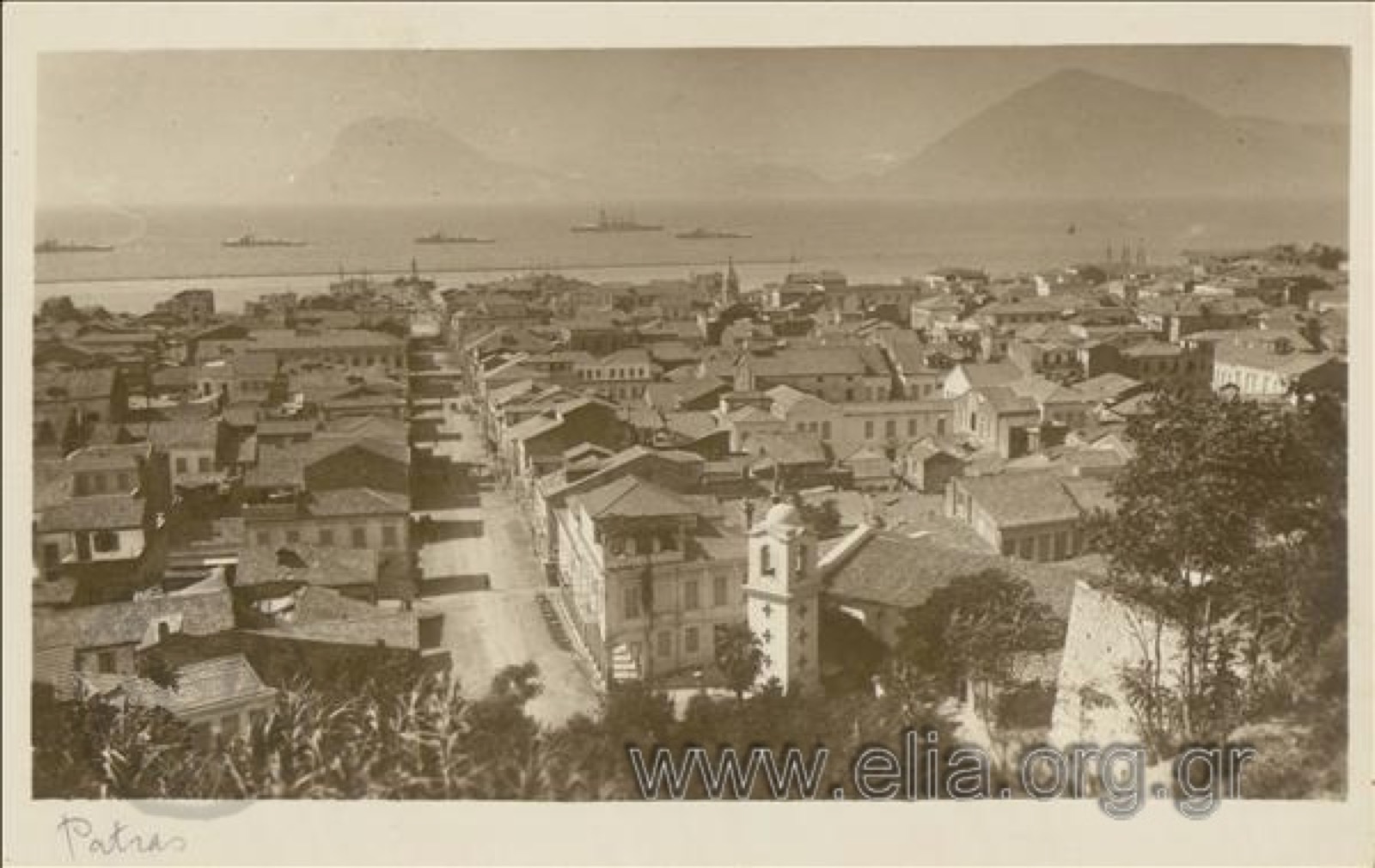
Patras.
· Hellenic Literary and Historical Archive - Cultural Foundation of the National Bank Of Greece (via Europeana)
CC BY


