Clan Rising
Novi Zrin today

Hungary · Demolished

Novi Zrin

Zrínyiújvár

Novi Zrin was a mid-17th-century frontier fortress built by the Zrinski (Zrínyi) family at the mouth of the Mura into the Drava to check Ottoman advance. Constructed between 1661 and 1664, it was besieged and destroyed in July 1664. The site today no longer preserves the original works; reconstructions are based on contemporary plans and descriptions.

Photograph via Wikimedia Commons

Its prime

1664

Today

Demolished

As it stood in 1664

What Novi Zrin looked like in its prime.

Sited on low marshy ground at the confluence of the Mura and Drava rivers, Novi Zrin appears on contemporary plans as a compact, geometrically arranged enclosed work with angular outworks and detached redoubts occupying a river mouth and floodplain. The fortress reads as a low-profile complex of ramparts, curtain enclosures and ancillary earthworks set amid channels and seasonal wetlands, approached by causeways from the surrounding river landscape.

Its story

The story of Novi Zrin.

Novi Zrin was built between 1661 and 1664 by the Zrinski (Zrínyi in Hungarian) noble family at the mouth of the Mura into the Drava, near the village of Donja Dubrava in the northernmost part of Croatia, at the border village of Őrtilos in Hungary. Its purpose was to prevent Ottoman forces from advancing further into Croatia.

The Ottomans attacked it several times from 1662 to 1664 without taking it. At the beginning of June 1664 a large Ottoman army of up to 100,000 men, led personally by Grand Vizier Köprülü Fazıl Ahmed Pasha, laid siege, and on 7 July 1664 the fortress was destroyed. Nothing of the original works survives on the site; reconstructions rest on contemporary plans and descriptions.

Step inside

6 places to explore in 1664.

The record describes 6 distinct spots at Novi Zrin, including 2 interiors: main gate and entrance, central courtyard. Create your own photoreal reconstruction and explore every one, more scenes means more rooms, more angles, and more of the place to stand in.

Approach from the river mouthLand causeway approachMain gate and entranceCentral courtyardRampart parapet and outlookDetached outer redoubt

Build Your Own Castle

Recreate Novi Zrin with AI to explore it.

The artist rebuilds it as it stood in 1664, a photoreal reconstruction that belongs to you alone. Pay with coins, no subscription needed.

Recreate this castle →Defend this castle →

Whose castle

Clans who held Novi Zrin.

The families that held Novi Zrin for a decade or more across its history, follow a name to its clan.

  • Zrinski

    Built and held by the Zrinski (Zrínyi) family, 1661–1664, until its destruction by the Ottomans.

From the archive

Novi Zrin on paper: the measured plan and period views.

The survey plan and photographs below are the ground truth this page's reconstructions are checked against, drawn and photographed while the castle was still a working garrison. Every image is public-domain or openly licensed, with its source named.
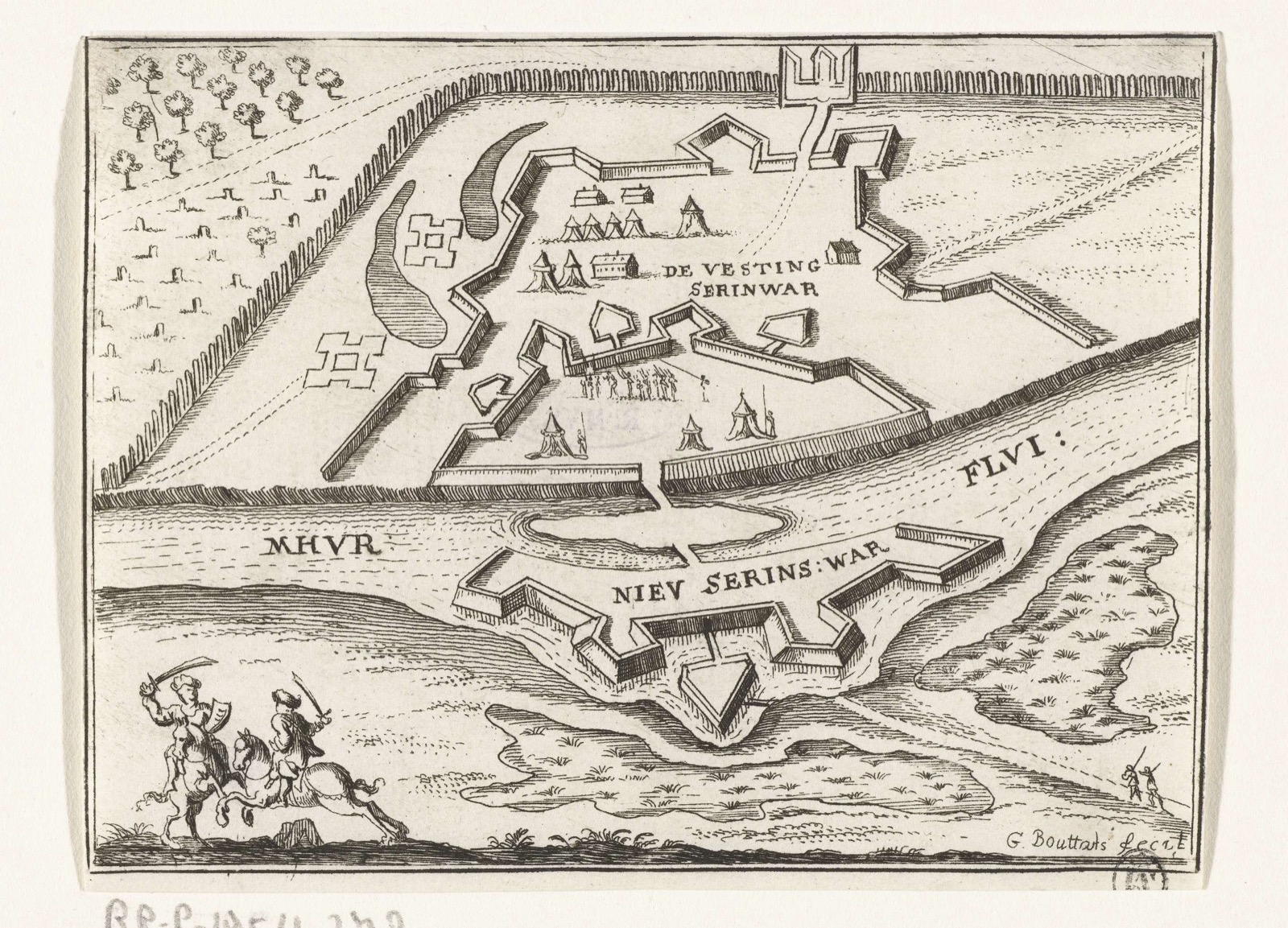
Plattegrond van Zrin en Novi Zrin, Novi Zrin

Plattegrond van Zrin en Novi Zrin

1686 · Rijksmuseum (via Europeana)

Public domain

Questions about Novi Zrin

What is the history of Novi Zrin?

Novi Zrin’s history belongs to the mid-17th century, when the Zrinski family built it as a frontier fortress between 1661 and 1664. It was attacked several times by Ottoman forces from 1662 to 1664 without being conquered. A large Ottoman army besieged it in June 1664, and the fortress was destroyed on 7 July that year.

What is inside Novi Zrin?

The documented interior spaces of Novi Zrin are the main gate and entrance and the central courtyard. The original works no longer survive, so these are documented spaces rather than preserved rooms that can be viewed today.

Why was Novi Zrin built, and what was it used for?

Novi Zrin was built to prevent Ottoman forces from advancing further into Croatia. Its position at the mouth of the Mura into the Drava also supported the defence of nearby territories and helped monitor Ottoman movements. It served as a frontier military fortress, rather than as a residence or later palace.

Where is Novi Zrin?

Novi Zrin was at the mouth of the Mura into the Drava, near Donja Dubrava and Őrtilos. It stood in the northernmost part of Croatia, at the border village of Őrtilos in Hungary. The site was between Őrtilos and Belezna, on low marshy ground at the river confluence.

When was Novi Zrin built?

Novi Zrin was built in the 17th century, between 1661 and 1664. Construction began in 1661 and continued until 1664, when the fortress was destroyed during the Ottoman siege. The first-raised year is not recorded as a separate date.

Was Novi Zrin ever attacked or besieged?

Novi Zrin was attacked several times by Ottoman forces from 1662 to 1664, but those attacks did not take it. A large Ottoman army laid siege to the fortress at the beginning of June 1664. The fortress fell during the assault on 30 June and was destroyed by the grand vizier on 7 July 1664.

Which family or clan held Novi Zrin?

Novi Zrin was built and held by the Zrinski family from 1661 until its destruction by the Ottomans in 1664. The family is also known as Zrínyi in Hungarian. Its period of control therefore lasted only through the fortress’s short operational life.

What did Novi Zrin look like in its prime?

Novi Zrin appeared as a compact, geometrically arranged enclosed fortress on low marshy ground at the Mura–Drava confluence. Its low-profile form consisted of ramparts, curtain enclosures, angular outworks and detached redoubts. Causeways crossed the surrounding channels and seasonal wetlands, linking the fortress to the river landscape.

Is Novi Zrin still standing or is it a ruin?

Novi Zrin is demolished and no longer standing. The fortress was destroyed in July 1664, and nothing of its original works survives on the site. Reconstructions are based on contemporary plans and descriptions rather than preserved fabric, and it was never rebuilt.
All castles of Hungary · Castles of Europe · the best castles in Europe · explore the finished reconstructions.