Italy · Restored
Brunnenburg
Castel Brunnenburg
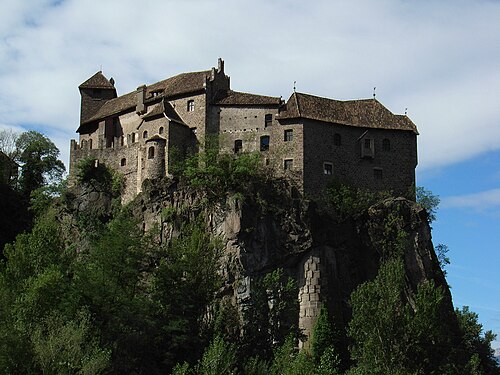
Brunnenburg (Italian: Castel Fontana, Castel Brunnenburg) is a 13th-century stone castle above Merano in South Tyrol, northern Italy. Built around 1250, it stands on a wooded, terraced slope and today contains a literary centre and guest accommodation while remaining a restored historic castle.
Its prime
1250
Today
Restored
As it stood in 1250
What Brunnenburg looked like in its prime.
A compact medieval stone fortress of roughly grey rubble masonry set on a steep, wooded crag above terraced vineyards. The silhouette is dominated by a tall square keep with crenellated parapet, attached lower ranges with battlemented walkways and a smaller cylindrical tower, all pierced by narrow arched windows and slit embrasures. Buildings cluster close to the rock edge, with a visible stone stair/bridge descending the slope and terraces of vines stepping away into the valley.
Its story
The story of Brunnenburg.
Wilhelm Tarant's Castle Above Merano, 1241–1437
Brunnenburg stands above the city of Merano, on the outskirts of the municipality of Tirol, in country that then lay within the diocese of Chur. Its building is placed in 1241, around 1250 by other reckonings, and is credited to Wilhelm Tarant, in the service of Count Albert III of Tyrol. The castle was destroyed and rebuilt several times over the centuries that followed.
The name probably comes from a spring that may once have risen nearby, a derivation the early forms incline towards: the place is attested as Prunnenberch in 1285 and as Brunnberg in 1437. Another line of argument derives the name instead from one of the castle's many owners.
The Bopfingen Brothers, Bishop Putsch and the Kripp Centuries, 1356–1812
In 1356 Brunnenburg was bought by the brothers Heinrich and Johann von Bopfingen. Heinrich was parish priest of Tirol, a delegate of Ludwig von Brandenburg and captain of the county of Tyrol until 1359; Johann went by the byname of the Minnesänger, the troubadour. In 1421 the castle was bought by Ulrich Putsch, chaplain to Duke Frederick of the Empty Pockets and later bishop of Brixen.
Hans, or Johann, von Kripp bought Brunnenburg in 1457, and it belonged to his family until 1812, though as early as 1600 the fortification was being described as an old ruined castle.
Gregor Hofer, the Schützen and the Schwickert Rebuild, 1705–1927
In 1705 the farmer Gregor Hofer set the castle's restoration in hand and carried out some structural work. In 1884 another farmer, Michael Sonnenburger, mayor of Tirol, took possession. A shooting range was inaugurated in 1889 with a great parade of Schützen and, as guest of honour, Archduke Franz Ferdinand, who was assassinated at Sarajevo in 1914.
Brunnenburg was bought in 1903 by Karl Schwickert, an industrialist from Pforzheim, whose restoration spared neither means nor resources. It transformed the structure radically, all but redrawing the castle to the new owner's taste, with a faint echo of the neo-Gothic. The work was never completed, because Schwickert died in 1927, and the castle fell into ruin once more.
The Rachewiltz Restoration and the Last Cantos, 1946–1958
In 1955 the castle was bought by Prince Boris de Rachewiltz, a professor and Egyptologist, who in 1946 had married Mary, daughter of the poet Ezra Pound and the violinist Olga Rudge. The couple completely restored and updated Brunnenburg in the mid-twentieth century. The family's vineyard surrounds it.
Pound came to the castle in 1958, after his return from the United States, and stayed there with his daughter and her family. It was at Brunnenburg that he wrote the last six of the 116 cantos of The Cantos.
The Farm Museum and the Pound Centre, from 1974
Since 1974 the castle has housed the Landwirtschaftsmuseum Brunnenburg, an agricultural museum setting out the customs and working methods of the district's farmers; it opens daily from April to October. Pound's daughter established the Ezra Pound Center for Literature at the castle, tied to the University of New Orleans, where students come from around the world to study the poet's work, and a large guesthouse on the grounds accommodates them, usually a semester at a time. Mary lived at Brunnenburg until her death in 2026. The castle is listed among the cultural heritage monuments of South Tyrol.
Step inside
7 places to explore in 1250.
The record describes 7 distinct spots at Brunnenburg, including 2 interiors: inner courtyard, guesthouse and outbuildings on the grounds. Create your own photoreal reconstruction and explore every one, more scenes means more rooms, more angles, and more of the place to stand in.
Build Your Own Castle
Recreate Brunnenburg with AI to explore it.
The artist rebuilds it as it stood in 1250, a photoreal reconstruction that belongs to you alone. Pay with coins, no subscription needed.
Recreate this castle →Defend this castle →From the archive
Brunnenburg on paper: the measured plan and period views.
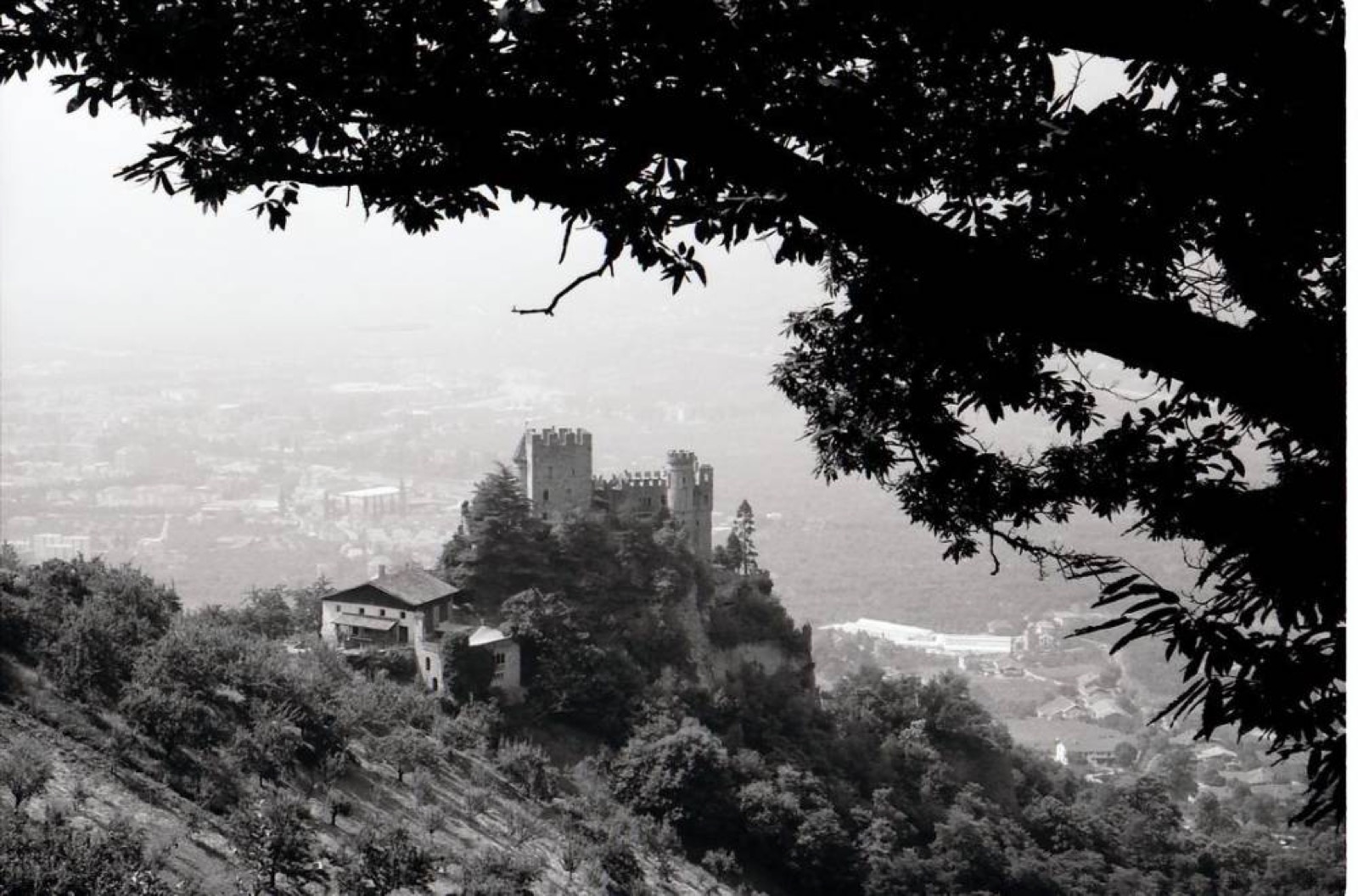
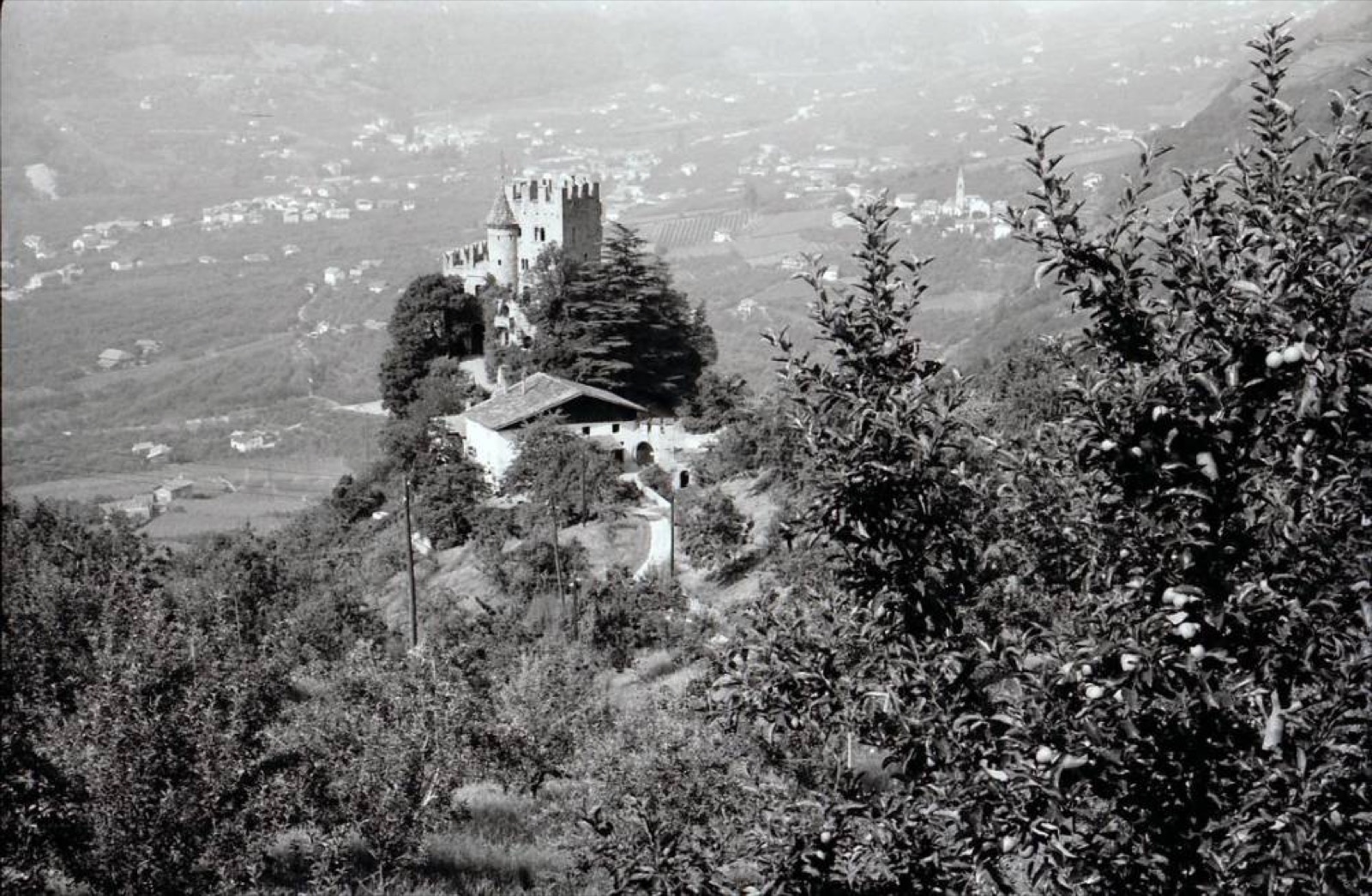
The survey plan and photographs below are the ground truth this page's reconstructions are checked against, drawn and photographed while the castle was still a working garrison. Every image is public-domain or openly licensed, with its source named.
Dorf Tirol: Brunnenburg von oben
· State Archives of Baden-Württemberg (via Europeana)
CC BY
Dorf Tirol: Brunnenburg von oben
· State Archives of Baden-Württemberg (via Europeana)
CC BY