
Italy · Restored
Castle of Rivoli
Castello di Rivoli
The Castle of Rivoli is a former Savoyard royal residence in Rivoli near Turin, Italy, now housing the Castello di Rivoli – Museo d'Arte Contemporanea. The structure preserves large red-brick wings from its 16th–17th-century rebuilding (notably the Manica Lunga) and later unfinished Baroque additions; it has been restored and repurposed as a museum since 1984. The complex includes a 16th-century nymphaeum and the long gallery intended as the Savoy Gallery.
First raised
1984
Its prime
1644
Today
Restored
As it stood in 1644
What Castle of Rivoli looked like in its prime.
A massive red-brick palace block with a long, horizontal gallery wing (the Manica Lunga) and a taller gabled eastern mass. The exterior foreground shows a sequence of large round-arched openings set into rusticated brick piers with white stone quoins and balustraded openings. Tall rectangular windows are regularly spaced on the upper floors; brick courses and pilaster framing define openings. The castle sits on a slight hillside above the town, with visible layered arcades and a deep entrance passage.
Its story
The story of Castle of Rivoli.
Frederick Barbarossa's Diploma and the Savoy Takeover, 1159–1273
A fortress is thought to have stood on the hill above Rivoli since the 9th or 10th century, but the site enters the documentary record only in 1159, in a diploma of the Emperor Frederick Barbarossa ceding the Rivoli lands to the bishops of Turin. The House of Savoy acquired Rivoli soon afterwards (by one account already in the 11th century, by another only at the close of the 12th), and a feud with the bishops left it damaged in 1184.
In 1273 King Edward I of England, returning home from crusade, was met here by messengers of the Count of Savoy before travelling on to Susa and the Mont Cenis pass to visit Count Philip I at Saint-Georges-d'Espéranche.
Duke Emmanuel Philibert's Exclusion from Turin and the Manica Lunga, 1559–1644
The Treaty of Cateau-Cambrésis of 1559 barred Duke Emmanuel Philibert of Savoy from residing in Turin until he had a male heir, so he took up residence at Rivoli instead, having the castle restored to designs by the architect Ascanio Vitozzi. His son and heir, Charles Emmanuel I, was born in 1562, and the duke returned to Turin. Work to Vitozzi's designs continued until 1644 under Carlo and Amedeo di Castellamonte, who built the Manica Lunga, a lower wing linked to the main castle only by a narrow passage some 120 metres long, raised to house the Savoy picture gallery. It remains the only 17th-century part of the complex still standing.
War of the Spanish Succession and the King's Imprisonment, 1706–1730s
At the start of the 18th century, French troops burned and sacked the castle and the Manica Lunga during the War of the Spanish Succession, carrying off numerous works of art. After the siege of 1706, Victor Amadeus II recovered the territory and ordered the damage repaired, first under the architect Michelangelo Garove, who enlarged the Manica Lunga, then, after Garove's death, under Antonio Bertola. Bertola oversaw the works for three more years until Filippo Juvarra took charge in 1716; Juvarra's grand design was never completed, and only the extensions of the two eastern wings were finished, leaving the façade unfinished.
In 1730 the castle became a prison for its own former master. Victor Amadeus II had abdicated in favour of his son Charles Emmanuel III but refused to relinquish power and tried to depose him; the new king, acting with his minister Carlo Vincenzo Ferrero d'Ormea, had his father confined at Rivoli. Gratings were fitted to the windows and the passage to the Manica Lunga was sealed off. Victor Amadeus lived out his final years there as a prisoner with his morganatic wife, the Marchesa di Spigno.
From Municipal Barracks to Contemporary Art Museum, 1794–1997
The castle saw little further use until 1794, when the architect Carlo Randoni carried out alterations for at least partial use of the residence. In 1863 the comune of Rivoli rented the building and converted it into barracks; twenty years later the municipality bought it outright and moved its civic library into part of it, while the rest continued as barracks. The castle was heavily damaged during the Second World War, and post-war restoration under the Turin architect Andrea Bruno went no further than repairing structural damage for lack of funds; fuller restoration began only in 1979.
The restored castle reopened in 1984 as the Castello di Rivoli – Museo d'Arte Contemporanea, the first contemporary art museum in Italy, and in 1997 it was placed on the UNESCO World Heritage list together with thirteen other Savoy residences. It remains the property of the municipality of Rivoli.
Step inside
5 places to explore in 1644.
The record describes 5 distinct spots at Castle of Rivoli, including 2 interiors: savoy gallery (manica lunga) interior, nymphaeum (16th-century garden cave). Create your own photoreal reconstruction and explore every one, more scenes means more rooms, more angles, and more of the place to stand in.
Build Your Own Castle
Recreate Castle of Rivoli with AI to explore it.
The artist rebuilds it as it stood in 1644, a photoreal reconstruction that belongs to you alone. Pay with coins, no subscription needed.
Recreate this castle →Defend this castle →Whose castle
Clans who held Castle of Rivoli.
The families that held Castle of Rivoli for a decade or more across its history, follow a name to its clan.
Savoy
A residence of the House of Savoy, which acquired Rivoli in the 11th century.
From the archive
Castle of Rivoli on paper: the measured plan and period views.
The survey plan and photographs below are the ground truth this page's reconstructions are checked against, drawn and photographed while the castle was still a working garrison. Every image is public-domain or openly licensed, with its source named.
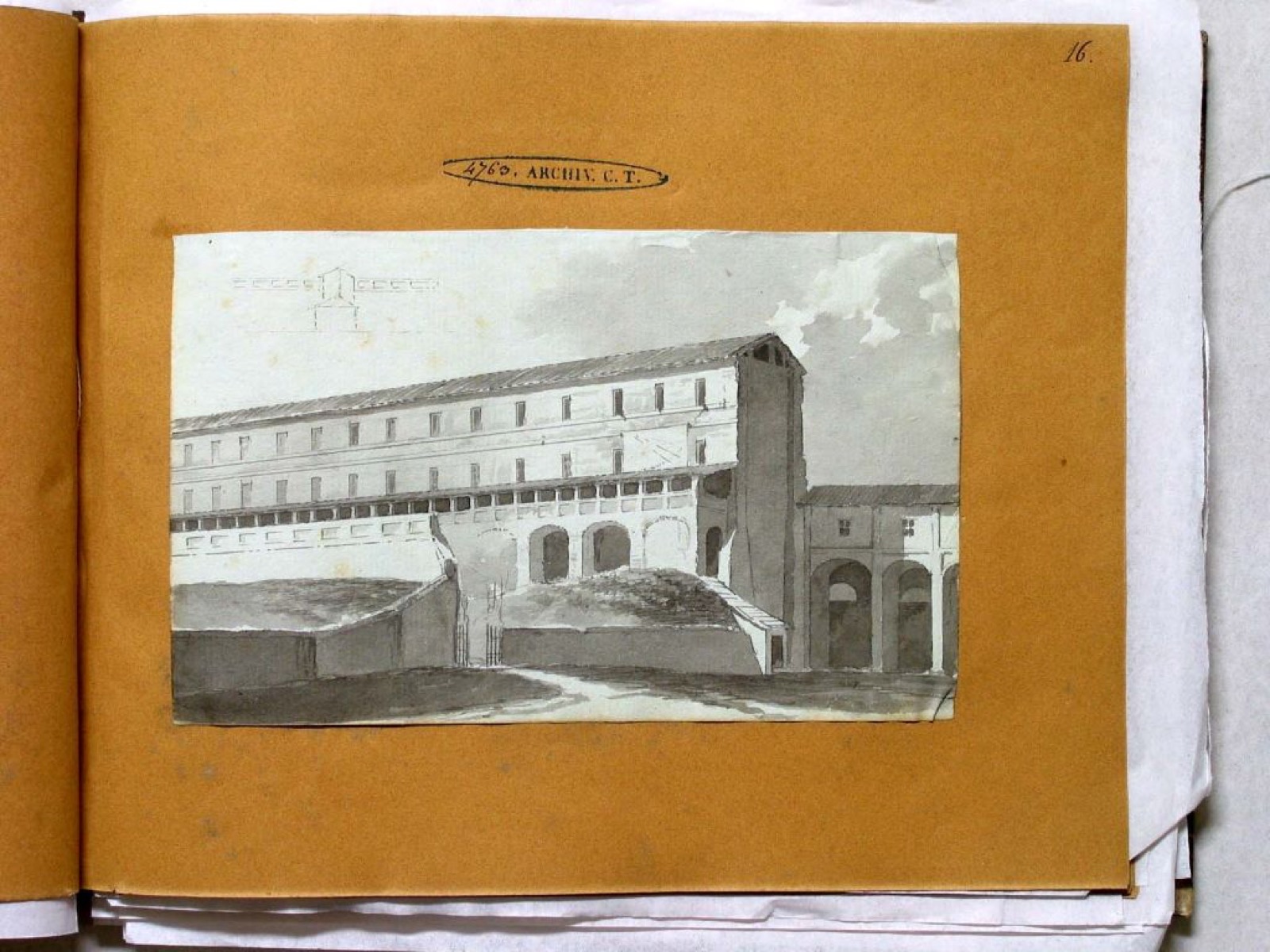
Ala lunga dell'antico castello di Rivoli detta la Galera con terrapieno di fronte
1817 · Turin Gallery for Modern and Contemporary Art (via Europeana)
CC BY
Nearby


