
Italy · Restored
Torrechiara Castle
Castello di Torrechiara
Torrechiara Castle is a 15th-century fortified residence built 1448–1460 near Langhirano in the province of Parma, northern Italy. It was commissioned by Pier Maria II de' Rossi and combines defensive walls and towers with richly decorated private rooms and a panoramic loggiato.
First raised
1450
Its prime
1460
Today
Restored
As it stood in 1460
What Torrechiara Castle looked like in its prime.
Perched on a terraced hill, the castle presents four massive rectangular stone towers linked by two lines of merloned curtain walls enclosing a rectangular inner courtyard. Low sloping glacis and an outer stone curtain form a stepped defensive base. Roofs are low-pitched clay tiles; wall masonry is light beige local stone. The tallest keep (Lion Tower) rises above the surrounding towers; narrow slit windows, crenellations and a panoramic loggiato opening from the main residential block are visible from the approach, set above farmland and the Parma valley.
Its story
The story of Torrechiara Castle.
Pulled Down by Parma, 1259-1313
The fortilizio of Torchiara first appears in 1259, when the podesta of Parma ordered it demolished: rebels had used it repeatedly as a refuge and a base for attacks on the city. The commune forbade rebuilding there in 1267 and again in 1297, the second ban after the destruction of the Scorza family's casaforte in 1293.
It was disregarded: in 1308 Gilio Scorza sheltered at Torrechiara the Lupi marquesses and two Rossi brothers, expelled from Parma at the will of Giberto III da Correggio; the exiles rebuilt the manor and took from it the monastery of San Paolo's fort at Giarola. Giberto destroyed Giarola, then besieged Torrechiara, coming to terms with Gilio's son Rolandino only after a long time. In 1313 Rolandino's brother Cabrietto and Guglielmo de' Rossi attacked Giberto on several fronts, and in that fighting the fortress was stormed and destroyed.
Pier Maria de' Rossi's Castle, 1448-1464
In May 1448, unopposed by the commune of Parma, Pier Maria II de' Rossi, fourth count of San Secondo, began a great castle over those ruins, taking a personal hand in designing its defences. The Rossi domains ran to roughly a fifth of the Parmense, and the fortress, visible down the valley, was built to show it: three circuits of wall and four heavy corner towers.
It was also a private house where the count could meet his mistress Bianca Pellegrini d'Arluno. The Camera d'Oro, whose lunettes show her crossing the couple's lands in search of her lover, was frescoed by a hand still disputed between Benedetto Bembo, Francesco Tacconi and Bonifacio or Girolamo Bembo. Work finished in 1460. In 1464 Pier Maria willed the castle to Ottaviano, formally Bianca's son by her husband Melchiorre Arluno and more probably his own; Ottaviano died before him, and it went to the principal heir, Guido.
The War of the Rossi and Trivulzio's Siege, 1476-1496
The murder of Galeazzo Maria Sforza in 1476 changed matters sharply for Pier Maria, his loyal ally, the more so when Ludovico il Moro came to power, advanced the Pallavicini and pressed demands the count refused. Isolated, he sought Venetian support; the war of the Rossi broke out in February 1482 and he did not live to finish it. Bianca had died at Torrechiara around 1480; the count died in the castle on 1 September 1482 and, by tradition, was displayed for some days seated on a throne in the Camera d'Oro before burial in the oratory of San Nicomede, in the north-east tower, where Bianca lies too.
Guido held it a few months. Gian Giacomo Trivulzio besieged Torrechiara in May 1483, after Felino had fallen, and the next month it surrendered to the Milanese as soon as word came that Rossi had fled to Genoa. The three Rossi strongholds went to Leone Sforza, il Moro's younger son, and on his death in 1496 for a time to the duchess Beatrice d'Este.
A French Marshal, the War of Parma and the Torlonia Dowry, 1499-1821
The French conquest of Milan in 1499 set the castle moving between owners. Louis XII granted San Secondo, Felino and Torrechiara to Troilo I de' Rossi, who could take only the first, some inhabitants of the other two backing his cousin Filippo Maria; in October the king gave Torrechiara and Felino to the marshal Pierre de Rohan instead, and Rohan sold the pair in 1502 for 15,000 scudi to the marquess Galeazzo I Pallavicino.
Pallavicino II Pallavicini died in 1522, the year Filippo Maria gave up his claim, leaving Torrechiara to his daughter Luisa, who brought it in dowry to count Sforza I Sforza in 1545. In 1551, during the war of Parma, Ferrante I Gonzaga took the two Sforza castles; ducal troops of Ottavio Farnese counter-attacked Torrechiara, held by the imperial captain Ascanio Comneno, and retook it. Sforza I and his son Francesco then turned the fortress towards residence, raising loggias over the Val Parma and having the interiors frescoed by Cesare Baglione among others. In 1821 Anna Sforza Cesarini carried the castle in dowry to duke Marino Torlonia.
Stripped, Made a Monument, Reopened: 1909-2024
In 1909 the Torlonia sold the manor to Pietro Cacciaguerra, who at once began selling off its furnishings. A replica of the Camera d'Oro shown at an exhibition in Rome in 1911 did much for its fame; it was declared a national monument that year to stop the stripping, and in 1912 the state bought the emptied building and opened it to the public.
An earthquake of about magnitude 5.2 on 23 December 2008 damaged the outer walls of the San Nicomede tower and its battlements. Rooms were shut, consolidated in 2009 and reopened in July 2014. The ministry ran it through the Polo museale dell'Emilia-Romagna from December 2014, and on 1 June 2024 it was attached to the Complesso monumentale della Pilotta in Parma.
Step inside
11 places to explore in 1460.
The record describes 11 distinct spots at Torrechiara Castle, including 3 interiors: torre di san nicomede and oratory, camera d'oro (golden chamber), salone dei giocolieri (jugglers hall). Create your own photoreal reconstruction and explore every one, more scenes means more rooms, more angles, and more of the place to stand in.
Build Your Own Castle
Recreate Torrechiara Castle with AI to explore it.
The artist rebuilds it as it stood in 1460, a photoreal reconstruction that belongs to you alone. Pay with coins, no subscription needed.
Recreate this castle →Defend this castle →Whose castle
Clans who held Torrechiara Castle.
The families that held Torrechiara Castle for a decade or more across its history, follow a name to its clan.
Built 1448–1460 by Pier Maria II de' Rossi, fourth count of San Secondo.
From the archive
Torrechiara Castle on paper: the measured plan and period views.
The survey plan and photographs below are the ground truth this page's reconstructions are checked against, drawn and photographed while the castle was still a working garrison. Every image is public-domain or openly licensed, with its source named.
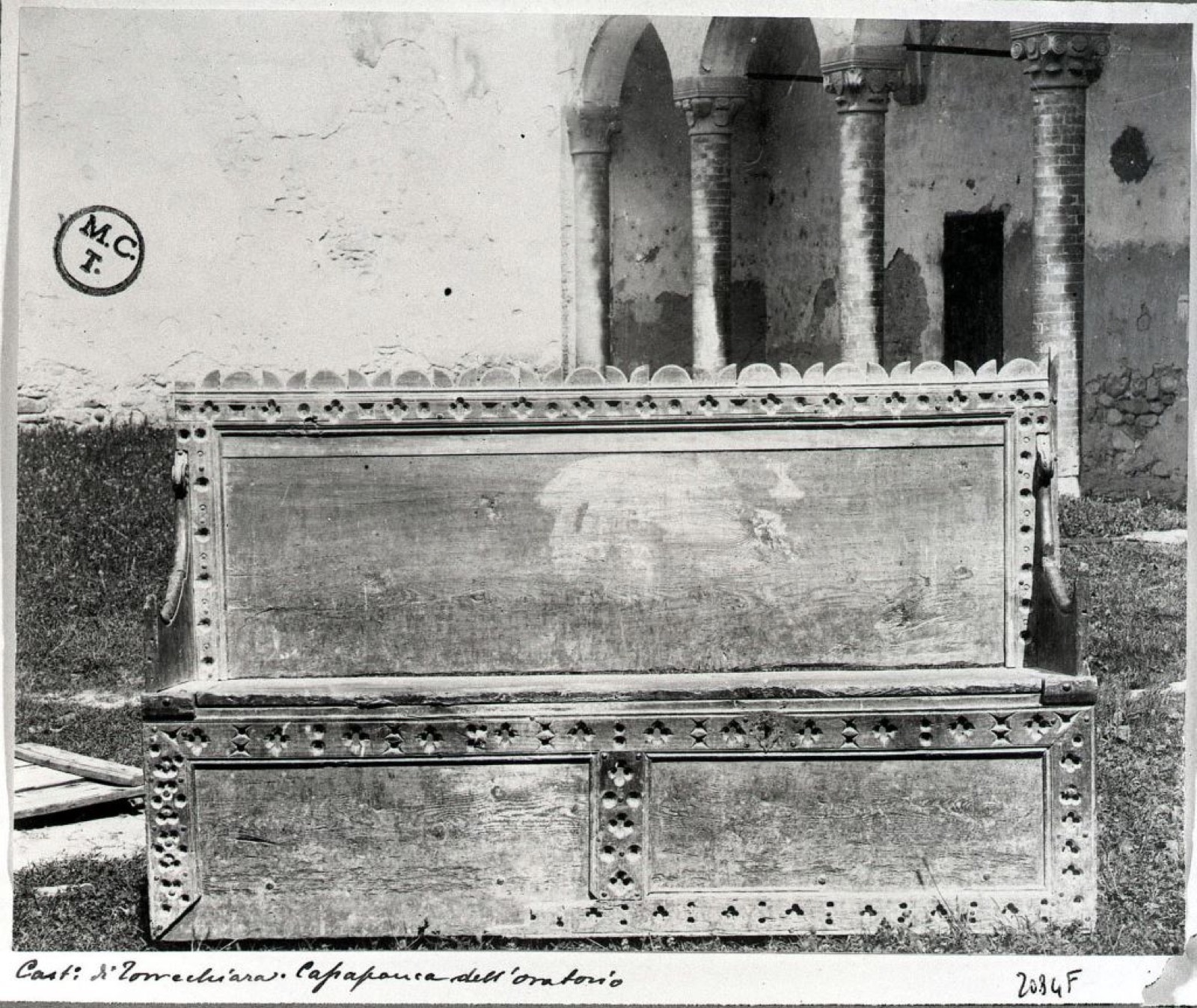
Torrechiara - Oratorio, cassapanca
· Turin Gallery for Modern and Contemporary Art (via Europeana)
CC BY
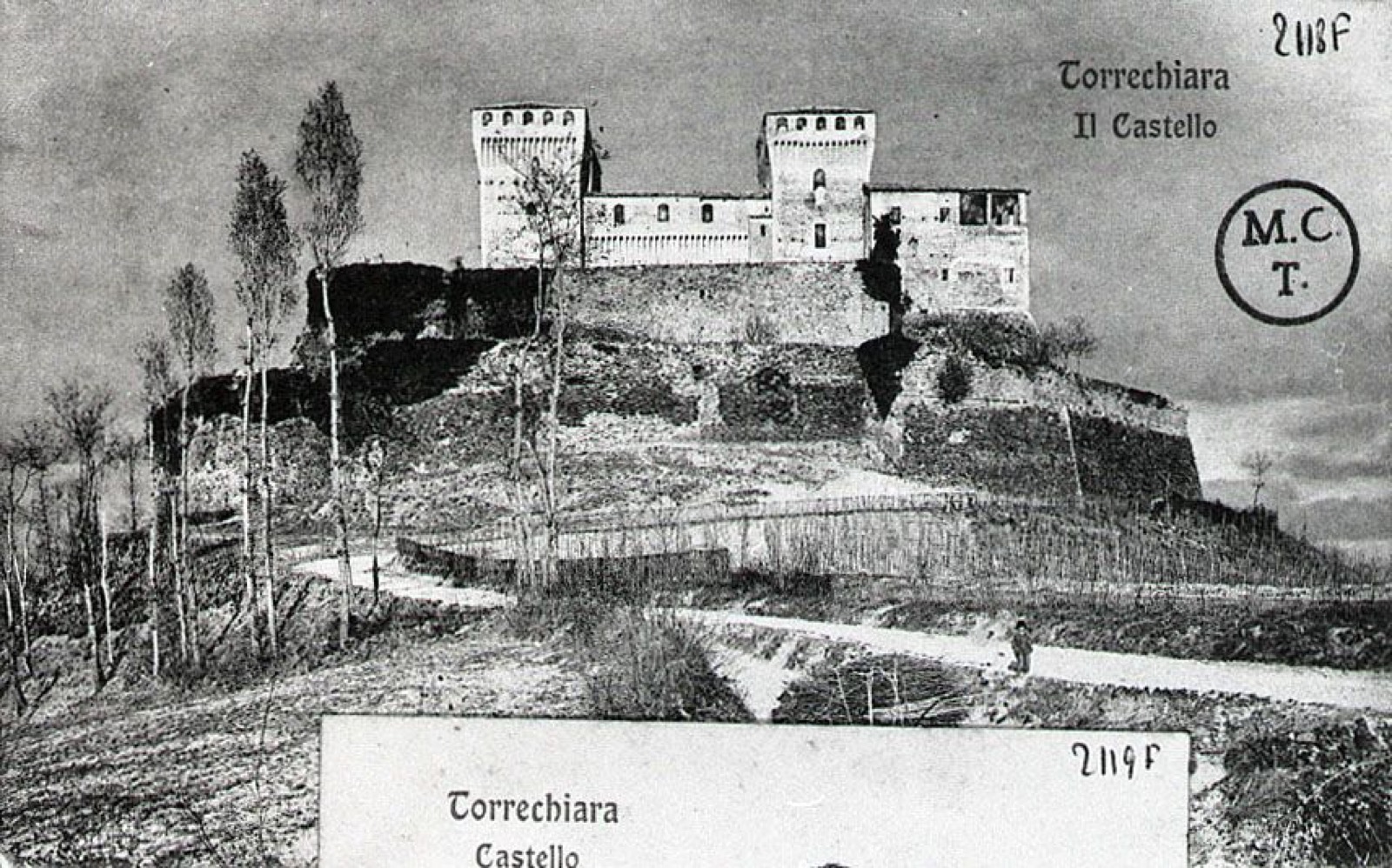
Torrechiara - Castello, (cartolina)
· Turin Gallery for Modern and Contemporary Art (via Europeana)
CC BY
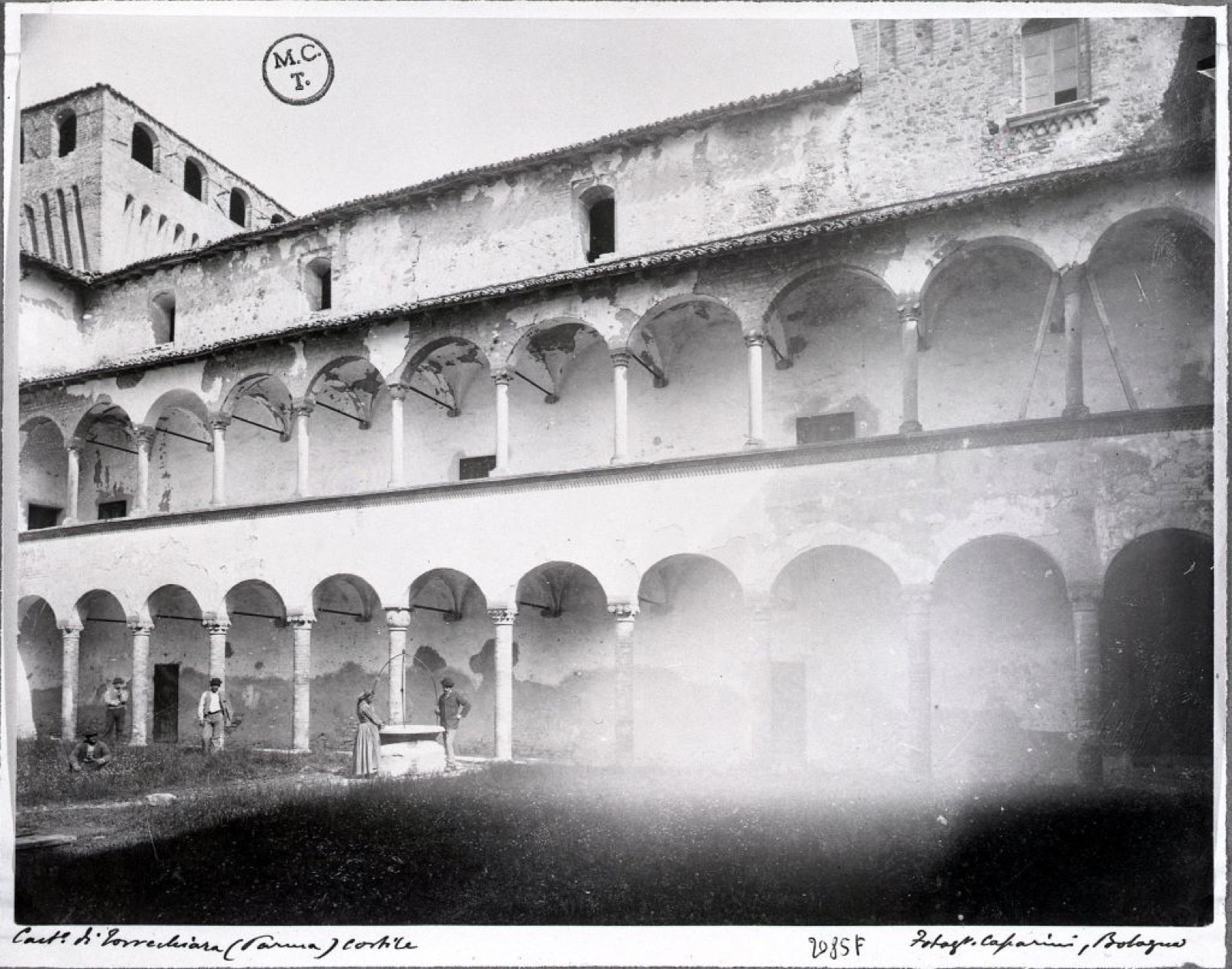
Torrere- Castle, yard
· Turin Gallery for Modern and Contemporary Art (via Europeana)
CC BY
Nearby


