Italy · Restored
Castle of Venus
Castello di Venere
The Castle of Venus (Castello di Venere) is a medieval fortress on the summit rock of Monte Erice in western Sicily, built over an ancient sanctuary of Venus. The surviving masonry combines Norman and later Spanish features and encloses reused classical architectural fragments; the site now functions as a historic monument and public venue.
First raised
1100
Its prime
1632
Today
Restored
As it stood in 1632
What Castle of Venus looked like in its prime.
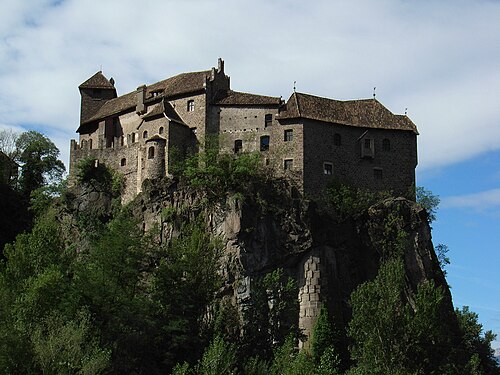
Perched on an isolated rocky outcrop at the summit plateau, the fortress reads as a compact curtain of pale grey-beige masonry with a dominant rectangular tower and crenellated Guelph battlements on the western façade. A rock-cut ditch separates the summit from the town and a stone ramp climbs to the gate; the entrance wall shows a machicolation, a mullioned (bifora) window and a carved coat of arms above the portal. Inside the precinct are fragments of Ionic columns, frieze blocks and a circular pit set within a stony courtyard.
Its story
The story of Castle of Venus.
The Sanctuary of Venus Erycina and the Venerii
A temple to the goddess of fertility and love stood on the castle rock from at least the fifth century BCE. Elymian in its origins, its deity was identified in turn with Astarte, Aphrodite and Venus, and the sanctuary of Venus Erycina became renowned throughout the Mediterranean; Diodorus Siculus wrote that Eryx, son of Butes and of Aphrodite herself, had raised the temple to his own mother and founded the city below it. Hamilcar Barca sacked the place. Strabo describes the temple of Aphrodite at Eryx as once full of female temple-slaves dedicated from Sicily and abroad, though their numbers had declined by his own day, while Cicero testifies to the wealth and renown of Venus Erycina. Roman administration put the sanctuary under the collective care of seventeen Sicilian cities and raised a special military corps of some 200 soldiers, the Venerii, to guard the temple and the town.
A Roman coin of 57 BCE depicts the sanctuary as a small tetrastyle temple set on a rocky summit within a walled precinct. Masonry surviving inside the castle precinct is traditionally identified with the wall that Diodorus described Daedalus building to protect the sanctuary at Eryx: twelve horizontal courses of neatly squared stone, laid opus rectum against the steep northern face. The circular pit long called the Well of Venus was most likely a capacious grain silo rather than the goddess's pool.
The Norman Fortress and Ibn Jubayr's Jabal Hamid, 12th Century
The present fortress was built in the twelfth century under Norman rule, at a time when much of western Sicily was being fortified. It went up over the remains of the ancient sanctuary and took spolia from the temple of Venus into its fabric, Ionic column drums and frieze fragments among the pieces lying in the courtyard. Within the precinct the small church of Santa Maria della Neve was established.
Medieval Arabic writing attests to how strongly the mountaintop was held. The twelfth-century traveller and geographer Ibn Jubayr called the mountain Jabal Hamid and described a formidable fortress controlling access to the summit, reckoned crucial to the defence of the island; he recorded bridges that could be severed in time of danger, ditches separating the adjacent summits, and quarters used as a refuge for civilians under attack.
Royal Fortress, Spanish Governor and the Garrison of 1632
The castle served as a royal fortress for the Aragonese viceroys and the Spanish Habsburgs into the sixteenth century. In that century a stone ramp replaced the drawbridge that had linked the fortress to the Balio Towers, filling the ditch between the lower fortified ground and the rock summit. The west front still carries the arms of Charles V above its portal.
Under Spanish rule the fortress reached its administrative height. The town's civilian magistrate, the Bajulo, worked from the Balio Towers, while the castle itself was the official residence of the Spanish Governor, the Castellano. According to the historian Giuseppe Vito Castronovo, the Governor held supreme military authority over the mountain and answered for the strategic defence of the western Sicilian coast against Barbary pirate raids. After 1632, following the abandonment of the nearby Spanish Quarter barracks project, the permanent Spanish garrison was quartered within the fortress itself.
Bourbon Prison, Disuse and the Pepoli Concession
Under the Bourbons the castle became a prison, and after that service it fell into disuse. In the first decades of the nineteenth century it passed to the comune of Erice, which at the end of that century granted it in concession to Count Agostino Pepoli in exchange for a restoration of the Balio Towers.
Excavations from 1930 to the Restoration Completed in 2025
Archaeological excavations were carried out in the 1930s by the Cultural Heritage Office of Trapani, with Cultrera digging in 1934-36 in search of the temple; the remains of a small Roman bath, one room lined with the hydraulic mortar typical of such a finish, were identified in 1930-31. Most of the finds are kept in the Museo Pepoli at Trapani, and more recent study has turned up Greek pottery and burial areas.
The castle is listed as Italian national heritage and open to the public as a historic monument, and it is among the venues the comune of Erice designates for civil wedding ceremonies. A restoration funded by the Sicilian regional government, completed in 2025, covered structural stabilisation, the adaptation of interior spaces for potential museum use, and improvements to accessibility and visitor infrastructure.
Step inside
9 places to explore in 1632.
The record describes 9 distinct spots at Castle of Venus, including 2 interiors: santa maria della neve (small chapel), remains of roman-period baths. Create your own photoreal reconstruction and explore every one, more scenes means more rooms, more angles, and more of the place to stand in.
Build Your Own Castle
Recreate Castle of Venus with AI to explore it.
The artist rebuilds it as it stood in 1632, a photoreal reconstruction that belongs to you alone. Pay with coins, no subscription needed.
Recreate this castle →Defend this castle →